Proper bitumen storage and transportation are part of product quality control. Even when bitumen meets its specification at the production stage, excessive heating, prolonged storage at elevated temperature, contaminated tanks, water ingress, grade mixing, or unsuitable transfer lines can change viscosity, stiffness, uniformity, safety, and final performance.
In industrial operations, bitumen should be maintained at a temperature high enough for safe pumping, loading, transport, and discharge, but without unnecessary thermal stress. There is no single universal temperature suitable for every product. Bitumen grade, viscosity, storage duration, tank design, heating method, ambient conditions, and supplier guidance must be considered together.
This guide explains how bitumen storage temperature should be controlled, how tanks and transport tankers should be prepared, how contamination and grade mixing can be prevented, and what documents and quality checks should be reviewed before loading and upon delivery.
Why Do Storage and Transport Conditions Affect Bitumen Quality?
Bitumen is a temperature-sensitive viscoelastic material. As temperature increases, viscosity decreases and pumping becomes easier. However, long exposure to high temperature may accelerate oxidation, loss of lighter components, and gradual hardening of the binder.
Bitumen quality may be affected by:
- Excessive or uneven heating
- Long-term storage at elevated temperature
- Repeated heating and cooling cycles
- Ingress of water, fuel, oil, dust, or foreign material
- Accidental mixing with another grade or product
- Phase separation in some modified products
- Use of contaminated tanks, lines, hoses, or tankers
- Poor sampling practice or lack of batch traceability
Key Technical Principle
The objective is not to keep bitumen at the highest possible temperature. The objective is to use the lowest practical and safe temperature that allows pumping, loading, blending, or discharge without thermal damage or unnecessary operational risk.
How Should Bitumen Storage Temperature Be Determined?
No single temperature can be recommended for every bitumen product. The appropriate operating range should be based on product viscosity, grade type, storage duration, pumping requirements, line dimensions, ambient conditions, equipment design, and supplier instructions.
| Factor |
Why It Matters |
| Bitumen grade and type |
Penetration-grade bitumen, polymer modified bitumen, emulsion, and cutback bitumen should not be managed with one common temperature rule. |
| Viscosity |
Temperature should be sufficient for safe flow through pumps and lines, but not unnecessarily higher than required. |
| Storage duration |
The longer the storage period, the more important it becomes to limit unnecessary heat exposure. |
| Tank and heating design |
Insulation, coil location, circulation, heating capacity, and temperature distribution affect thermal uniformity. |
| Supplier guidance |
The product TDS and SDS should define practical operating limits and safety requirements. |
Tank temperature should be monitored with reliable instruments. In large tanks, one reading may not represent the full product volume, especially when temperature differences exist between the heating coil zone, tank center, and upper layers.
Related product guide: For specifications, applications, and quality considerations of one of the most widely used paving grades, read
What Is Bitumen 60/70?
What Are the Risks of Overheating Bitumen?
Overheating may affect binder properties while also increasing energy consumption and vapor generation. The severity of change depends on temperature, exposure time, contact with air, product type, and formulation.
Oxidation and hardening: Long exposure of hot bitumen to air may increase viscosity and gradually harden the product.
Loss of lighter components: High temperature may increase the loss of volatile fractions and alter binder balance.
Damage to modifiers: Some polymer modified binders are more sensitive to high temperature and prolonged storage.
Higher safety risk: Elevated temperature may increase vapor exposure and reduce the safety margin to flash point.
Warning: Flash point should not be treated as the recommended storage or operating temperature. Working temperature must be lower and should follow the SDS, equipment design, supplier instructions, and site safety assessment.
Do Repeated Heating and Cooling Cycles Cause Problems?
Repeated heating and cooling do not automatically mean that bitumen must be rejected, but they increase cumulative thermal exposure, energy use, and the risk of oxidation, contamination, and non-uniformity.
- Manage tank inventory according to actual production and loading requirements.
- Avoid keeping bitumen hot for long periods without operational need.
- Reheat gradually and as uniformly as possible.
- Avoid direct flame and localized overheating.
- After prolonged storage or unusual events, consider re-sampling and retesting.
What Are the Key Features of a Suitable Bitumen Storage Tank?
| Feature |
Why It Matters |
| Clean and dedicated service |
Residual fuel, oil, water, emulsion, solvent, or another grade may alter product properties. |
| Proper insulation |
Reduces heat loss and the need for repeated heating. |
| Controlled heating system |
Helps prevent hot spots and uneven heating. |
| Reliable temperature measurement |
Supports accurate monitoring and temperature records. |
| Circulation or agitation when required |
May improve uniformity and reduce separation in some modified products. |
| Tank identification and traceability |
Supports tracking of grade, batch, receipt date, and product history. |
| Ventilation and safety equipment |
Important for vapor control, pressure management, safe access, and emergency response. |
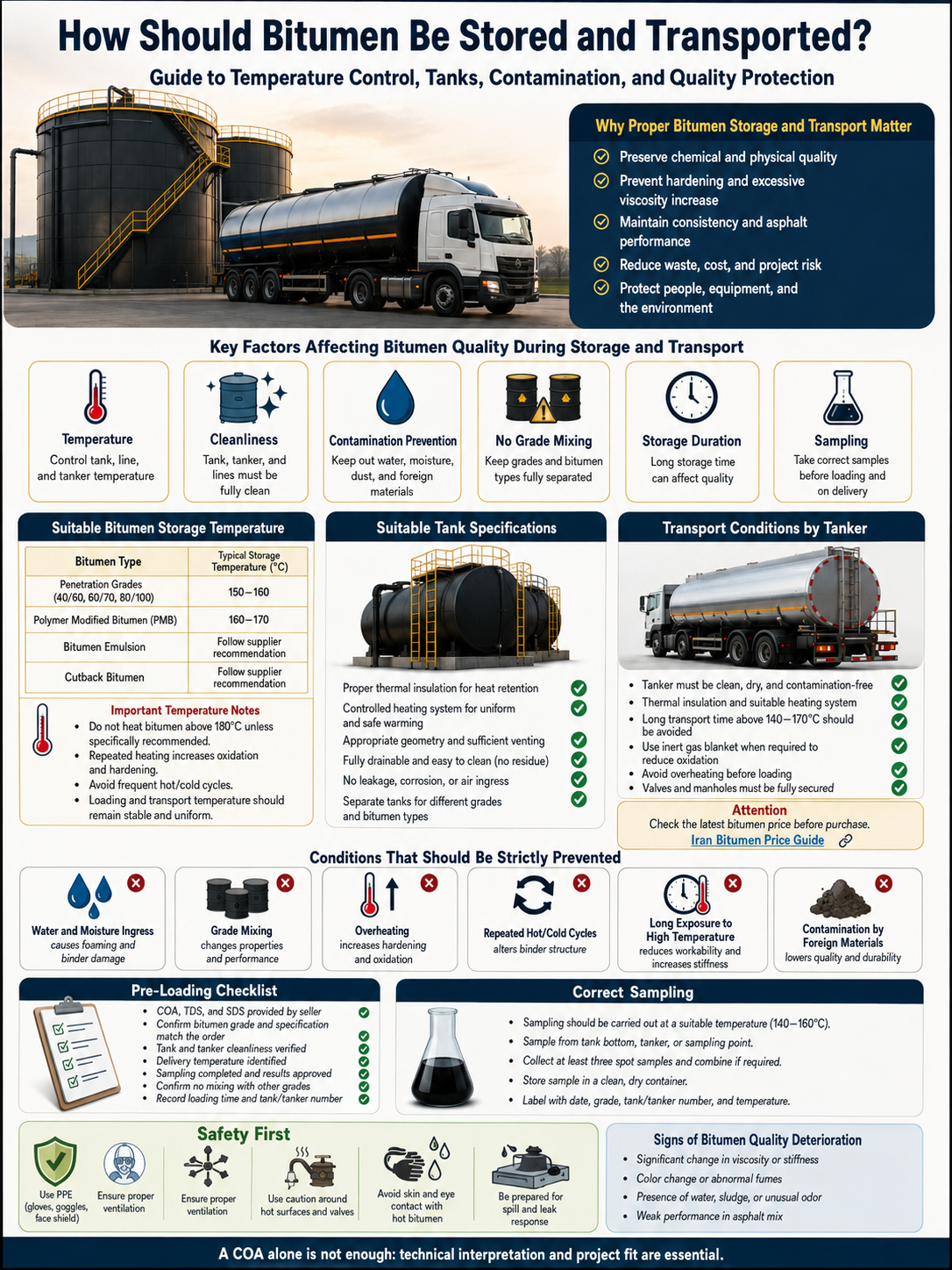
This infographic summarizes the main controls required for bitumen storage and transportation: using the lowest practical temperature for pumping, avoiding prolonged heating and hot spots, using clean and dedicated tanks and transfer lines, preventing grade mixing and contamination, checking samples before loading and at delivery, and following the product TDS, SDS, and supplier instructions.
How Can Bitumen Contamination Be Prevented?
Contamination is not always visible. Even small amounts of fuel, oil, water, solvent, or another product may affect viscosity, flash point, adhesion, foaming behavior, or final performance.
- Check the previous cargo history of the tanker or tank.
- Verify the cleanliness of the tank, valves, pump, hoses, and transfer lines.
- Confirm that the tank is dry and free of water.
- Separate bitumen lines from fuel, oil, and solvent lines.
- Keep openings closed to prevent dust, rain, or foreign-material ingress.
- Apply and record seals after loading.
- Record tanker number, tank number, batch number, loading time, and temperature.
Water and Hot Bitumen
Water entering hot bitumen may cause violent foaming, sudden expansion, and dangerous splashing. Tanks, tankers, and transfer lines should be checked for water before receiving hot bitumen.
Why Is Mixing Different Bitumen Grades a Risk?
Mixing Bitumen 40/60, 60/70, 80/100, polymer modified bitumen, or other bituminous products may result in a material that no longer meets the specification of any original grade. Even residue left in a tank, line, hose, or tanker may affect the next shipment.
| Mixing Risk |
Possible Consequence |
| Mixing two penetration grades |
Changes in penetration, softening point, and viscosity; possible deviation from contract specification. |
| Mixing conventional and polymer modified bitumen |
Loss or alteration of modified performance and unpredictable behavior. |
| Ingress of cutback or fuel |
Lower viscosity or flash point and increased technical and safety risk. |
| Ingress of emulsion or water |
Foaming, instability, and reheating risk. |
What Should Be Checked During Bitumen Transport by Tanker?
The transport tanker should be compatible with the bitumen type and operating temperature. Insulation, heating equipment, valves, hoses, loading seals, allowable capacity, and previous cargo history should be checked before loading.
- The tanker should be clean, dry, and suitable for the product.
- Loading and delivery temperatures should be recorded.
- Localized overheating without suitable circulation should be avoided.
- Manhole and discharge-valve seals should be documented.
- Loading, dispatch, arrival, and unloading times should be traceable.
- After a long delay, product temperature and the need for retesting should be reviewed.
- A retained sample should be kept according to the agreed sampling procedure.
Delivery conditions and price: Loading temperature, packaging type, transport method, destination, order volume, and technical documentation may affect commercial terms. For a broader review, read the
Iran Bitumen Price Guide.
How Is Polymer Modified Bitumen Storage Different?
Polymer modified bitumen may have stricter limits than conventional penetration-grade bitumen in terms of storage temperature, storage duration, and the need for circulation or agitation. Some products may be more sensitive to phase separation or structural change when stored without movement at elevated temperature.
- Recommended storage and pumping temperature range
- Maximum storage duration at a stated temperature
- Requirement for circulation or agitation
- Recommended reheating procedure
- Uniformity and storage-stability controls
- Sampling and acceptance conditions after transport
For more information, read What Is Polymer Modified Bitumen?
Sampling and Quality Control Before Loading
The supplier COA should correspond to the actual batch or tank. For critical orders, the contract may also require pre-loading sampling, retained samples, joint sampling, or independent confirmation testing.
- Match the product name, grade, and batch number with the purchase order.
- Check tank temperature and product uniformity before sampling.
- Use a clean, dry, heat-resistant sample container.
- Label the sample with date, time, tank, batch, and sampler identity.
- Keep a retained sample through the acceptance period or as required by contract.
- Compare the COA, confirmation-test results, and loading records.
What Documents Should Be Reviewed with the Shipment?
| Document |
Purpose |
| COA |
Actual test results for the batch or sample linked to the shipment. |
| TDS |
General technical information, application guidance, and product temperature information. |
| SDS |
Hazards, personal protection, storage, emergency response, and safety requirements. |
| Loading record |
Tanker number, weight, loading time, temperature, tank number, and seals. |
| Tank and tanker history |
Supports contamination and grade-mixing risk assessment. |
| Sampling record |
Confirms where, when, and how the sample was taken. |
Warning Signs of Deterioration or Contamination
The following do not automatically require rejection, but they justify stopping the process, sampling, and technical review:
- Foaming or unusual sound during heating
- Unexpected change in viscosity or pumping behavior
- Abnormal odor associated with solvent or fuel
- Visible particles, sludge, or foreign matter
- Significant temperature difference within the same tank
- Test results outside limits or inconsistent with the COA
- Lack of traceability for tank, batch, tanker, or seals
- Unusual flash point, penetration, softening point, or solubility results
Bitumen Storage and Transport Checklist
| Control Point |
Expected Condition |
| Product identity |
Grade, batch, tank, and purchase order are consistent. |
| Storage temperature |
Controlled and recorded according to TDS, SDS, and actual pumping need. |
| Storage duration |
Known and compatible with the product type and supplier guidance. |
| Tank and lines |
Clean, dry, identified, and free of incompatible residue. |
| Transport tanker |
Previous cargo, cleanliness, insulation, valves, and fittings verified. |
| Grade separation |
Tank, lines, valves, and hoses assigned to the correct grade. |
| Sampling |
Main and retained samples taken, labeled, and sealed properly. |
| Documents |
COA, TDS, SDS, and loading records are complete and traceable. |
| Delivery check |
Seals, temperature, weight, appearance, and documents checked upon arrival. |
For technical and supply information: Send the required grade, reference standard, order volume, packaging type, destination, and documentation requirements through the
Dejpa Contact Page. Product families can also be reviewed on the
Dejpa Products Page.
Conclusion
Maintaining bitumen quality after production depends on careful control of temperature, time, tanks, transfer lines, transport tankers, contamination risk, and traceability. Higher temperature does not always mean better handling; the lowest practical temperature should be used for safe and effective transfer.
Prolonged heating, hot spots, excessive contact with air, grade mixing, ingress of water or petroleum materials, and contaminated tanks or tankers may change test results and product performance. For polymer modified bitumen, supplier guidance on temperature, storage time, and circulation is especially important.
Before loading and upon delivery, the COA, TDS, SDS, batch number, product temperature, tanker records, seals, and retained sample should be reviewed. If any abnormal sign is observed, the technical decision should be based on proper sampling and valid testing rather than appearance alone.
Frequently Asked Questions
What is the correct storage temperature for bitumen?
There is no single temperature suitable for every product. The correct range should be determined from the product TDS, SDS, required pumping viscosity, grade type, storage duration, and equipment design.
Does high-temperature storage reduce bitumen quality?
Long exposure to high temperature may accelerate oxidation, hardening, viscosity increase, and loss of lighter components. The effect depends on temperature, duration, bitumen type, and contact with air.
Can different bitumen grades be stored in the same tank?
Unintentional mixing may move the product outside specification. Dedicated tanks and lines, or verified cleaning before a service change, are recommended.
Why is water in a bitumen tank dangerous?
Water in contact with hot bitumen may rapidly vaporize and cause violent foaming, sudden expansion, and dangerous splashing.
Is a COA enough to confirm quality before transport?
A COA is important, but it should be linked to the actual batch and shipment. Tank conditions, transport conditions, sampling, sealing, delivery temperature, and confirmation testing may also be important.
Does polymer modified bitumen require agitation during storage?
It depends on the formulation. Some polymer modified binders may require circulation or agitation to maintain uniformity, so supplier guidance should be followed.
When should bitumen be retested after storage?
Retesting may be appropriate after prolonged storage, unusual heating, suspected contamination, accidental mixing, borderline results, inconsistency with the COA, or where required by contract.
References