BITUMEN SELECTION GUIDE
Bitumen for Hot Climates: Which Grade Should You Choose?
Choosing bitumen for a hot climate is not simply a matter of selecting the hardest available grade. The correct binder depends on pavement temperature, traffic loading, asphalt mixture design, project specifications and the grading system being used.
Grades such as 60/70, VG30, VG40, Performance Grade bitumen and polymer-modified bitumen may all be considered in high-temperature road projects, but they are not interchangeable. Each belongs to a different specification approach and should be selected according to the technical requirements of the project.
Quick Answer: Which Bitumen Grade Is Suitable for Hot Climates?
There is no single bitumen grade that is automatically best for every hot climate. The appropriate binder should be selected according to pavement temperature, traffic conditions, asphalt mixture requirements and the applicable project specification. Depending on the grading system, options may include 60/70, VG30, VG40, a suitable PG grade or a polymer-modified binder.
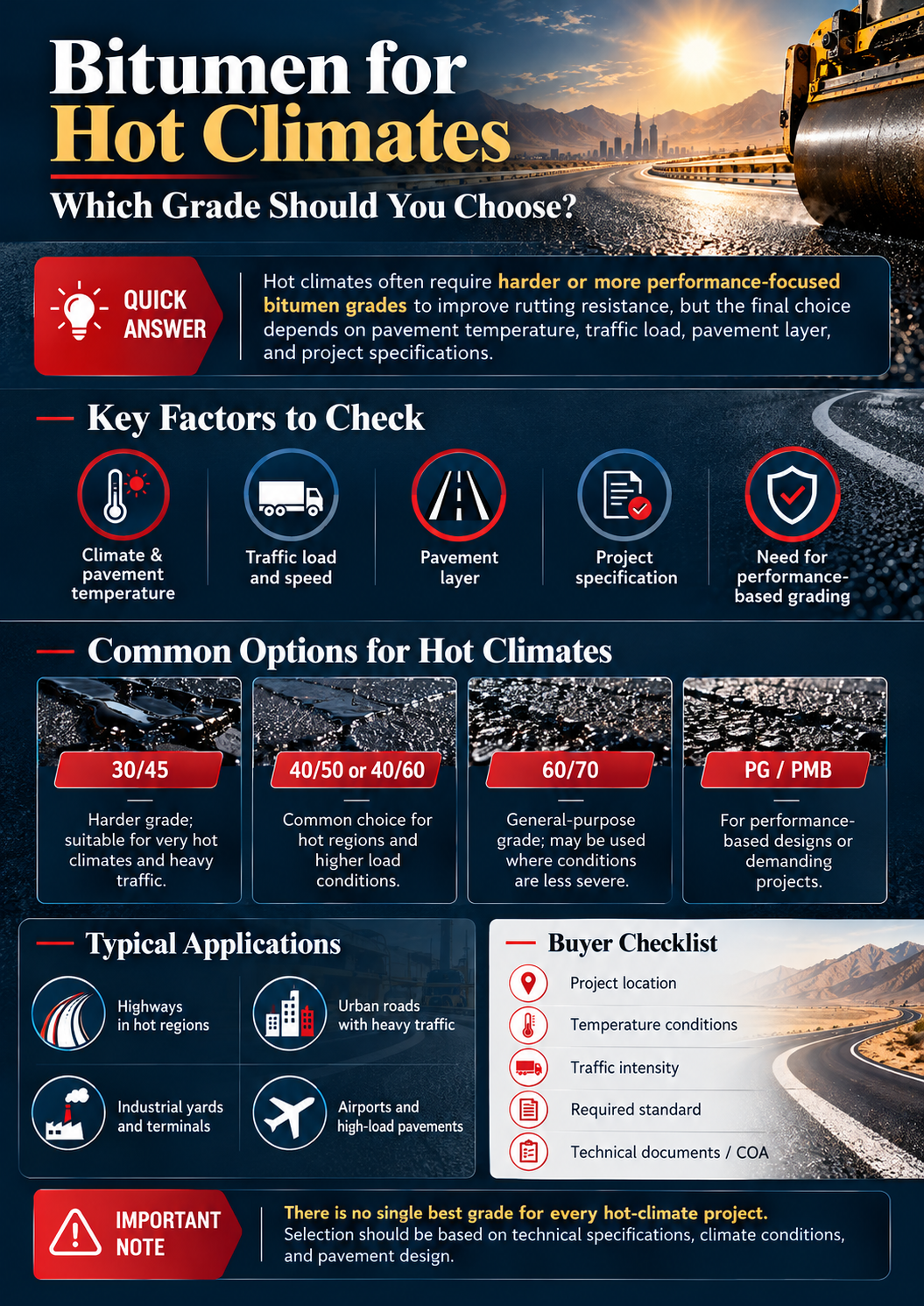
Bitumen grade selection should consider pavement temperature, traffic, mixture design and the project specification together.
Why Does Temperature Matter in Bitumen Selection?
Bitumen is a temperature-sensitive material. Its stiffness and resistance to deformation change as temperature changes, which is why climatic conditions are an important part of binder selection.
At higher pavement temperatures, the binder becomes softer and the asphalt mixture may become more susceptible to permanent deformation if the binder, mixture design and pavement structure are not appropriate for the service conditions.
Air Temperature Is Not the Only Factor
Road engineers are usually concerned with the temperature experienced by the pavement and binder, not only the reported ambient air temperature. Solar radiation, pavement color, location, season and traffic conditions can all affect the actual thermal environment of the pavement.
What Can Happen to Asphalt at High Temperatures?
When pavement temperatures remain high, the asphalt binder becomes less stiff. Under repeated traffic loading, an unsuitable binder or mixture may become more vulnerable to permanent deformation.
One of the key concerns is rutting, where repeated wheel loads create longitudinal depressions in the wheel paths. The risk depends not only on the binder grade but also on aggregate structure, mixture design, compaction, pavement thickness, traffic loading and construction quality.
Hotter Does Not Simply Mean “Use the Hardest Bitumen”
A binder that is too stiff for the overall project conditions may create other performance concerns. Grade selection should therefore balance high-temperature resistance with the full range of expected service conditions and the requirements of the pavement design.
Is 60/70 Bitumen Suitable for Hot Climates?
60/70 is a penetration-grade bitumen widely used in paving applications, but its suitability for a hot-climate project should not be determined by the grade name alone.
A project may specify 60/70 where the pavement design, traffic conditions and local standard consider it appropriate. In more demanding conditions, however, the project specification may require another penetration grade, a viscosity grade, a suitable PG binder or a modified binder.
For a detailed overview of this grade, see Dejpa’s guide to 60/70 bitumen .
When Is VG30 Considered for Hot Regions?
VG30 belongs to the viscosity grading system and may be specified for asphalt and road projects in warm or hot regions where the relevant standard requires this grade.
Its use should still be based on the project specification rather than on a general assumption that VG30 is automatically suitable for every high-temperature environment. Traffic loading, pavement temperature, mixture design and technical limits remain important.
Do Not Treat VG30 as a Direct 60/70 Equivalent
VG30 and 60/70 belong to different grading systems. They may appear in similar paving applications, but they should not be substituted for one another without checking the applicable specification and technical requirements.
When Is VG40 Considered?
VG40 is a higher viscosity grade within the same viscosity grading system. It may be specified where the project standard calls for a binder with higher viscosity characteristics, including certain demanding pavement conditions.
However, VG40 should not be selected simply because the climate is hotter or because the traffic is heavier. The project engineer or specification should determine whether VG40, VG30 or another binder system is appropriate.
Why Traffic Matters as Much as Climate
High temperature and heavy traffic can act together to increase the demand placed on an asphalt binder. Slow-moving or stationary heavy vehicles can be particularly important because the pavement is subjected to repeated loads for longer periods.
For this reason, two roads in the same hot climate may require different binder specifications if their traffic intensity, axle loading, vehicle speed or pavement structures are different.
Selection Principle
The correct question is not simply “Which bitumen is best for hot weather?” but rather “Which binder meets the specification for this pavement temperature, traffic level, mixture design and project condition?”
How Does PG Bitumen Help in Hot-Climate Selection?
Performance Grade bitumen provides a different approach to binder selection because the grade is linked to the pavement temperatures the binder is expected to experience in service.
This can make the PG system particularly useful when temperature conditions are a central part of the pavement design. Instead of relying only on a traditional penetration or viscosity designation, the binder is selected according to performance-related temperature requirements and laboratory testing.
Why PG Can Be Useful in Hot Regions
In very warm pavement environments, the high-temperature side of a PG specification helps engineers assess whether the binder is appropriate for the expected pavement temperature and traffic conditions.
However, the PG system should still be used according to the applicable design method and project specification. A PG designation should not be treated as a direct numerical conversion from 60/70, VG30 or VG40.
For a broader explanation of this grading system, see Dejpa’s guide to Performance Grade bitumen .
When Is Polymer-Modified Bitumen Considered in Hot Climates?
In projects with more demanding service conditions, conventional paving bitumen may not always provide the performance required by the pavement design. In such cases, the specification may call for polymer-modified bitumen, commonly referred to as PMB.
Polymer modification is used to change binder performance characteristics and may be considered where the project requires improved resistance to deformation, enhanced elasticity or better overall performance under severe traffic and temperature conditions.
PMB Is Not Automatically Required in Every Hot Climate
The fact that a project is located in a hot region does not automatically mean that polymer-modified bitumen is necessary. Modification should be based on the pavement design, traffic demand, performance requirements and applicable specification.
To understand how modified binders differ from conventional paving grades, see Dejpa’s guide to Polymer Modified Bitumen .
60/70 vs VG30 vs VG40 vs PG vs PMB: How Do They Differ?
These binder options should not be compared as if they were simply different levels on one scale. Some belong to different grading systems, while PMB describes a modified binder category that may itself be specified through performance or other technical requirements.
| Binder / Grade |
Classification Approach |
What It Mainly Represents |
Hot-Climate Selection Consideration |
| 60/70 |
Penetration grade |
Binder consistency within a specified penetration range |
Use where the project specification confirms suitability for the pavement and traffic conditions |
| VG30 |
Viscosity grade |
Viscosity-related requirements under the relevant standard |
May be specified for warm or hot-region paving projects depending on the applicable standard |
| VG40 |
Viscosity grade |
Higher viscosity-grade requirements within the VG system |
May be considered where the project specification requires a higher viscosity grade |
| PG Bitumen |
Performance Grade |
Performance-related requirements linked to pavement temperature |
Useful where pavement temperature and performance-based selection are central to the design |
| PMB |
Modified binder |
Binder properties modified to meet more demanding performance requirements |
May be specified where high temperature combines with severe traffic or other demanding conditions |
Does a Hotter Climate Always Require a Higher Grade?
Not necessarily. Higher temperature is an important design factor, but binder selection should not be reduced to a rule such as “the hotter the climate, the higher the grade.”
A pavement in a hot region with moderate traffic may have different binder requirements from a heavily loaded industrial road in the same climate. Similarly, the same road may require different approaches depending on the asphalt mixture, pavement structure and governing standard.
Avoid “Higher Grade = Better” Thinking
A higher viscosity grade, a higher PG high-temperature designation or a modified binder is not automatically the best option. The correct binder is the one that meets the required performance and specification for the actual project.
How Should Heavy Traffic Change the Selection?
Traffic loading becomes especially important in hot climates because high pavement temperature can reduce binder stiffness while repeated wheel loads increase the risk of permanent deformation.
Roads carrying frequent heavy trucks, slow-moving vehicles, buses or industrial traffic may place greater demand on the asphalt mixture than roads exposed mainly to lighter and faster-moving traffic.
The appropriate response may involve changes to the binder grade, use of a performance-based specification, polymer modification, changes in aggregate structure or other pavement-design measures. Binder selection should therefore be considered as part of the overall asphalt and pavement design.
Why Asphalt Mixture Design Matters
The binder is only one component of asphalt. Aggregate gradation, aggregate quality, binder content, air voids, compaction and mixture structure all influence how the pavement performs under high temperature and traffic.
Using a technically suitable binder cannot compensate for a poorly designed or poorly constructed mixture. Likewise, a good mixture design still needs a binder that meets the specified performance requirements.
Binder + Mixture + Pavement
High-temperature pavement performance should be evaluated as a system. Binder grade, asphalt mixture design, pavement structure, construction quality and traffic conditions all contribute to the final result.
What Should Buyers Check Before Ordering Bitumen for a Hot-Climate Project?
Before requesting a quotation, buyers should confirm the exact binder requirement with the project specification or engineering team. Purchasing only by a commonly used grade name can create technical and commercial problems if the specification requires another grading system or additional performance criteria.
- Confirm the required grading system: penetration, viscosity, PG or modified binder
- Identify the exact grade required by the project
- Review expected pavement temperature and climatic conditions
- Check traffic intensity, axle loading and vehicle speed
- Confirm asphalt mixture and pavement design requirements
- Review the applicable technical standard
- Request relevant TDS and COA documentation where required
- Define quantity, packaging, destination and delivery requirements
Why Should Buyers Review the COA?
The grade name alone does not confirm whether a specific batch meets the technical requirements of a project. A Certificate of Analysis allows the buyer or technical team to review actual test results against the relevant specification.
The exact parameters depend on the grading system and product specification. Buyers should therefore compare the COA with the required standard rather than relying only on a general product description.
For additional guidance, see how to read a bitumen Certificate of Analysis .
A Practical Selection Framework
A practical way to approach bitumen selection for hot climates is to move from project conditions to the required technical specification rather than starting with a preferred grade.
| Step |
Question |
Why It Matters |
| 1 |
What grading system does the project use? |
Prevents incorrect comparison between penetration, VG and PG grades |
| 2 |
What pavement temperatures are expected? |
Helps define the binder demand under high-temperature service |
| 3 |
How severe is the traffic loading? |
Heavy or slow-moving traffic can increase deformation demand |
| 4 |
What does the asphalt mixture design require? |
Binder selection should work together with the aggregate and mixture structure |
| 5 |
What does the project specification require? |
The final product must comply with the governing technical requirements |
What Information Should Buyers Include in an RFQ for Hot-Climate Bitumen?
A useful RFQ should describe both the required binder and the project conditions clearly enough for the supplier to understand the technical and commercial requirement.
| RFQ Item |
What to Specify |
| Binder / Grade |
Exact required grade, such as 60/70, VG30, VG40, a specified PG grade or a modified binder |
| Technical Standard |
Applicable project, national or international specification |
| Project Conditions |
Relevant climate, pavement temperature and traffic requirements where applicable |
| Quantity |
Required tonnage and expected delivery or shipment schedule |
| Packaging / Supply Mode |
Required supply format according to project and logistics requirements |
| Destination |
Project destination, port or other required delivery point |
| Quality Documents |
TDS, COA, inspection requirements and other technical documents required by the contract |
Procurement Principle
If the project already defines the binder grade and standard, those requirements should be reproduced accurately in the RFQ. The supplier should not be expected to infer the required grade from the destination climate alone.
What Are the Most Common Mistakes When Selecting Bitumen for Hot Regions?
Hot-climate binder selection can become misleading when climate is treated as the only design variable or when different grading systems are compared as if they were directly interchangeable.
- Selecting a binder only from average air temperature
- Assuming that a harder or higher grade is automatically better
- Treating 60/70, VG30, VG40 and PG grades as direct equivalents
- Ignoring heavy or slow-moving traffic
- Ignoring asphalt mixture design and pavement structure
- Using a common market grade instead of the grade specified by the project
- Comparing quotations without checking the applicable standard
- Relying on generic online specification tables instead of project documents, TDS and COA
Frequently Asked Questions About Bitumen for Hot Climates
What is the best bitumen grade for a hot climate?
There is no universal best grade for every hot climate. The correct binder depends on pavement temperature, traffic loading, asphalt mixture design, grading system and the applicable project specification.
Is 60/70 bitumen suitable for hot weather?
60/70 may be suitable where the project specification permits it and the pavement design considers it appropriate. Hot climate alone is not enough to confirm suitability.
Is VG30 suitable for hot climates?
VG30 may be specified for paving projects in warm or hot regions, but it should be selected according to the applicable viscosity-grade standard and the actual project conditions.
Is VG40 better than VG30 for hot climates?
Not automatically. VG40 is a higher viscosity grade, but whether it is preferable depends on the project specification, traffic demand, pavement temperature and asphalt mixture requirements.
Is PG bitumen better for high-temperature roads?
PG grading can be particularly useful where binder selection is linked directly to pavement temperature and performance requirements. However, the correct PG grade still has to be determined through the applicable design method and specification.
When should PMB be used in a hot climate?
Polymer-modified bitumen may be specified where the pavement is exposed to demanding combinations of high temperature, heavy traffic or other performance requirements. It is not automatically necessary for every hot-region project.
Does heavy traffic change the required bitumen grade?
It can. Heavy axle loads, repeated loading and slow-moving traffic can increase deformation demand, especially at high pavement temperatures. The binder requirement should therefore be assessed together with the overall pavement design.
Can VG30 be directly replaced with 60/70?
No direct one-to-one substitution should be assumed. VG30 and 60/70 belong to different grading systems and should be evaluated against their respective technical specifications.
Should buyers choose bitumen based on country or destination?
Destination can provide useful climatic context, but it is not sufficient by itself. Local pavement temperature, project standards, traffic loading and design requirements should determine the final binder specification.
Final Selection Guide
Selecting bitumen for a hot climate should begin with the pavement and project conditions, not with a predetermined grade name. High temperature matters, but its effect has to be considered together with traffic loading, mixture design, pavement structure and the governing technical specification.
60/70, VG30, VG40, PG bitumen and polymer-modified binders each represent different specification approaches or performance options. They should not be treated as interchangeable alternatives simply because they may all appear in hot-climate paving projects.
For procurement, the safest approach is to confirm the grading system and exact product requirement first, then review the relevant technical standard, TDS and COA before comparing commercial offers.
In One Sentence
The best bitumen for a hot climate is not simply the hardest or highest grade—it is the binder that meets the project specification for the expected pavement temperature, traffic demand and asphalt design.
Need Bitumen for a Hot-Climate Project?
Send Dejpa your required grade or project specification, quantity, packaging or supply mode, destination and technical documentation requirements for supply review.
Send Your Inquiry
sales@dejpa.com