PENETRATION GRADE BITUMEN GUIDE
What Is 30/45 Bitumen? Specifications, Applications and Comparison with 40/50 and 60/70
30/45 bitumen is a relatively hard penetration-grade paving binder used where the project specification requires this particular consistency range. The designation 30/45 refers to the binder’s penetration range under standardized test conditions and helps distinguish it from softer penetration grades such as 40/50 and 60/70.
However, penetration grade alone does not determine whether a binder is suitable for a specific road or asphalt project. Climate, traffic loading, pavement design, asphalt mixture requirements and the applicable technical standard must also be considered.
Quick Answer: What Is 30/45 Bitumen?
30/45 bitumen is a penetration-grade bitumen identified by a penetration range of 30 to 45 under the specified standard test conditions. It is harder than higher-penetration grades such as 60/70 and may be specified for asphalt and paving applications where a harder conventional binder is required. Final selection must follow the applicable project specification.
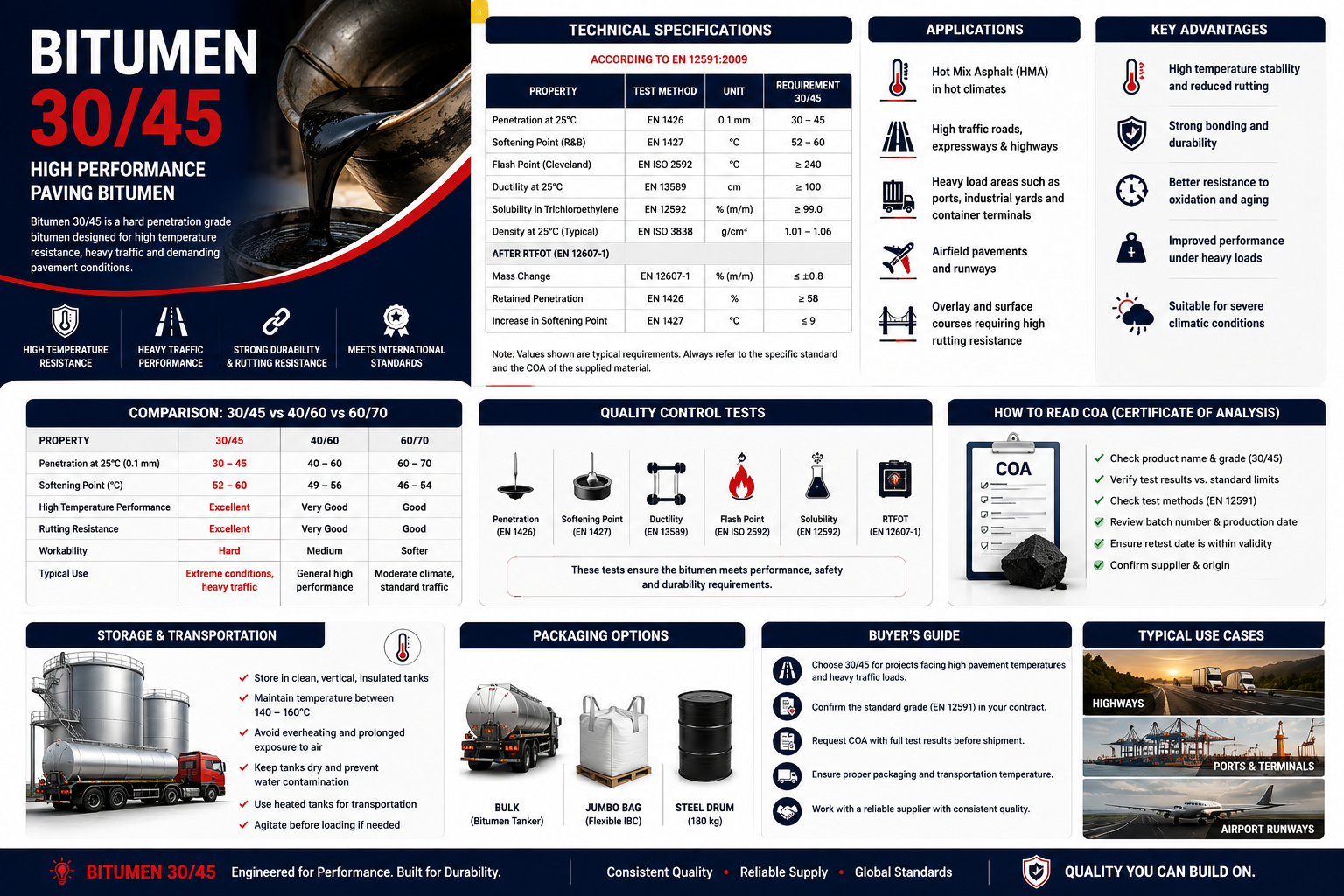
30/45 is a penetration-grade bitumen. Its suitability depends on the required specification, pavement conditions and asphalt application.
What Do the Numbers 30 and 45 Mean in 30/45 Bitumen?
The numbers in a penetration-grade designation refer to the penetration range measured using a standardized penetration test. The test evaluates how far a standard needle penetrates the bitumen under defined test conditions.
For 30/45 bitumen, the designation indicates that the measured penetration must fall within the range associated with this grade when tested according to the applicable standard. Penetration is traditionally expressed in tenths of a millimetre.
How Should the Grade Be Interpreted?
A lower penetration value generally corresponds to a harder conventional bitumen, while a higher penetration value generally indicates a softer binder under the specified test conditions.
This means 30/45 is generally harder than 40/50 and 60/70 penetration grades, but this comparison should not be interpreted as meaning that one grade is automatically better than another.
What Are the Main Technical Properties of 30/45 Bitumen?
Penetration is the defining property used in the grade name, but it is not the only characteristic that should be reviewed when evaluating 30/45 bitumen. Product conformity normally involves a broader set of physical and performance-related properties according to the applicable specification.
Depending on the standard, project and supplier documentation, buyers may need to review properties such as softening point, viscosity, ductility or related deformation characteristics, flash point, solubility and changes after aging.
Important Technical Note
The required values for these properties can vary according to the applicable standard and product specification. For procurement, the buyer should review the relevant TDS, Certificate of Analysis (COA) and project requirements rather than relying on generic values published for the grade.
Which Tests Are Used to Evaluate 30/45 Bitumen?
Quality control for penetration-grade bitumen involves laboratory testing to confirm that the supplied binder complies with the required specification. The exact testing program depends on the governing standard and contract requirements.
| Test or Property |
What It Helps Evaluate |
| Penetration |
Consistency of the binder and conformity with the penetration grade |
| Softening Point |
Temperature-related softening behaviour under the specified test method |
| Viscosity |
Resistance to flow under specified temperature and test conditions |
| Flash Point |
A safety-related characteristic associated with heating the binder |
| Aging-related Tests |
Changes in binder properties after simulated short-term aging |
For a broader explanation of common laboratory tests used in bitumen quality evaluation, see Dejpa’s guide to bitumen quality control tests .
Where Is 30/45 Bitumen Used?
30/45 bitumen can be specified as a paving binder for asphalt production and road construction where the pavement design and applicable specification call for a relatively hard conventional penetration grade.
Its actual suitability depends on the asphalt mixture, climate, loading conditions, pavement layer and project requirements. For this reason, the grade should not be assigned to a particular road type solely on the basis of its penetration range.
Potential Application Areas
- Asphalt mixture production where 30/45 is specified
- Road and highway paving projects
- Infrastructure projects requiring a harder penetration-grade binder
- Other paving applications subject to the applicable technical specification
Is 30/45 Bitumen Suitable for Hot Climates?
Because 30/45 is a relatively hard penetration grade, it may be considered in projects where a harder conventional binder is required. However, describing it simply as a “hot-climate bitumen” would be an oversimplification.
Binder selection should consider pavement temperature, traffic loading, asphalt mixture design, project specifications and the grading system required by the relevant authority. Where performance-based specifications are used, a PG binder requirement may be more appropriate than selecting a product only by penetration grade.
Is 30/45 Bitumen Suitable for Heavy Traffic?
A harder penetration grade may be considered in some heavily loaded pavement applications, but penetration grade alone is not enough to determine suitability for heavy traffic.
Axle loading, traffic volume, vehicle speed, pavement temperature, asphalt mix design and the applicable specification all influence binder requirements. Projects with demanding traffic or temperature conditions may also require performance-graded or modified binders.
Selection Principle
Do not select 30/45 solely because it is harder than 60/70. The correct binder is the grade that satisfies the project specification and the actual pavement service conditions.
How Does 30/45 Bitumen Compare with 40/50 and 60/70?
30/45, 40/50 and 60/70 are all penetration-grade bitumens, but they represent different consistency ranges. In general, a lower penetration range corresponds to a harder conventional binder, while a higher range indicates a softer binder under the specified penetration test conditions.
This means 30/45 is generally harder than 40/50, and both are generally harder than 60/70. However, this does not mean that 30/45 is automatically the best choice. Each grade is intended for projects whose specifications and service conditions match its required properties.
| Grade |
Relative Consistency |
General Interpretation |
Selection Should Consider |
| 30/45 |
Relatively harder |
Lower penetration range within the compared grades |
Project specification, climate, traffic and asphalt mix requirements |
| 40/50 |
Intermediate |
Between 30/45 and 60/70 in penetration consistency |
Applicable standard and project conditions |
| 60/70 |
Relatively softer |
Higher penetration range among these three grades |
Climate, traffic, pavement design and project specification |
Important Comparison Note
Penetration grade describes one important aspect of binder consistency, but it should not be used as the only basis for comparing overall pavement performance. Other specification limits and test results must also be reviewed.
30/45 vs 40/50 Bitumen: What Is the Difference?
The main difference between 30/45 and 40/50 lies in their penetration ranges. 30/45 represents a relatively harder binder, while 40/50 falls into a slightly softer penetration range.
In practice, the choice between these grades should follow the project specification rather than a simple preference for a harder or softer product. Climate, pavement temperature, asphalt mixture design and loading conditions all remain important.
30/45 vs 60/70 Bitumen: What Is the Difference?
The difference between 30/45 and 60/70 is more pronounced in terms of penetration consistency. 30/45 is generally harder, while 60/70 is a softer conventional penetration grade.
This does not mean that one grade should replace the other. 60/70 is widely specified for many paving applications, while 30/45 may be required where the technical specification calls for a harder penetration-grade binder. The governing standard and project design should determine the correct choice.
For more information about 60/70 bitumen, see Dejpa’s guide to Bitumen 60/70 .
How Should Buyers Choose Between 30/45, 40/50 and 60/70?
The correct grade should be selected from the project specification and technical requirements rather than from the grade number alone. A lower penetration range does not automatically indicate a superior product, just as a softer grade is not automatically less suitable.
Before Selecting a Grade, Review:
- Applicable road or project specification
- Expected pavement temperature range
- Traffic volume and axle loading
- Asphalt mixture design
- Pavement layer and function
- Required quality-control test limits
What Is the Difference Between 30/45 Bitumen and PG Bitumen?
30/45 and PG grades belong to different classification systems. 30/45 is a penetration grade, while Performance Grade (PG) bitumen is classified according to performance-related requirements associated with pavement temperatures and laboratory testing.
| Classification |
Primary Basis |
Example |
| Penetration Grade |
Penetration consistency and other specification properties |
30/45, 40/50, 60/70 |
| Performance Grade |
Performance-related requirements associated with pavement temperatures |
PG 64-22, PG 70-16 |
A penetration grade should therefore not be directly converted into a PG grade using a simple one-to-one rule. The two systems evaluate and classify binders differently.
For a detailed explanation of the Performance Grade system, see Dejpa’s PG bitumen guide .
Can 30/45 Bitumen Replace a PG Binder?
Not automatically. If a project specification requires a particular PG binder, supplying a penetration-grade product only because it appears to have similar consistency would not demonstrate compliance with the required PG specification.
The binder must meet the grading system and test requirements stated in the project documents. Any substitution should therefore be evaluated and approved according to the relevant engineering and contractual requirements.
Why Is the Certificate of Analysis Important for 30/45 Bitumen?
The grade name alone does not provide all the information needed to evaluate a shipment. A Certificate of Analysis can help buyers review the measured test results against the agreed technical specification.
Depending on the specification, the COA may include results related to penetration and other required properties. Buyers should compare the reported values with the applicable limits rather than relying only on the product label.
For practical guidance, see Dejpa’s guide to reading a Bitumen Certificate of Analysis .
What Should Buyers Check Before Ordering 30/45 Bitumen?
Before placing an order, buyers should confirm that 30/45 is actually the grade required by the project and that the applicable standard and quality requirements are clearly defined.
- Confirm the exact grade required by the project specification
- Identify the applicable technical standard
- Review the required quality-control tests
- Request the relevant TDS and COA where applicable
- Specify quantity and packaging or supply mode
- State destination and delivery requirements
- Define any inspection or documentation requirements before quotation
What Information Should Buyers Include in a 30/45 Bitumen RFQ?
A complete request for quotation should give the supplier enough information to confirm the technical requirement, supply format and commercial basis of the inquiry. Simply stating “30/45 bitumen” may not be enough for an accurate quotation.
| RFQ Information |
What to Specify |
| Product |
Bitumen 30/45 and any required technical designation |
| Standard |
Applicable product or project specification |
| Quantity |
Required tonnage and expected shipment schedule |
| Packaging / Supply Mode |
Bulk, drum, jumbo bag or other required supply format |
| Destination |
Project or delivery destination and required delivery terms |
| Quality Documents |
TDS, COA, inspection or other required technical documentation |
Buyer Tip
If the project specification contains exact property limits, attach or quote those requirements in the RFQ instead of assuming that the grade name alone defines every technical parameter.
What Are Common Mistakes When Buying 30/45 Bitumen?
Most procurement mistakes do not come from the grade name itself, but from incomplete technical information or assumptions about how one penetration grade compares with another.
- Assuming 30/45 is suitable for every hot-climate project
- Selecting the grade only because it is harder than 60/70
- Treating penetration grade as a direct substitute for PG classification
- Ignoring the applicable project or road authority specification
- Comparing supplier offers without confirming that the same standard and test requirements are being quoted
- Relying on generic online specification tables instead of the relevant TDS or COA
- Leaving inspection, packaging or documentation requirements until after the quotation
Frequently Asked Questions About 30/45 Bitumen
What does 30/45 mean in bitumen?
30/45 identifies a penetration-grade bitumen. The numbers refer to the penetration range measured under the applicable standardized test conditions.
Is 30/45 bitumen harder than 60/70?
Yes, in terms of penetration consistency, 30/45 is generally a harder conventional penetration grade than 60/70 because it has a lower penetration range.
Is 30/45 bitumen harder than 40/50?
Generally, yes. 30/45 has a lower penetration range and is therefore classified as a relatively harder penetration grade than 40/50 under the specified test conditions.
Is 30/45 bitumen suitable for hot weather?
It may be specified in some projects requiring a relatively hard conventional binder, but climate alone is not enough to confirm suitability. Pavement temperature, traffic, asphalt mix design and the applicable specification must also be considered.
Can 30/45 bitumen be used for heavy traffic?
Potentially, if the project specification requires this grade. However, heavy traffic cannot be evaluated from penetration grade alone. Loading, speed, temperature, pavement structure and performance requirements must also be reviewed.
Is 30/45 the same as PG bitumen?
No. 30/45 belongs to the penetration grading system, while PG bitumen is classified using a performance-based grading system associated with pavement temperatures and additional laboratory requirements.
Can 30/45 be directly converted to a PG grade?
No simple one-to-one conversion should be assumed. Penetration grading and Performance Grading use different classification approaches and test requirements.
What documents should a buyer request for 30/45 bitumen?
Depending on the project and contract, buyers may request the relevant TDS, Certificate of Analysis, test results, inspection documents and other technical documentation required by the specification.
Final Considerations
30/45 bitumen is a relatively hard conventional penetration-grade binder defined by its penetration range under standardized test conditions. It can be used in asphalt and paving applications where the project specification requires this grade.
Its lower penetration range makes it generally harder than 40/50 and 60/70, but this should not be interpreted as meaning that 30/45 is inherently better. Each grade serves different project conditions and technical requirements.
For procurement, the correct approach is to confirm the applicable standard, review the required test properties, compare the TDS or COA with the project limits, and specify quantity, packaging, destination and documentation requirements clearly in the RFQ.
Looking for 30/45 Bitumen?
Send Dejpa your required grade, applicable specification, quantity, packaging, destination and quality-document requirements to review technical and supply availability.
Send Your Inquiry
sales@dejpa.com