BITUMEN HANDLING & ASPHALT PRODUCTION GUIDE
Bitumen Temperature Guide: Mixing, Pumping and Asphalt Compaction
Temperature control is an important part of bitumen handling, asphalt production and pavement construction. Heating changes the viscosity of bitumen, affecting how easily it can be pumped, transferred, mixed with aggregates and incorporated into an asphalt mixture.
However, there is no single temperature suitable for every bitumen grade or application. The appropriate temperature depends on binder characteristics, viscosity, modification, equipment, asphalt mixture design and project requirements. Excessive heating can also contribute to binder aging and other operational problems.
Quick Answer: What Is the Right Temperature for Bitumen?
The correct bitumen temperature depends on the binder, the operation and the applicable technical requirements. Storage and pumping temperatures must provide sufficient flowability, mixing temperatures must support proper aggregate coating, and asphalt compaction temperatures must allow the mixture to achieve the required density before excessive cooling occurs.
For unmodified paving binders, laboratory mixing and compaction temperatures can be estimated using viscosity-temperature relationships. Modified binders may require supplier recommendations or alternative laboratory methods. These laboratory temperatures should not automatically be treated as field production or paving temperatures.
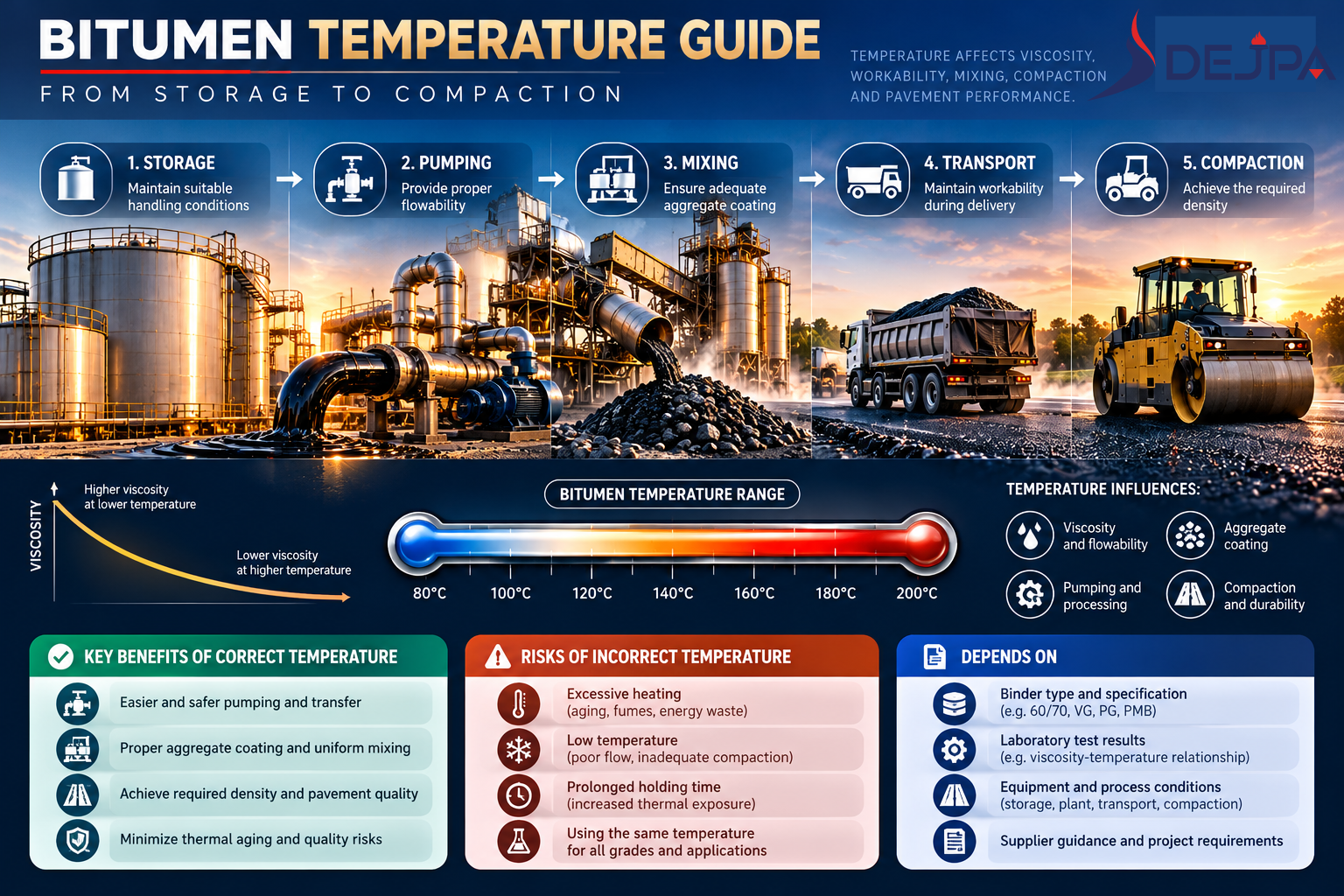
Different stages of bitumen handling and asphalt production require different temperature considerations.
Why Is Temperature Important for Bitumen?
Bitumen is a temperature-sensitive, viscoelastic material. Its resistance to flow and deformation changes with temperature and loading conditions.
At elevated temperatures, conventional paving bitumen generally becomes less viscous and flows more readily. As temperature decreases, viscosity increases and the material becomes more resistant to flow.
This behavior is important during industrial handling and asphalt production. The binder must be sufficiently fluid for the intended process, but heating beyond what is necessary can create quality, safety, energy and environmental concerns.
Temperature Changes Workability
When temperature increases, binder viscosity generally decreases. This can facilitate pumping, transfer and aggregate coating. When temperature falls, increasing viscosity can make these processes more difficult.
What Is the Relationship Between Bitumen Temperature and Viscosity?
Viscosity describes a material's resistance to flow. For conventional paving bitumen, the relationship between temperature and viscosity is one of the most useful properties for determining suitable heating and handling conditions.
As bitumen is heated, its viscosity generally decreases. This makes it easier to move through pipes and pumps and helps the binder coat aggregate particles during asphalt mixing.
However, the exact viscosity-temperature relationship is not identical for every binder. Two materials with similar penetration grades can have different viscosities at elevated temperatures because of differences in composition and temperature susceptibility.
| Temperature Condition |
Typical Binder Behavior |
Operational Consideration |
| Lower Temperature |
Higher viscosity and greater resistance to flow |
Pumping and transfer may become more difficult |
| Appropriate Process Temperature |
Viscosity suitable for the intended operation |
Supports pumping, mixing or other specified processes |
| Excessive Heating |
Lower viscosity but increased thermal exposure |
Potential aging, fumes, energy waste or binder damage |
Are Storage, Pumping, Mixing and Compaction Temperatures the Same?
No. These temperatures refer to different operations with different technical objectives. A temperature suitable for storing or transferring liquid bitumen does not automatically establish the correct asphalt mixing or field compaction temperature.
| Process |
Main Objective |
Important Variables |
| Storage |
Maintain the binder in a suitable condition while minimizing unnecessary thermal exposure |
Binder type, holding time, tank design and supplier guidance |
| Pumping / Transfer |
Provide sufficient flowability for safe, efficient movement |
Viscosity, pump characteristics, pipeline conditions and flow requirements |
| Asphalt Mixing |
Achieve suitable aggregate coating and mixture workability |
Binder properties, aggregate condition, mixture design and production method |
| Asphalt Compaction |
Achieve the specified pavement density while the mixture remains workable |
Mixture temperature, lift thickness, weather, rolling pattern and equipment |
Do Not Use One Temperature for Every Process
Binder storage, transfer, asphalt production and field compaction should each follow their own technical requirements. The correct settings must be confirmed using the binder specification, relevant test results, equipment limitations and project procedures.
What Temperature Is Needed to Pump Bitumen?
Bitumen pumping temperature should be selected so that the material reaches a viscosity compatible with the pump, pipeline and required flow rate.
If the binder is too viscous, transfer may become difficult and pumping-system resistance may increase. On the other hand, unnecessarily high temperatures can increase energy consumption and thermal exposure.
The appropriate temperature depends on the actual binder and pumping system, including pipeline length and configuration, equipment capability and the required transfer conditions. Supplier recommendations and plant operating procedures should be followed rather than applying a single universal pumping temperature.
How Is Asphalt Mixing Temperature Determined?
Asphalt mixing temperature must allow the binder to distribute adequately and coat aggregate particles while producing a mixture with suitable workability.
In hot-mix asphalt production, both the binder and aggregate conditions matter. Aggregates must be appropriately dried and heated, and the plant must produce a uniform mixture without excessive thermal exposure.
For conventional, unmodified asphalt binders, laboratory mixing temperatures can be determined using the viscosity-temperature relationship. For plant operations, binder supplier guidance, mixture characteristics, aggregate moisture, weather and construction requirements must also be considered.
Laboratory Temperature Is Not Automatically Plant Temperature
Laboratory mixing temperatures are established for controlled asphalt mixture testing and design. Actual plant mixing temperatures must also account for production and construction conditions and should follow the applicable project requirements.
How Are Laboratory Mixing and Compaction Temperatures Determined?
For conventional unmodified binders, a recognized laboratory approach uses the relationship between viscosity and temperature. Viscosity measurements obtained at specified temperatures are used to develop a viscosity-temperature curve, from which appropriate laboratory mixing and compaction temperature ranges can be identified.
The Asphalt Institute describes an equiviscous approach in which the laboratory mixing range corresponds to a dynamic viscosity of approximately 0.17 ± 0.02 Pa·s and the laboratory compaction range corresponds to approximately 0.28 ± 0.03 Pa·s for unmodified binders.
These are viscosity criteria used to derive laboratory temperatures, not fixed temperature recommendations for every bitumen grade or every field operation.
Important Limitation for Modified Bitumen
The conventional equiviscous approach may produce unrealistically high mixing or compaction temperatures for certain polymer-modified binders. Supplier recommendations or alternative rheological methods should be used where appropriate.
What Is the Correct Mixing Temperature for 60/70 Bitumen?
There is no single laboratory or production mixing temperature that can be assigned to every 60/70 bitumen solely from its penetration grade.
The 60/70 designation describes the penetration range under specified test conditions. It does not, by itself, establish the complete viscosity-temperature relationship of an individual product.
To establish an appropriate laboratory mixing range, viscosity data for the actual 60/70 binder should be evaluated using the relevant procedure. Plant operating temperatures should then be established in accordance with the product guidance, mixture design and project conditions.
For more information about this penetration grade, see Dejpa's guide to 60/70 bitumen .
Which Laboratory Tests Help Determine Bitumen Temperature Requirements?
Testing provides a more reliable basis for selecting handling and laboratory mixing temperatures than relying only on a general grade designation.
| Test or Method |
Purpose |
| Rotational Viscosity |
Measures resistance to flow at selected temperatures and supports the evaluation of binder handling and laboratory mixing behavior |
| Viscosity-Temperature Relationship |
Shows how viscosity changes with temperature and helps derive laboratory mixing and compaction ranges for suitable unmodified binders |
| Dynamic Shear Rheometer (DSR) |
Evaluates rheological behavior and can support alternative temperature determination procedures for certain modified binders |
| Asphalt Mixture Testing |
Helps assess mixture workability, volumetric properties and compaction performance under specified laboratory conditions |
For an introduction to related bitumen properties and laboratory evaluation, read Dejpa's guide to bitumen quality control tests .
Key Technical Principle
The appropriate temperature should be derived from the actual binder characteristics and operational requirements. A grade label alone is not sufficient to establish universal storage, pumping, mixing or compaction temperatures.
Do VG10, VG30 and VG40 Require Different Heating Temperatures?
VG10, VG30 and VG40 belong to the viscosity grading system. Their specifications establish different viscosity-related requirements, which can influence how the binders behave during heating, pumping and asphalt mixing.
However, a viscosity grade does not automatically provide one universal pumping or mixing temperature. The appropriate temperature depends on the actual binder's viscosity-temperature relationship, processing equipment, operating conditions and applicable project requirements.
A higher viscosity grade may require different handling conditions from a lower viscosity grade, but the correct operating temperature must be established using suitable technical data rather than a fixed temperature assigned to the grade name.
Viscosity Grade Does Not Equal Heating Temperature
VG30 and VG40 identify different binder specifications, not specific heating temperatures. The actual temperature requirements should be determined from product data, equipment characteristics and the intended operation.
Does PG Bitumen Have a Specific Mixing Temperature?
Performance Grade bitumen is classified according to performance-related requirements associated with pavement temperatures. The numbers in a PG designation do not represent the temperature at which the binder should be heated, pumped or mixed with aggregates.
For example, PG 64-22 describes a binder's performance grade under specified testing conditions. The number 64 should not be interpreted as an asphalt mixing temperature, and the number -22 is not a storage or pumping temperature.
The processing temperature for a PG binder must be established separately, using binder characteristics, the appropriate laboratory methodology, supplier recommendations and project requirements.
For more information, see Dejpa's guide to Performance Grade bitumen .
Why Does Polymer-Modified Bitumen Require Special Temperature Control?
Polymer-modified bitumen, or PMB, contains modifiers designed to change the binder's rheological and performance characteristics. These modifications can also affect how the binder behaves during heating, storage, pumping and asphalt production.
Certain polymer-modified binders may show non-Newtonian behavior, meaning their apparent viscosity can depend on shear conditions as well as temperature. For this reason, conventional viscosity-based procedures used for unmodified binders may not always provide appropriate mixing and compaction temperatures for PMB.
In some cases, applying conventional equiviscous criteria to modified binders can produce unnecessarily high laboratory temperature estimates. Such temperatures should not be adopted without checking the relevant product recommendations or an appropriate alternative testing procedure.
Important: PMB Is Not One Uniform Product
Different polymer types, modification levels and binder formulations may require different heating and handling procedures. Always refer to the specific PMB grade, supplier technical guidance and project requirements rather than applying a universal PMB temperature.
For a broader understanding of modified binders, read Dejpa's guide to Polymer-Modified Bitumen .
What Is the Correct Asphalt Compaction Temperature?
Asphalt compaction temperature is the temperature at which an asphalt mixture has sufficient workability to achieve the required density under the specified compaction method.
It is important to distinguish laboratory compaction temperature from field compaction temperature. Laboratory procedures use controlled conditions to prepare and evaluate asphalt specimens. Field compaction involves paving equipment, roller patterns, weather, transport time, pavement thickness and changing mixture temperatures.
The appropriate field compaction range must therefore be established according to the asphalt mixture, project specifications and construction procedures. It should not be determined solely from the penetration or viscosity grade of the binder.
| Condition |
Why It Matters |
| Mixture Temperature |
Affects binder viscosity and the ability of the mixture to respond to compaction |
| Asphalt Layer Thickness |
Affects the rate at which the placed mixture loses heat |
| Ambient and Surface Conditions |
Air temperature, wind and the underlying surface can influence mixture cooling |
| Roller Type and Pattern |
Compaction equipment and timing affect the achievable pavement density |
| Mixture Composition |
Aggregate structure, binder characteristics and mixture design influence compactability |
What Happens When Asphalt Is Compacted at Too Low a Temperature?
When an asphalt mixture cools, binder viscosity generally increases and the mixture can become more difficult to compact. If the mixture becomes insufficiently workable before the required density is achieved, the pavement may retain excessive air voids.
Inadequate compaction can contribute to increased permeability and reduced durability, potentially making the pavement more vulnerable to moisture-related damage and premature deterioration.
However, a low temperature does not produce the same outcome for every asphalt technology. Warm-mix additives and processes, for example, may be designed to improve workability and permit production or compaction at lower temperatures under approved procedures.
Compaction Is About Achieving the Required Density
The goal is not to compact at the highest possible temperature. It is to achieve the specified density and pavement quality within the suitable temperature and time window for the particular asphalt mixture.
What Happens If Bitumen Is Heated Too Much?
Excessive bitumen heating can increase thermal exposure, accelerate certain aging processes and create additional operational and safety concerns. The severity of these effects depends on temperature, exposure time, oxygen availability and binder composition.
During hot handling, oxidative aging can change binder chemistry and rheological behavior. Over time, this may increase binder stiffness and reduce its ability to accommodate deformation under some service conditions.
Higher temperatures may also increase energy consumption and emissions from handling operations. Consequently, raising the temperature above the level needed for the process should not be considered a reliable way to improve product quality or production efficiency.
Temperature and Holding Time Must Be Considered Together
A binder held at an elevated temperature for an extended period can experience different thermal and oxidative exposure from a binder heated briefly for a controlled operation. Both the temperature and the duration of exposure matter.
Can Overheating Affect Polymer-Modified Bitumen?
Yes. Polymer-modified binders can be sensitive to inappropriate temperature and storage conditions. Depending on the formulation, excessive heating or prolonged storage may contribute to changes in binder properties, modifier degradation or storage-stability problems.
Some modified binders may also require circulation or agitation during heated storage to maintain suitable uniformity. These requirements depend on the specific formulation and supplier guidance.
For this reason, PMB should be handled according to its specific technical documentation rather than automatically following procedures developed for conventional penetration-grade bitumen.
How Should Bitumen Temperature Be Controlled During Storage?
Temperature control during storage should maintain the binder in a suitable condition for the intended operation while avoiding unnecessary heating and prolonged thermal exposure.
Industrial storage systems may use insulated tanks, controlled heating arrangements, temperature sensors, circulation systems and operating procedures designed for the specific binder and equipment.
The tank heating system should also avoid localized overheating. Reliable temperature monitoring, appropriate equipment maintenance and operational controls are important for consistent binder handling.
Practical Storage Control Checklist
- Follow the binder supplier's specified storage and handling limits
- Monitor the actual binder temperature using suitable calibrated instruments
- Avoid unnecessary heating and excessive holding time
- Prevent localized overheating near heating surfaces
- Maintain equipment and insulation in suitable operating condition
- Apply circulation or agitation where the specific binder requires it
- Prevent contamination and unintended mixing of incompatible products
For more detailed guidance on storage and transport practices, see Dejpa's guide to bitumen storage and transportation .
Why Is Temperature Uniformity Important?
The temperature displayed by one sensor may not always represent every location within a large storage tank, pipeline or processing system. Temperature differences can occur because of heating configuration, insulation, circulation and operating conditions.
Poor temperature uniformity may lead to inconsistent flow behavior, difficulties during transfer or localized thermal exposure. The appropriate monitoring arrangement depends on the equipment and process design.
Control the Material, Not Just the Heater
The relevant process condition is the temperature and behavior of the bitumen itself. Heater settings alone do not necessarily confirm that the entire binder volume is at an appropriate, uniform temperature.
How Can Temperature Control Support Bitumen Quality?
Appropriate temperature control helps provide the workability required for pumping, transfer and asphalt production while limiting unnecessary thermal exposure.
For asphalt construction, temperature management also supports consistent mixture handling and helps crews achieve the required compaction conditions. However, temperature control must work together with appropriate binder selection, mixture design, equipment operation and construction quality control.
Key Technical Principle
Effective bitumen temperature management aims to provide sufficient workability for each operation while minimizing unnecessary heating, excessive holding time and binder quality risks.
Practical Bitumen Temperature Control Guide
A reliable temperature control plan should identify the purpose of each heating operation, the relevant binder properties, equipment limitations and the technical requirements of the asphalt production or construction process.
Instead of applying a single temperature to every binder and operation, producers and contractors should establish suitable operating conditions using product-specific technical information and applicable laboratory or project procedures.
| Operation |
Temperature Objective |
How to Determine Requirements |
Key Risk to Avoid |
| Heated Storage |
Maintain suitable binder handling conditions |
Supplier guidance, product characteristics, tank design and expected holding time |
Excessive thermal exposure or localized overheating |
| Pumping and Transfer |
Provide appropriate flowability |
Binder viscosity, pump capability, pipeline design and required flow rate |
Poor flow, excessive resistance or unnecessary heating |
| Laboratory Mixing |
Prepare a uniform mixture under the specified test procedure |
Applicable laboratory method, viscosity-temperature data or approved binder-specific procedure |
Incorrect temperature derived from an unsuitable method |
| Asphalt Plant Mixing |
Achieve adequate aggregate coating and mixture workability |
Binder recommendations, mixture design, plant conditions and project specifications |
Inadequate coating or excessive thermal exposure |
| Laboratory Compaction |
Produce specimens under controlled conditions |
Specified compaction procedure and appropriate binder or mixture methodology |
Inconsistent or noncompliant specimen preparation |
| Field Compaction |
Achieve the required in-place pavement density |
Mixture design, field conditions, rolling procedures and project requirements |
Loss of workability before the required density is achieved |
What Should Be Checked Before Heating Bitumen?
Before heating or transferring bitumen, operators should confirm the product identity, relevant temperature limits, equipment conditions and the intended use of the material.
Pre-Operation Checklist
- Confirm the bitumen grade and applicable product specification
- Review the supplier's technical data and handling instructions
- Check viscosity-temperature information where available and relevant
- Verify tank, pipeline, pump and heating-system suitability
- Check temperature measuring instruments and process controls
- Confirm that the required heating and holding conditions are defined
- Review applicable safety, ventilation and operating procedures
- Confirm any special storage or circulation requirements for modified binders
What Is the Difference Between Binder Temperature and Asphalt Mixture Temperature?
Binder temperature refers to the temperature of the bitumen itself, such as when it is stored in a heated tank, transferred through a pipeline or introduced into an asphalt mixer.
Asphalt mixture temperature refers to the temperature of the combined binder and aggregates. It can be affected by aggregate temperature and moisture, mixing conditions, transport time, environmental exposure and the stage of construction.
These temperatures should not be assumed to be identical. Asphalt production and construction quality control should measure and manage the appropriate material temperature at the required process stages.
A Common Measurement Mistake
A temperature reading from a binder storage tank does not establish the temperature of the asphalt mixture arriving at the paving site. These are different measurements taken at different stages of the process.
Can Asphalt Be Produced at Lower Temperatures?
Yes. Warm Mix Asphalt technologies are designed to facilitate asphalt production and placement at temperatures that can be lower than those commonly used for comparable conventional Hot Mix Asphalt processes.
Depending on the technology, improved workability may be achieved through additives, foaming processes or other approved techniques.
However, lower-temperature production requires appropriate mixture design, process control and validation. Operators should not simply reduce the temperature of a conventional hot-mix process without confirming that the selected technology and mixture meet the applicable requirements.
What Are the Most Common Bitumen Temperature Control Mistakes?
Temperature-related problems often result from applying generalized rules without considering the specific binder, operation, equipment or asphalt mixture.
- Using the same heating temperature for every bitumen grade
- Treating a penetration grade as a complete viscosity-temperature specification
- Applying conventional equiviscous temperature criteria directly to all polymer-modified binders
- Confusing laboratory mixing temperatures with actual plant production temperatures
- Assuming binder temperature and asphalt mixture temperature are identical
- Heating bitumen excessively to improve short-term flowability
- Keeping bitumen at elevated temperatures longer than necessary
- Failing to monitor localized heating or temperature variation
- Ignoring supplier instructions for modified binders
- Ignoring weather, transport time and asphalt layer thickness during field compaction
Frequently Asked Questions About Bitumen Temperature
What is the ideal temperature for heating bitumen?
There is no universal ideal heating temperature. The appropriate temperature depends on the binder properties, the purpose of heating, the equipment and the applicable supplier or project requirements.
Why is bitumen heated before pumping?
Heating generally reduces the viscosity of conventional paving bitumen, making it easier to transfer through suitable pumps and pipelines. The temperature must be compatible with the specific binder and pumping system.
What is the mixing temperature for 60/70 bitumen?
A single mixing temperature cannot be established from the 60/70 penetration designation alone. Laboratory temperature determination should consider the actual binder's viscosity-temperature relationship, while plant temperatures should follow the relevant production and project requirements.
Does VG30 require a higher heating temperature than VG10?
VG30 is a higher viscosity grade than VG10, but a fixed heating-temperature difference should not be assumed. Appropriate temperatures depend on the actual products, required flow conditions and operating equipment.
Does the PG grade indicate asphalt mixing temperature?
No. PG designations describe performance-related temperature requirements for the binder in pavement service. They do not directly specify the temperature for asphalt mixing, pumping or storage.
Does polymer-modified bitumen need a different temperature?
It may. Polymer-modified binders can exhibit different rheological and storage behavior from conventional bitumen. Their handling and mixing conditions should be determined using product-specific guidance and appropriate procedures.
What happens if bitumen becomes too hot?
Excessive heating can increase thermal and oxidative exposure, contribute to binder aging, increase fumes and energy consumption, and create additional safety or operational risks. The effects depend on temperature, duration and binder composition.
What happens if asphalt is compacted at too low a temperature?
As the mixture cools, workability can decrease. If the required density is not achieved before the mixture becomes too stiff for effective compaction, excessive air voids and reduced durability may result.
Are laboratory compaction and field compaction temperatures the same?
Not necessarily. Laboratory compaction follows controlled specimen-preparation procedures, while field compaction is affected by mixture temperature, weather, transport time, pavement thickness and rolling operations.
How can the correct bitumen temperature be determined?
Use the appropriate product technical data, viscosity or rheological test results where applicable, equipment requirements, supplier recommendations and the relevant asphalt mixture or project specifications.
Can bitumen be stored at high temperature for a long time?
Prolonged heated storage should be managed carefully because time and temperature together influence thermal exposure and aging. Follow the product-specific storage recommendations and avoid unnecessary heating.
Final Considerations: How Should Bitumen Temperature Be Managed?
Bitumen temperature management should be based on the requirements of the specific material and operation rather than a single generalized temperature recommendation.
Storage and pumping require sufficient flowability without unnecessary heating. Asphalt mixing must provide adequate aggregate coating and suitable mixture workability, while compaction must take place under conditions that allow the specified pavement density to be achieved.
For conventional binders, viscosity-temperature testing can support laboratory temperature determination. Modified binders may require different methods or supplier-specific recommendations. In all cases, excessive heating, prolonged exposure and inappropriate temperature control should be avoided.
The most reliable approach combines product-specific technical information, suitable equipment, laboratory testing, process control and compliance with the relevant project requirements.
In One Sentence
The correct bitumen temperature is the temperature or operating range that provides the required workability for a specific process while respecting binder properties, quality limits, equipment requirements and project specifications.
Need Technical Information or Bitumen Supply?
Send Dejpa your required bitumen grade, technical specification, quantity, packaging or supply mode and project requirements. Our team can review product availability and relevant technical documentation for your inquiry.
Contact Dejpa
sales@dejpa.com