BITUMEN QUALITY CONTROL & SUPPLY CHAIN GUIDE
Bitumen Contamination: Causes, Effects on Quality and Prevention Methods
Bitumen quality is influenced not only by its production process and technical specifications but also by the conditions under which it is stored, handled, transported and delivered. Even when bitumen initially meets the required quality standards, unintended contact with water, fuels, solvents, foreign materials or other bituminous products can compromise its properties or create operational risks.
For bitumen producers, quality-control laboratories, asphalt contractors and industrial buyers, understanding contamination risks is essential. This guide examines how bitumen contamination occurs, which materials may affect product quality, how potential contamination can be investigated and what preventive measures can help maintain product integrity throughout the supply chain.
Quick Answer: What Is Bitumen Contamination?
Bitumen contamination occurs when unintended substances or incompatible materials enter bitumen and potentially affect its quality, safety or compliance with specifications. Common sources include water, diesel or other fuels, solvents, foreign particles, residues from previous cargoes and unintended mixing of different bitumen grades or products.
Depending on the contaminant, consequences may include changes in viscosity, penetration, flash point or other relevant properties, as well as handling hazards. Suspected contamination should be investigated through representative sampling, appropriate testing and documented quality-control procedures before the affected material is released for use.
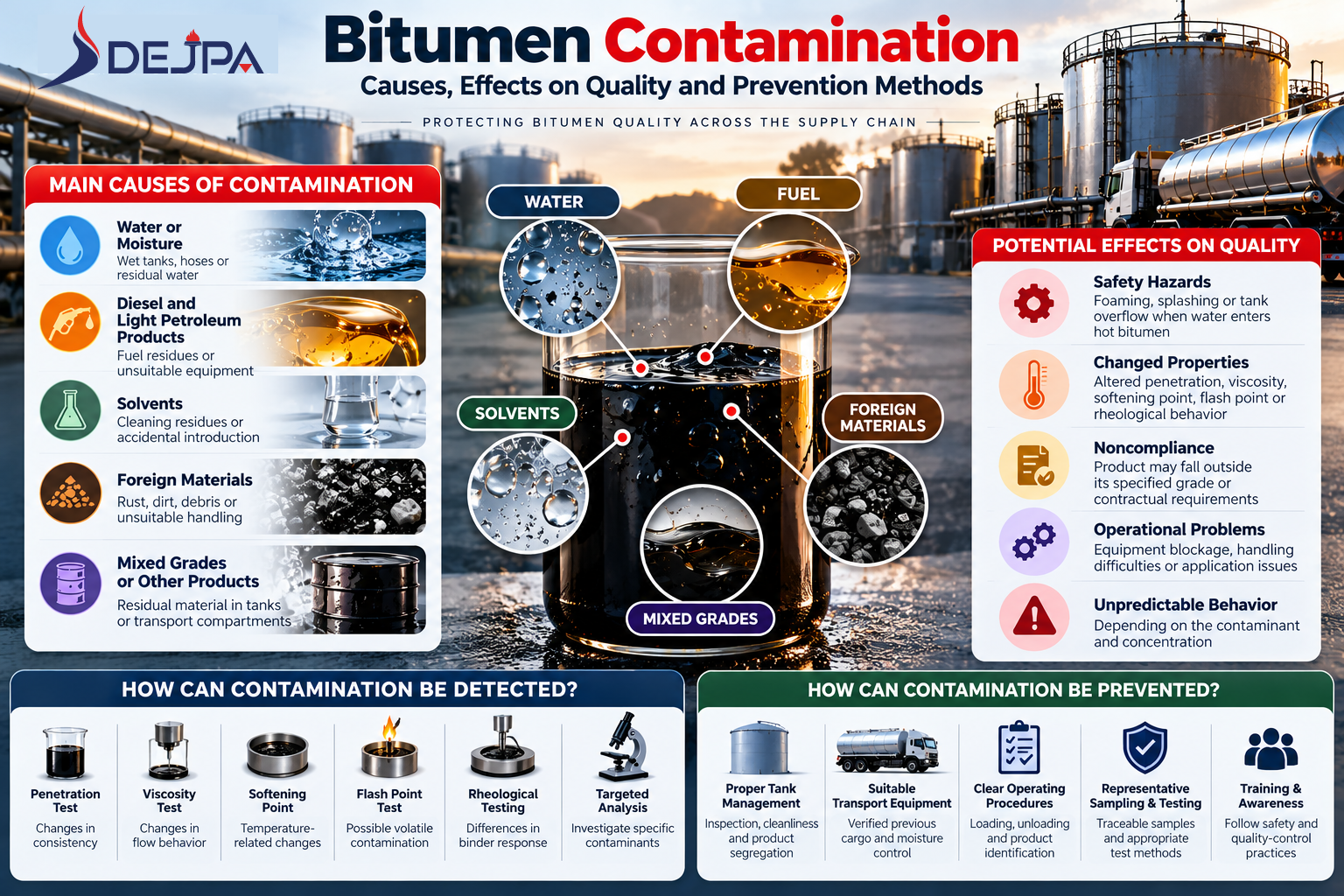
Main contamination pathways and their potential effects on bitumen quality, operational safety and product acceptance.
Why Is Bitumen Contamination a Quality-Control Concern?
Bitumen is manufactured and supplied to meet specific physical, rheological and performance-related requirements. These characteristics are evaluated through relevant laboratory tests and compared with the applicable product standards or contractual specifications.
When unintended materials enter the product, its original composition may change. Depending on the nature and amount of contamination, this can alter one or more measured properties or introduce risks during handling and application.
The consequences are not necessarily the same for every contaminant. Water in hot bitumen presents an immediate safety concern, while contamination by light petroleum products may alter binder properties. Unintended mixing of different grades may result in a product that no longer satisfies its original specification.
Can Bitumen Be Contaminated After Leaving the Refinery?
Yes. Contamination can occur during tank storage, loading, transport, unloading, transfer between systems or subsequent handling. A product that meets specification at dispatch may require further investigation if contamination is suspected later in the supply chain.
What Are the Main Types of Bitumen Contamination?
The most relevant contamination risks depend on the product, storage system and handling operations. For paving-grade bitumen, contamination concerns commonly involve moisture, light petroleum products, foreign substances and unintended mixing with other materials.
|
Contamination Type
|
Possible Source
|
Potential Consequence
|
|
Water or Moisture
|
Wet tanks, hoses, transport equipment or residual water
|
Rapid steam generation, foaming, splashing or tank boil-over during hot handling
|
|
Diesel and Light Petroleum Products
|
Fuel residues, unsuitable transport equipment or unintended mixing
|
Changes in binder consistency, rheological properties and potentially flash point
|
|
Solvents
|
Cleaning residues or accidental introduction
|
Altered binder properties and possible handling or flammability concerns
|
|
Foreign Particles
|
Rust, dirt, debris or unsuitable handling equipment
|
Loss of product cleanliness, equipment problems or specification concerns
|
|
Unintended Mixing of Grades
|
Residual material in tanks, pipelines or transport compartments
|
Changes in measured properties and possible noncompliance with the intended grade
|
|
Incompatible Bituminous Products
|
Residues of emulsions or other products in shared systems
|
Unpredictable handling behavior, property changes or safety hazards depending on the materials involved
|
What Happens When Water Enters Hot Bitumen?
Water contamination is one of the most important safety concerns during the storage and handling of hot bitumen.
When water comes into contact with sufficiently hot bitumen, it can vaporize rapidly. The resulting expansion and steam generation may produce severe foaming, splashing or an uncontrolled overflow from a tank or container.
Water may enter the system through insufficiently dried tanks, wet hoses, residual moisture in transport equipment or inadequate checks before loading and unloading.
The Asphalt Paving Handbook identifies the presence of water or asphalt emulsion residues in receiving tanks as a potentially serious hazard when hot asphalt binder is introduced.
Safety Warning: Water and Hot Bitumen
Never assume that an apparently empty tank, hose or transport compartment is dry. Before introducing hot bitumen, the receiving system must be checked according to site-specific safety procedures. If water contamination is suspected, suspend the affected operation and follow the established safety and emergency procedures. Do not attempt improvised heating or removal methods.
How Does Diesel Contamination Affect Bitumen?
Diesel and other light petroleum products can change the composition and handling characteristics of paving bitumen when introduced unintentionally.
Depending on the contaminant and concentration, the binder may become softer or exhibit reduced viscosity. Penetration values and other measured properties may also change, potentially causing the product to fall outside its specified limits.
Certain light petroleum contaminants may also affect the product's flash point and create additional safety concerns. Therefore, any suspected fuel contamination should be evaluated before the material is heated further, transferred or approved for use.
Can Small Amounts of Diesel Affect Bitumen Quality?
Yes. Even relatively small quantities of light petroleum products can affect bitumen properties. However, the magnitude and significance of the change depend on the contaminant, concentration, original binder characteristics and applicable product specifications. There is no universal safe contamination percentage for all bitumen grades.
Can Solvents Contaminate Bitumen?
Yes. Solvent residues may enter bitumen through improperly cleaned tanks, containers, transfer lines or handling equipment.
Some solvents can alter the consistency and rheological behavior of the binder. Depending on their volatility and chemical characteristics, they may also introduce additional handling, emission or flammability concerns.
For this reason, equipment used to store or transport bitumen should be maintained according to approved cleaning and compatibility procedures. The presence of residual solvents should never be treated as harmless without an appropriate technical evaluation.
Can Mixing Different Bitumen Grades Cause Contamination?
Unintended mixing of different bitumen grades can change the resulting product's measured characteristics, even when both materials individually meet their respective specifications.
For example, if a storage tank contains residual binder from a previous grade, introducing a new grade may produce a mixture whose penetration, viscosity or other properties differ from the intended specification.
This does not mean that all bitumen grades are chemically incompatible or that every mixture is inherently unsafe. Rather, unintended mixing creates a quality-control and traceability problem because the final properties may no longer match the declared product.
Intentional Blending Is Different From Accidental Mixing
Controlled blending may be used in approved production processes with defined formulations, suitable compatibility assessment and laboratory verification. Accidental mixing during storage or transportation is not equivalent to controlled production and requires its own quality assessment.
How Can Foreign Materials Enter Bitumen?
Foreign materials may include rust, dirt, dust, metal fragments or residues from unsuitable equipment and containers.
These materials may enter bitumen through poorly maintained tanks, damaged transport systems, contaminated packaging or inadequate handling procedures.
Depending on the nature and quantity of the foreign material, contamination may affect product cleanliness, interfere with transfer or application equipment, or raise concerns about compliance with the specified quality requirements.
Consequently, equipment condition, container cleanliness and appropriate inspection procedures are important parts of contamination prevention.
Does All Bitumen Quality Deterioration Mean Contamination?
No. Contamination is not the only possible cause of changes in bitumen properties.
Exposure to elevated temperatures and oxygen over time can contribute to oxidative aging, which may increase binder stiffness and change its rheological characteristics without any foreign material being introduced.
Similarly, manufacturing variation, sampling errors, unsuitable testing conditions or the use of an incorrect product grade may create quality discrepancies that require investigation but are not necessarily evidence of contamination.
A reliable quality investigation should therefore examine potential contamination alongside other possible explanations rather than assuming a single cause.
Key Technical Principle
A change in bitumen properties is a reason to investigate, not automatic proof of contamination. Establishing the cause requires representative samples, appropriate test methods, product records and a technically justified comparison with the original specifications.
Where Does Bitumen Contamination Occur in the Supply Chain?
Bitumen contamination can occur at several points between production and final application. The risk is not limited to refinery operations. Storage tanks, loading systems, transport vehicles, pipelines, unloading facilities and receiving tanks can all become sources of unintended material introduction.
The probability and consequences of contamination depend on equipment condition, previous cargoes, cleaning procedures, moisture control, product segregation and operational practices.
A well-documented quality-control system should therefore identify the product at each transfer point and maintain records that help trace potential contamination to the relevant stage.
|
Supply Chain Stage
|
Possible Contamination Source
|
Preventive Control
|
|
Storage Tanks
|
Water accumulation, residues of previous products, corrosion or foreign materials
|
Tank inspection, product identification, maintenance and appropriate cleanliness checks
|
|
Loading Systems
|
Residual material in hoses, pumps, valves and transfer lines
|
Line verification, suitable cleaning procedures and loading checklists
|
|
Transport Vehicles
|
Previous cargo residues, moisture or unsuitable compartments
|
Vehicle inspection, cargo history review and compatibility checks
|
|
Drums and Other Packaging
|
Moisture, dirt, damaged containers or unintended foreign material
|
Packaging inspection, cleanliness verification and appropriate sealing
|
|
Unloading Operations
|
Incorrect connections, contaminated receiving equipment or product mixing
|
Receiving verification, line identification and controlled unloading procedures
|
|
Asphalt Production
|
Incorrect binder selection, unintended grade mixing or contamination in storage and transfer equipment
|
Grade verification, traceable production records and plant quality-control procedures
|
How Can Storage Tanks Become a Source of Bitumen Contamination?
Storage tanks are important control points because bitumen may remain in them for extended periods and can come into contact with residual materials from previous operations.
A tank described as empty may still contain residual binder, deposits or other substances. If a different grade is introduced without verifying the tank condition, the incoming product may mix with these residues and undergo changes in its measured properties.
Water accumulation is a separate and potentially severe concern. Before introducing hot bitumen, the receiving tank must be confirmed suitable for the operation according to established plant safety procedures.
An Empty Tank Is Not Necessarily a Clean Tank
Before changing bitumen grades or returning a tank to service, operators should verify the previous product, remaining material, cleanliness, moisture condition and suitability of the tank. These checks are especially important when the incoming product must satisfy a specific grade or contractual specification.
How Can Bitumen Become Contaminated During Transportation?
Transport equipment may carry contamination risks when its previous contents, cleaning history or physical condition are not adequately controlled.
For bulk bitumen, residues in tanker compartments, hoses and unloading connections may introduce unintended substances. Moisture or incompatible material remaining in a receiving system can create additional hazards when hot bitumen is transferred.
For packaged bitumen, damaged containers, poor sealing, inappropriate storage conditions or foreign material introduced during handling may create product integrity concerns.
Preventive measures should be appropriate to the transport method, packaging specification, product characteristics and contractual responsibilities.
Why Does Previous Cargo History Matter?
Previous cargo records help identify possible residues and compatibility concerns. They do not replace physical inspection or appropriate cleanliness verification, but they provide useful evidence when deciding whether transport equipment is suitable for a new bitumen shipment.
What Are the Possible Signs of Contaminated Bitumen?
Suspected bitumen contamination may become apparent through unexpected handling behavior, visible foreign materials, abnormal laboratory results or discrepancies between delivery records and the product received.
However, these observations are indicators for investigation rather than definitive evidence. Different contaminants can produce different effects, and some types of contamination may not be identifiable through visual inspection alone.
|
Possible Indicator
|
Possible Explanation
|
Recommended Response
|
|
Unexpected Foaming During Hot Handling
|
Possible water or moisture contamination
|
Follow emergency and operating procedures; do not attempt unsafe investigation while equipment is operating
|
|
Unusual Flow Behavior
|
Possible composition change, temperature variation or incorrect grade
|
Review operating conditions and investigate relevant binder properties
|
|
Visible Foreign Particles
|
Possible debris, corrosion products or packaging contamination
|
Isolate the concern and arrange suitable sampling and examination
|
|
Unexpected Penetration or Viscosity Results
|
Possible contamination, grade mixing, aging or testing discrepancy
|
Verify sampling and test methods, then compare results with specifications and reference records
|
|
Unexplained Flash Point Difference
|
Possible volatile contamination or another product-related discrepancy
|
Apply appropriate safety precautions and perform an authorized technical investigation
|
Visual Inspection Has Limitations
A normal-looking bitumen sample is not proof that contamination is absent. Likewise, an unusual appearance is not sufficient to identify a specific contaminant. Representative sampling, laboratory testing and supply-chain records are necessary for a reliable assessment.
Which Laboratory Tests Can Help Detect Bitumen Contamination?
Laboratory testing is an important part of evaluating suspected contamination, but there is no single universal test capable of identifying every contaminant.
The testing program should be selected according to the suspected material, the original bitumen specification, the observed discrepancy and the information available from handling or transport records.
Common binder tests can reveal changes in physical or rheological properties. More specialized analytical methods may be necessary when the objective is to identify or investigate a particular foreign substance.
|
Test or Evaluation
|
What It Can Reveal
|
Important Limitation
|
|
Penetration Test
|
Unexpected changes in binder consistency
|
A changed penetration value does not identify the contaminant or prove contamination
|
|
Viscosity Test
|
Changes in flow behavior at specified testing temperatures
|
Results may also be influenced by binder type, aging and testing conditions
|
|
Softening Point Test
|
Changes in temperature-related consistency for applicable binders
|
Not a direct method for identifying a foreign substance
|
|
Flash Point Test
|
Potential changes in flash-point behavior, including concerns associated with certain volatile contaminants
|
Cannot independently determine the identity or concentration of a contaminant
|
|
Rheological Testing
|
Differences in binder response under specified loading and temperature conditions
|
Changes can have several possible causes and require technical interpretation
|
|
Targeted Analytical Examination
|
May help investigate suspected foreign substances through suitable specialized methods
|
Method selection, sample preparation and interpretation depend on the suspected contaminant
|
For a more detailed introduction to conventional binder tests, read
Dejpa's guide to bitumen quality control tests
.
A Test Result Is Not Automatically a Contamination Diagnosis
An out-of-specification result establishes a quality concern, not necessarily its cause. Contamination, aging, grade differences, sampling problems and laboratory errors may require separate investigation before a defensible conclusion can be reached.
Why Is Representative Sampling Essential When Contamination Is Suspected?
The reliability of a contamination investigation depends heavily on sampling quality. A laboratory can accurately test the material it receives, but the result may still be misleading if the sample does not adequately represent the shipment or the area of concern.
ASTM D140/D140M provides a recognized practice for sampling asphalt materials at points of manufacture, storage and delivery. The sampling objective may be to represent the bulk material or to evaluate variations within it, depending on the investigation.
If contamination is suspected to be unevenly distributed, a single sample from an arbitrary location may be insufficient. An appropriate sampling plan should be established by qualified personnel, taking the equipment, suspected contamination and applicable procedure into account.
Sampling Safety Comes First
Suspected contamination may create additional hazards. Sampling must be carried out only by trained personnel under approved procedures, with suitable equipment and protective measures. Do not open, heat or disturb a potentially hazardous system merely to obtain a sample without an appropriate safety assessment.
How Should Bitumen Samples Be Labeled and Documented?
Sample identification and documentation are essential for traceability. When multiple samples are collected at different supply-chain points, incomplete labeling can make it difficult to determine where a discrepancy first appeared.
The documentation should reflect the actual sampling procedure and the relevant product or shipment information.
Recommended Sample Records
-
Product name, grade and applicable specification
-
Shipment, batch or tank identification
-
Sampling location and relevant sampling point
-
Date and time of sample collection
-
Name or identification of the authorized sampler
-
Sampling method and container identification
-
Relevant observations or suspected abnormalities
-
Sample sealing and custody information where required
-
Requested laboratory tests and investigation reference
For detailed information about representative samples and handling procedures, see
Dejpa's guide to bitumen sampling
.
How Can a Certificate of Analysis Help Investigate Contamination?
A Certificate of Analysis (COA) provides documented test results associated with a specified product, batch or shipment. When contamination is suspected, the original COA can serve as a useful reference for assessing whether subsequent test results differ from the documented properties.
However, the COA alone cannot establish when or where contamination occurred. A reliable comparison requires attention to sample identity, test methods, applicable specifications, measurement variability and the history of storage and transport.
|
Comparison Point
|
What Should Be Verified?
|
|
Product Identity
|
Do the COA and received material refer to the same grade and identifiable shipment or batch?
|
|
Test Methods
|
Were comparable methods, conditions and reporting units used?
|
|
Specification Limits
|
Are the results within the applicable contractual or product limits?
|
|
Sample Representation
|
Do the samples represent the same material condition and relevant stage?
|
|
Handling History
|
Were there transfers, grade changes, prolonged heating or other events between sampling points?
|
To understand how laboratory results should be compared with specifications, read
Dejpa's practical guide to reading a bitumen COA
.
Why Are Retained Samples Important in Bitumen Quality Investigations?
Retained samples can provide valuable reference material when questions arise about a shipment after dispatch, transport or delivery.
Where an appropriate retained sample exists and its identity, storage and integrity can be established, the sample may help investigators compare the material's condition at different points in the supply chain.
For example, an investigation may compare a properly retained dispatch sample with an appropriately collected receiving sample. If the results differ materially, further investigation may be needed to identify possible handling, storage, transport or sampling causes.
Such a comparison does not automatically establish responsibility for the discrepancy. Conclusions should be based on the complete evidence, including shipment records, sample traceability, testing conditions and contractual arrangements.
What Should Happen When a Bitumen Shipment Is Suspected of Contamination?
A shipment suspected of contamination should not be released for normal use solely because the material appears acceptable or because its original documentation shows compliance.
The appropriate response depends on the nature of the suspected contamination, the safety implications and the contractual or project requirements. Where an immediate hazard is possible, safety procedures take priority over routine testing or commercial decisions.
Recommended Quality-Control Response
-
Identify and document the suspected issue, affected shipment and relevant equipment.
-
If a safety hazard is suspected, stop the affected operation and apply site-specific safety procedures.
-
Place the material on quality hold or segregate it where appropriate and safe.
-
Review shipment documents, product specifications, COA and available handling records.
-
Establish a safe, technically appropriate representative sampling plan.
-
Select laboratory tests based on the suspected contamination and observed discrepancies.
-
Evaluate results against relevant specifications, reference samples and investigation findings.
-
Document the authorized decision regarding release, further investigation, reprocessing or rejection.
Passing a Routine Test Does Not Always Resolve a Contamination Concern
A product may satisfy selected routine test limits while a separate suspected contamination issue remains unresolved. The final decision should address both specification compliance and any outstanding safety, compatibility or contractual concerns.
When Should Contaminated Bitumen Be Rejected or Reassessed?
There is no universal contamination level or single laboratory result that determines acceptance for every bitumen grade and application.
Material acceptance should be based on the applicable product specification, contractual requirements, intended use, identified hazards and technical assessment of the particular case.
Rejection may be appropriate when the material fails mandatory specifications, presents unresolved safety concerns or cannot be demonstrated to meet the required conditions of use. Other cases may require additional sampling, testing or authorized technical evaluation before a decision can be made.
Any proposal to reprocess, blend or otherwise manage nonconforming material should follow a technically validated and formally approved procedure. Uncontrolled dilution or mixing should never be assumed to restore product compliance.
Key Technical Principle
Investigating suspected bitumen contamination requires three separate questions: Is the material safe to handle? Does it comply with the required specification? Is there sufficient evidence to explain the discrepancy? A sound decision should address all three.
How Can Bitumen Contamination Be Prevented?
Preventing bitumen contamination requires coordinated quality-control measures throughout storage, loading, transportation, unloading and subsequent handling. The objective is to protect the product from unintended substances while maintaining traceability and compliance with its technical specification.
Effective prevention begins with suitable equipment, verified cleanliness, proper product identification and clear operating procedures. These controls should be supported by inspection records, personnel training and appropriate sampling and testing practices.
Preventive measures should be adapted to the specific binder, packaging or transport system and associated safety requirements. There is no single checklist that replaces a facility's approved operating procedures.
How Can Contamination Be Prevented in Bitumen Storage Tanks?
Storage tank management is an important part of bitumen quality assurance. Tanks should be suitable for the intended product, properly maintained and checked before receiving new material, particularly following a change of grade or previous cargo.
An apparently empty tank may still contain residual bitumen, moisture or other foreign substances. Verification of tank condition and product history can help reduce unintended mixing and contamination risks.
Storage Tank Contamination Prevention Checklist
-
Verify the identity and grade of the product assigned to each tank.
-
Check previous product records before changing the stored material.
-
Confirm tank suitability and cleanliness according to approved procedures.
-
Apply appropriate controls to prevent water and moisture ingress.
-
Inspect relevant valves, pipelines and transfer connections.
-
Maintain heating and temperature-control systems in suitable condition.
-
Prevent unauthorized product transfers or accidental mixing.
-
Maintain appropriate inspection, maintenance and operational records.
For additional information about temperature management and tank conditions, see
Dejpa's guide to bitumen storage and transportation
.
How Can Bitumen Contamination Be Prevented During Loading and Transportation?
Loading and transportation introduce additional quality-control responsibilities because the product moves between equipment, operators and potentially different facilities.
For bulk shipments, vehicle suitability, previous cargo history, transfer-line cleanliness and receiving-system conditions should be reviewed before loading or unloading.
For packaged bitumen, container condition, cleanliness, sealing, handling methods and protection from physical damage are relevant considerations.
Loading and Transport Checklist
-
Confirm the product grade and shipment documentation before loading.
-
Review the suitability and previous cargo history of transport equipment.
-
Verify the receiving compartment or container is suitable for the product.
-
Apply approved procedures to check for moisture and incompatible residues.
-
Identify and verify loading and unloading connections.
-
Inspect packaging condition and sealing where applicable.
-
Maintain shipment identification and traceability records.
-
Report and document any abnormal condition before proceeding.
What Should Buyers Check Before Accepting a Bitumen Shipment?
A receiving inspection helps buyers identify documentation discrepancies, packaging problems or indications that additional quality verification may be necessary.
Acceptance requirements should be established in the purchase agreement and applicable technical specification. The inspection process should also reflect the actual delivery method and any agreed independent testing or sampling arrangements.
|
Inspection Item
|
What to Check
|
Why It Matters
|
|
Product Identification
|
Grade, quantity, shipment or batch identification
|
Helps confirm that the delivered material matches the purchase requirements
|
|
Quality Documentation
|
COA, applicable technical specification and agreed inspection documents
|
Provides a documented reference for technical compliance
|
|
Packaging or Transport Condition
|
Visible damage, sealing, cleanliness and appropriate equipment condition
|
May reveal handling or product-integrity concerns
|
|
Receiving System
|
Tank identity, product compatibility and suitability for unloading
|
Helps prevent contamination or unintended grade mixing during receipt
|
|
Sampling Arrangements
|
Agreed sampling points, methods, responsibilities and retained samples
|
Supports traceable and reliable investigation if discrepancies arise
|
|
Observed Discrepancies
|
Unusual handling behavior, documentation mismatch or suspected contamination
|
Helps determine whether the shipment needs a quality hold or further investigation
|
What Are the Most Common Mistakes in Bitumen Contamination Control?
Contamination risks are often increased by incomplete equipment checks, inadequate product segregation or assumptions that routine quality documents can replace proper handling controls.
-
Assuming an empty tank or tanker compartment is automatically clean and dry
-
Using shared equipment without verifying previous cargo residues
-
Ignoring moisture risks before introducing hot bitumen
-
Mixing different grades without approved procedures or quality verification
-
Using inappropriate cleaning materials or leaving cleaning residues in the equipment
-
Relying only on visual inspection to evaluate possible contamination
-
Interpreting an abnormal laboratory result as definitive proof of a particular contaminant
-
Collecting samples without an appropriate representative sampling plan
-
Failing to maintain adequate shipment, sample and transfer records
-
Releasing a suspected shipment before unresolved safety or quality concerns have been evaluated
Frequently Asked Questions About Bitumen Contamination
What causes bitumen contamination?
Bitumen contamination can be caused by unintended entry of water, fuels, solvents, foreign particles, previous cargo residues or other bituminous products during storage, loading, transport, unloading and handling.
What happens if water enters hot bitumen?
Water can rapidly vaporize when exposed to sufficiently hot bitumen. The resulting steam generation may cause violent foaming, splashing or uncontrolled overflow. Suspected water contamination must be managed according to approved safety procedures.
Can diesel contamination change bitumen properties?
Yes. Depending on the contaminant and concentration, diesel or other light petroleum products can reduce binder viscosity, alter consistency and affect other properties, potentially including flash point. Testing is necessary to evaluate the actual consequences.
Can solvents affect bitumen quality?
Yes. Unintended solvent contamination may alter binder properties and introduce volatility or flammability concerns. The effects depend on the solvent, concentration and original binder characteristics.
Can different bitumen grades be mixed?
Controlled blending may be possible under approved production procedures, but accidental mixing can change the final binder properties and create specification or traceability concerns. Different grades should not be mixed without appropriate technical evaluation and authorization.
How can contaminated bitumen be identified?
Identification requires a combination of handling records, representative sampling, appropriate laboratory tests and comparison with the relevant specifications. Visual appearance or a single abnormal test result is not sufficient to identify every type of contamination.
Which laboratory tests detect bitumen contamination?
Penetration, viscosity, softening point, flash point and rheological tests may reveal changes associated with certain contamination events. Specialized analytical methods may be needed to investigate specific foreign substances. No single test detects all contaminants.
Does a passing COA guarantee that bitumen is free from contamination?
No. A COA reports specified test results for the identified material and sampling stage. It cannot guarantee that contamination will not occur during subsequent storage, transport or handling, and routine tests may not identify every possible contaminant.
Why are retained bitumen samples important?
Properly collected and preserved retained samples can provide useful reference material when investigating differences between dispatch and receiving test results. Their value depends on traceability, sample integrity and appropriate comparison methods.
Can contaminated bitumen be used if it still passes some tests?
Passing selected tests does not automatically resolve all contamination concerns. The material must be evaluated against applicable specifications, intended-use requirements, safety considerations and contractual conditions before an authorized release decision is made.
Can contaminated bitumen be corrected by adding clean bitumen?
Uncontrolled dilution should not be assumed to restore quality or safety. Any reprocessing or blending proposal requires a technically validated, formally approved procedure and verification of the resulting product against the required specification.
How can buyers reduce bitumen contamination risks?
Buyers can reduce risks through clear specifications, suitable transport and receiving equipment, agreed inspection procedures, product traceability, proper sampling arrangements and timely investigation of suspected discrepancies.
Final Considerations: Protecting Bitumen Quality Throughout the Supply Chain
Bitumen contamination is an important quality-control and operational safety concern because it can affect product properties, handling conditions and compliance with technical specifications.
Water contamination may create serious hazards during hot handling, while fuels, solvents, foreign materials and unintended mixing of grades can introduce different quality or compatibility risks. The consequences depend on the contaminant, its concentration, the binder and the conditions of use.
Effective prevention requires suitable storage and transportation equipment, verified cleanliness, proper product segregation, reliable operating procedures and documented quality-control practices.
When contamination is suspected, the investigation should distinguish between immediate safety concerns, specification compliance and the underlying cause of the discrepancy. Representative sampling, suitable tests, retained samples and traceable records help support defensible decisions.
Ultimately, maintaining bitumen quality requires coordinated controls from production and dispatch to receiving, storage and final application.
In One Sentence
Preventing bitumen contamination means protecting the binder from unintended materials, maintaining its specified properties and verifying product integrity through appropriate handling, traceability and quality-control procedures.
Looking for Bitumen with Verified Technical Specifications?
Contact Dejpa with your required bitumen grade, technical specification, quantity, packaging and intended application. Our team can review product availability and relevant quality documentation for your inquiry. Standard supply terms are EXW factory gate, without export customs declaration or seller-arranged international transportation.
Request Bitumen Information & Quotation
sales@dejpa.com