Proper bitumen sampling is the foundation of reliable laboratory results. Even when tests are performed with calibrated equipment and recognized standards, a sample that does not accurately represent the storage tank, tanker, transfer line, or shipment cannot provide a dependable basis for product acceptance or rejection.
In bitumen production, purchasing, loading, transportation, and delivery, quality cannot be confirmed by the grade name or Certificate of Analysis alone. The submitted sample must be selected, collected, handled, labeled, sealed, and traced correctly to the relevant batch, tank, tanker, and sampling time.
This guide explains what a representative bitumen sample is, how sampling from storage tanks, tankers, and transfer lines should be planned, what type of sample container should be used, how retained samples should be managed, and which common errors can make laboratory results unrepresentative of the actual product.
Reference standard: ASTM D140/D140M addresses the sampling of asphalt materials at points of production, storage, and delivery. The final sampling procedure should be aligned with the product type, sampling location, contract requirements, and intended laboratory tests.
Why Is Correct Bitumen Sampling Important?
A laboratory can only evaluate the sample it receives. If the sample is taken from a non-representative part of a tank, transferred into a contaminated container, mixed with another sample, or inadequately identified, even accurate testing cannot describe the actual quality of the shipment.
- An off-specification product may be accepted incorrectly.
- A compliant product may be rejected incorrectly.
- Results from the supplier, buyer, and independent laboratory may conflict.
- The test result may no longer be traceable to the actual batch or tanker.
- Contractual disputes may arise at delivery.
- Additional sampling and retesting may become necessary.
Key Principle
The quality of a test result cannot be better than the quality of the sample. The sample must represent the same product, batch, and shipment for which the technical decision will be made.
What Is a Representative Bitumen Sample?
A representative sample is one that reflects, as closely as practical, the actual properties of the product volume or flow being evaluated. It should not represent only the surface layer, tank bottom, localized sediment, the first material discharged from a line, or residue from a previous shipment unless the purpose is specifically to investigate that location.
| Question |
Why It Matters |
| Where was the sample collected? |
The location should be linked to a specific tank, tanker, transfer line, or delivery point. |
| When was it collected? |
The sampling time should correspond with production, circulation, loading, or delivery. |
| What was the product condition? |
Temperature, uniformity, circulation, and storage condition may affect representativeness. |
| Which batch or shipment does it represent? |
The batch, tank, tanker, or loading-document reference should appear on the label and sampling record. |
What Should Be Defined Before Sampling?
- Exact product name and bitumen grade
- Reference specification or standard
- Batch, tank, tanker, or shipment number
- Purpose of sampling: production control, pre-loading approval, delivery inspection, or dispute investigation
- Sampling location and method
- Required laboratory tests
- Number of primary and retained samples
- Container type and transport conditions
- Persons responsible for witnessing, sealing, and approval
For critical orders, the sampling procedure and retained-sample arrangement should be defined before loading in the contract, purchase order, inspection plan, or testing protocol.
Sampling Bitumen from a Storage Tank
Large storage tanks may not have completely uniform temperature and composition at every point. Sediment, contamination, residue from a previous grade, cold zones, or insufficient circulation may create differences between tank sections.
- Record the tank number and approximate capacity.
- Confirm the product type and grade in the tank.
- Review the previous product stored in the tank.
- Record storage duration and heating conditions.
- Confirm whether the product has been circulated or homogenized.
- Identify the sampling valve or access point.
- Consider the possibility of water, sediment, or foreign material.
When a sampling valve is used, stagnant material in the valve or short branch line should be removed according to an approved and safe procedure before collecting the sample. The flushing procedure and volume should follow site instructions and the applicable standard.
Safety note: Hot bitumen can cause severe burns, and water contacting hot bitumen may cause violent foaming and splashing. Sampling should be performed by trained personnel using suitable personal protective equipment.
Is a Surface Sample Enough?
No. A surface sample does not always represent the entire tank. The upper layer may be more exposed to air, cooling, or external contamination, while the tank bottom may contain more sediment, water, or heavy residue.
The choice of surface, middle, lower, outlet, or composite sampling should depend on the purpose, tank design, and agreed standard or contract. During quality disputes, the exact sampling depth or location should be recorded.
Sampling Bitumen from a Tanker
Tanker sampling may be performed before dispatch, at delivery, or before unloading. In every case, the sample must be linked to the correct tanker, compartment, and shipment.
- Record the tanker number and vehicle registration.
- Record all relevant seal numbers and seal condition.
- Review previous cargo history and tanker cleanliness.
- Record product temperature at the time of sampling.
- Identify the exact sampling point.
- Match the sample with the delivery note, bill of lading, batch, and loading tank.
- Prepare and seal a retained sample when required.
Sampling from a Transfer Line or During Loading
Sampling from a flowing transfer line may provide useful information about the material actually being loaded, provided that the flow is stable and the sample is not collected only at the very beginning or end of transfer.
- Identify the exact sampling point in the transfer system.
- Record sampling time relative to the start and end of loading.
- Confirm stable flow and product temperature.
- Use a clean sampling valve and container.
- Define the composite-sample method in advance when required.
- Link the sample to the volume and loading interval represented.
When Is the Best Time to Sample Bitumen?
| Stage |
Purpose |
| After production or blending |
Confirm the production batch before transfer or loading. |
| From the loading tank |
Evaluate the product intended for a specific order. |
| During loading |
Link the sample to the actual product flow entering the tanker. |
| After loading |
Prepare the final shipment sample and retained sample. |
| At delivery |
Document product condition at destination before acceptance or unloading. |
What Type of Container Should Be Used?
- The container should be clean and completely dry.
- It should withstand the temperature of the sample.
- It should not react with bitumen or its components.
- It should have a secure and reliable closure.
- It should not leak or open during transport.
- It should be suitable for labeling and sealing.
- It should not previously have contained fuel, solvent, oil, water, or unknown material.
The container should also be compatible with the intended test method. For some tests, even minor contamination or loss of volatile components may be significant. The laboratory should confirm the container type, sample quantity, and storage requirements before sampling.
How Much Sample Is Required?
The sample quantity should be sufficient for all planned tests, repeat testing if needed, and retained-sample storage. A single quantity is not suitable for every product and project.
- Product type and bitumen grade
- Number and type of tests
- Number of laboratories involved
- Need for repeat or confirmation testing
- Requirement for supplier, buyer, and retained samples
- Method used to divide the sample without creating non-uniform portions
How Can Sample Contamination Be Prevented?
- Use clean and dry containers and sampling tools.
- Keep the container closed until the moment of use.
- Do not touch the inside of the container or lid with contaminated gloves or surfaces.
- Do not leave the sample open near water, fuel, solvent, or dust.
- Do not use contaminated shared tools for different grades.
- Close the container securely immediately after sampling.
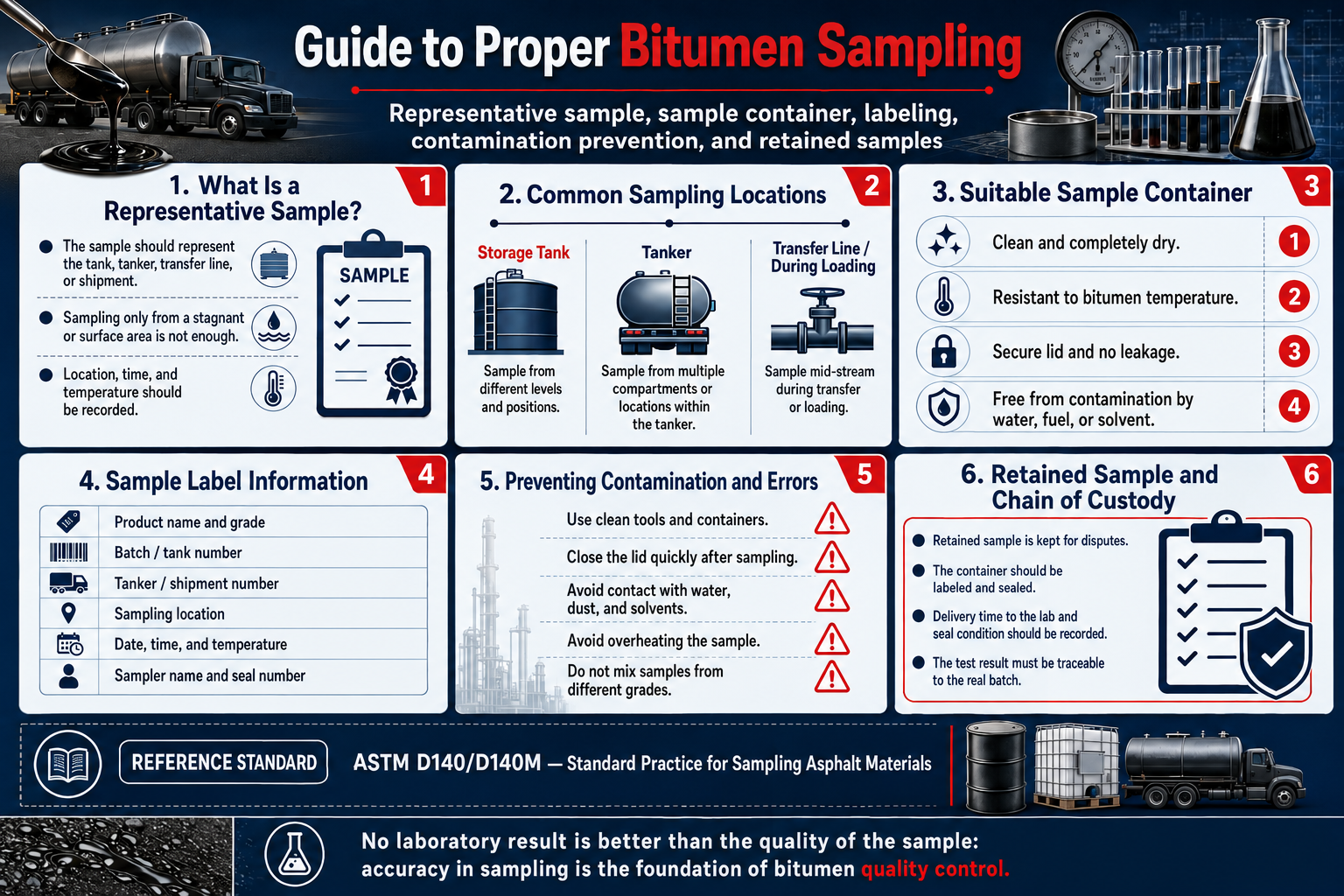
This infographic summarizes the main stages of correct bitumen sampling: defining the purpose and sampling point, collecting a representative sample, using a clean and dry container, preventing contamination, recording temperature and batch details, labeling and sealing the container, retaining a reference sample, and maintaining a traceable chain of custody.
What Information Should Appear on the Sample Label?
| Information |
Example or Purpose |
| Product name and grade |
For example, Penetration Bitumen 60/70 |
| Batch or tank number |
Identifier matching the COA and loading record |
| Tanker or shipment number |
Vehicle, compartment, or bill-of-lading reference |
| Sampling location |
Tank, outlet valve, transfer line, tanker, or delivery point |
| Date, time, and temperature |
Conditions at the time of sampling |
| Sampler name and seal number |
Supports traceability and chain-of-custody control |
What Is a Retained Bitumen Sample?
A retained sample is a separately sealed and labeled portion of the shipment sample kept for future confirmation testing, dispute resolution, or complaint investigation.
- It should come from the same agreed sampling process as the primary sample.
- It should carry an identifier linked to the primary sample.
- It should be closed with a traceable seal.
- It should be stored to prevent contamination, leakage, or mixing.
- Its retention period should be defined by contract, quality procedure, or acceptance period.
What Is Chain of Custody?
Chain of custody records who handled the sample from collection to laboratory receipt and documents the sample condition throughout this process.
- Sample identification number
- Date, time, and location of sampling
- Name and signature of the sampler
- Container and seal number
- Requested tests
- Date and time of transfer to each person or laboratory
- Seal condition at receipt
- Any leakage, damage, or discrepancy
Connection with the COA: Test results are valuable only when they are linked to the actual sample and batch. To review batch numbers, test methods, units, Specification and Result columns, and possible discrepancies, read
How to Read a Bitumen Certificate of Analysis (COA).
Should a Bitumen Sample Be Heated Before Testing?
At ambient temperature, bitumen normally requires heating for division, pouring, or test preparation. However, excessive or prolonged heating may change the sample properties.
- Use the lowest practical temperature required for homogenization and pouring.
- Avoid direct heating and localized hot spots.
- Limit the time the sample remains at elevated temperature.
- Mix gently without introducing unnecessary air.
- Follow the preparation requirements of the relevant test method.
- For polymer modified bitumen, follow product-specific instructions.
Related grade guide: For specifications, applications, and quality considerations of one of the most widely used paving grades, read
What Is Bitumen 60/70?
Sampling Polymer Modified Bitumen
Polymer modified bitumen may be more sensitive to prolonged static storage, phase separation, temperature variation, and sample preparation. Representative sampling and proper homogenization are therefore especially important.
- Check whether the tank has been circulated or agitated before sampling.
- Collect the sample from a point representing a uniform product.
- Record sampling time and temperature.
- Avoid prolonged reheating in the laboratory.
- Follow the producer’s storage and preparation instructions.
For further information, read What Is Polymer Modified Bitumen?
Common Bitumen Sampling Errors
Sampling from a stagnant branch: The sample may represent residue in the valve or previous transfer line.
Using a wet or contaminated container: Water, fuel, solvent, or oil may alter the test results.
Missing batch or tanker number: The link between the sample and actual shipment is lost.
Sampling only from the surface: The sample may not represent the full tank volume.
Overheating the sample: Oxidation and hardening may change laboratory results.
Bitumen Sampling Checklist
| Control Point |
Expected Condition |
| Sampling purpose | Defined and recorded before sampling. |
| Product identity | Product, grade, batch, tank, and shipment match the documents. |
| Sampling location | Identified, safe, and suitable for collecting a representative sample. |
| Sample container | Clean, dry, temperature-resistant, and compatible with the product. |
| Label and seal | Complete, readable, secure, and traceable. |
| Retained sample | Prepared and stored under controlled conditions. |
| Laboratory delivery | Chain of custody, transfer time, and container condition are recorded. |
For technical and product information: Send the required grade, reference standard, order volume, packaging type, destination, and documentation requirements through the
Dejpa Contact Page. Product families can also be reviewed on the
Dejpa Products Page.
Conclusion
Bitumen sampling is not a routine administrative step. It is part of quality control, shipment traceability, and technical dispute management. The sample should represent the actual product, and its connection with the grade, batch, tank, tanker, sampling location, and sampling time should be clearly documented.
Using a clean and dry container, preventing contamination, choosing the correct sampling point and time, recording product temperature, applying complete labels and seals, and retaining a reference sample are among the most important controls.
For sensitive orders, the sampling procedure should be agreed among the supplier, buyer, inspector, and laboratory before loading. A technical decision is more reliable when the sampling record, laboratory testing, COA, and shipment documents all refer to the same batch and traceable chain of custody.
Frequently Asked Questions
What is a representative bitumen sample?
It is a sample that reflects, as closely as practical, the actual properties of the tank, tanker, transfer flow, or shipment being evaluated rather than only one unusual or contaminated section.
Is a surface sample sufficient?
No. A surface sample may not represent the entire tank. The sampling location should be selected according to the purpose, tank condition, and applicable standard or contract.
What type of container should be used?
The container should be clean, dry, temperature-resistant, compatible with bitumen, securely closed, and suitable for labeling and sealing.
What is a retained bitumen sample?
It is a separately labeled and sealed portion of the shipment sample kept for confirmation testing, complaints, or dispute resolution.
Can a bitumen sample be reheated several times?
Repeated or prolonged heating may change sample properties. The sample should be heated only at the lowest practical temperature and for the shortest time required by the test method.
What does ASTM D140/D140M cover?
It covers sampling practices for asphalt materials at production, storage, and delivery points and is an important reference for preparing a sampling procedure.
References