Technical Guide to Viscosity-Graded Paving Bitumen
What Is AC Bitumen? AC-10, AC-20, AC-30 and AC-40 Grades, Applications and Differences from VG and Penetration Grades
AC Bitumen, also called viscosity-graded asphalt cement, is classified mainly according to the absolute viscosity of the original binder at 60°C. Grades such as AC-10, AC-20, AC-30 and AC-40 represent progressively higher viscosity levels under the specified test conditions. This guide explains how the AC grading system works, how the main grades differ, where they may be used, how AC compares with VG, penetration-grade and PG Bitumen, which tests should be reviewed and what buyers should specify before ordering.
Quick Answer
AC Bitumen is a viscosity-graded paving binder. In the traditional AC system, the grade designation is associated with the binder’s nominal absolute viscosity at 60°C. A higher AC number generally indicates a more viscous and relatively harder binder at the grading temperature. However, the correct grade must be selected from the project specification, climate, pavement temperature, traffic loading, asphalt-mix design and construction conditions rather than from the grade number alone.
| Topic |
Summary |
| Full name |
Viscosity-Graded Asphalt Cement |
| Common grades |
AC-10, AC-20, AC-30 and AC-40; some specifications also include other AC grades |
| Primary grading basis |
Absolute viscosity of the original binder at 60°C, with additional specification limits |
| Typical applications |
Hot mix asphalt, urban roads, highways, heavy-traffic pavements and selected industrial routes |
| Selection basis |
Project standard, climate, pavement temperature, traffic, loading, mix design and construction method |
What Is AC Bitumen?
AC Bitumen is a paving-grade asphalt binder classified through viscosity testing. The letters “AC” traditionally refer to asphalt cement. Unlike penetration grading, which primarily uses the depth of penetration of a standard needle at defined conditions, the AC system focuses on the binder’s resistance to flow at a specified temperature.
In the traditional viscosity-grading approach, absolute viscosity is measured at 60°C, while kinematic viscosity at 135°C is commonly reviewed because it provides useful information about pumping, mixing, aggregate coating and workability at elevated production temperatures.
The AC designation should not be treated as a complete performance description. The applicable standard may also specify penetration, flash point, ductility, solubility, aging and residue properties. Acceptance should therefore be based on the full specification and batch-specific Certificate of Analysis.
Technical note: AC is also used as an abbreviation for asphalt concrete. In this article, AC-10, AC-20, AC-30 and AC-40 refer specifically to viscosity grades of asphalt cement.
How Does the AC Grading System Work?
The grade number indicates the general viscosity level of the binder at 60°C. Under the same test conditions, a higher AC number represents greater resistance to flow. AC-10 is therefore less viscous than AC-20, while AC-40 is more viscous than AC-30.
Conventionally, the designation is associated with nominal absolute viscosity in poise. For example, AC-10 is centred around approximately 1,000 poise and AC-20 around approximately 2,000 poise. Exact allowable ranges, additional requirements and test methods must be taken from the named standard or contract specification.
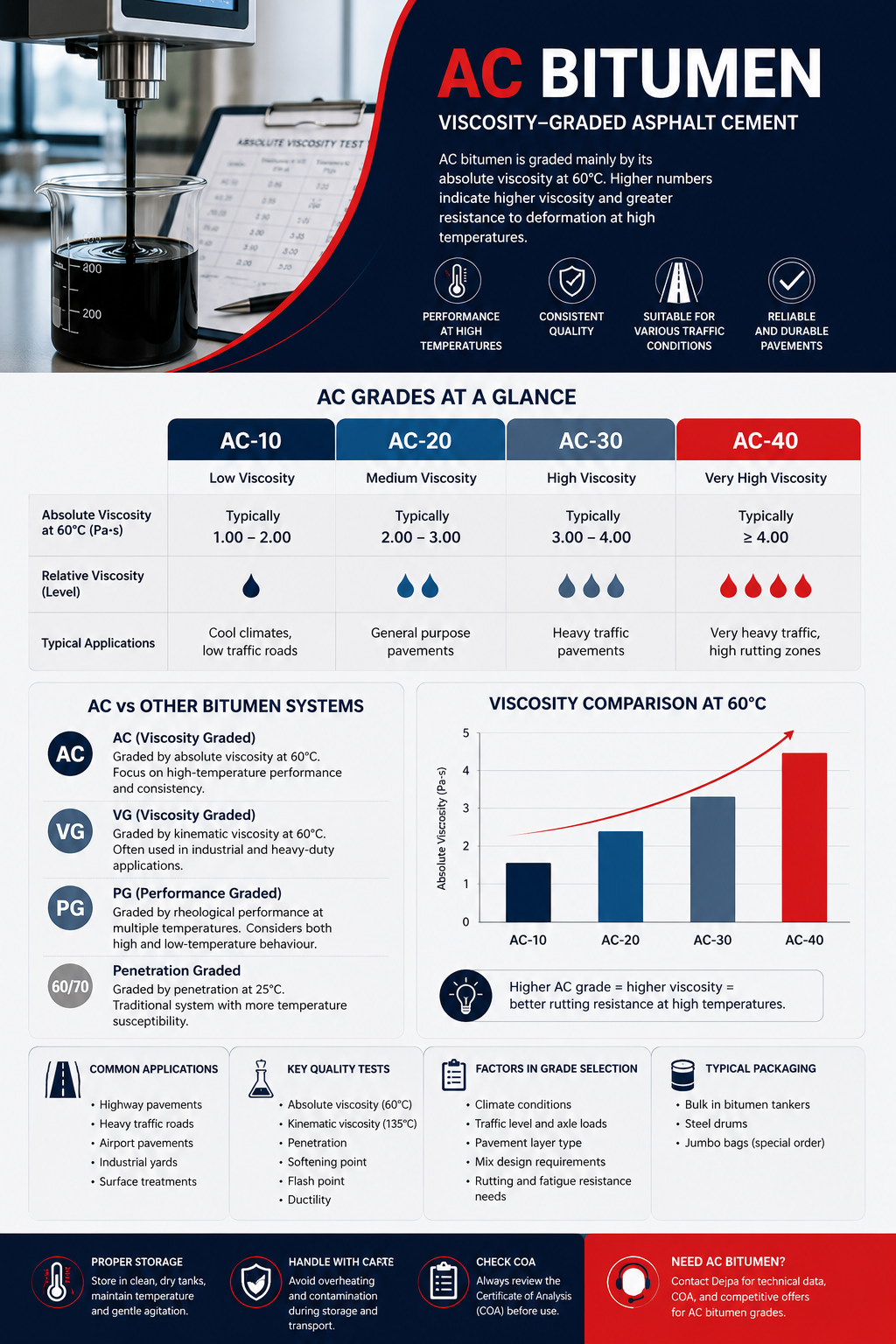
Comparison of AC-10, AC-20, AC-30 and AC-40 by relative viscosity, typical paving applications, selection factors and relationship with other binder-classification systems.
AC-10, AC-20, AC-30 and AC-40 at a Glance
| Grade |
Relative viscosity |
General application tendency |
Selection note |
| AC-10 |
Lowest of these four grades |
Selected cooler conditions or projects requiring a less viscous binder |
High-temperature suitability must still be verified |
| AC-20 |
Intermediate |
General hot mix asphalt, urban roads and highways, subject to specification |
Common use does not replace project evaluation |
| AC-30 |
Higher than AC-20 |
Warmer conditions, heavier traffic and greater high-temperature stiffness |
Workability and low-temperature behaviour must be checked |
| AC-40 |
Highest of these four grades |
Selected high-temperature, heavy-load or deformation-sensitive applications |
A harder binder is not automatically better |
AC Bitumen vs VG Bitumen
AC and VG are both viscosity-based systems, but their naming conventions, specification structures and regional use are not identical. Direct equivalence should not be assumed from the grade number alone.
For a detailed explanation, read What Is VG Bitumen?
AC Bitumen vs Penetration-Grade Bitumen
AC grades are based mainly on viscosity, while grades such as 40/60, 60/70 and 80/100 are named according to penetration range. There is no universal one-to-one conversion; the complete specification and actual laboratory results must be compared.
For one of the most widely used penetration grades, read What Is Bitumen 60/70?
AC Bitumen vs PG Bitumen
AC grading uses viscosity as the primary classification property, while PG grading evaluates binder performance over defined high and low pavement-temperature ranges. An AC grade should not be assigned a PG grade through a simple conversion chart.
Read What Is PG Bitumen? for a detailed explanation of performance grading.
Common Applications
- Hot mix asphalt for urban roads and highways.
- Selected heavy-traffic pavements and industrial routes.
- Warm-climate or deformation-sensitive applications using higher-viscosity grades.
- Selected cooler-climate or lower-demand applications using lower-viscosity grades.
- Designed blending and recycled-asphalt systems where permitted by specification.
Important Quality-Control Tests
- Absolute viscosity at 60°C.
- Kinematic viscosity at 135°C.
- Penetration at 25°C.
- Flash point and solubility.
- Ductility where required.
- Thin-film or rolling thin-film oven aging.
- Viscosity or other properties of the aged residue.
For a broader explanation of binder testing, read What Are the Main Bitumen Quality Control Tests?
How Should the Right AC Grade Be Selected?
- Exact project or employer specification.
- Maximum and minimum pavement temperatures.
- Traffic volume, axle load, speed and stopping frequency.
- Asphalt-mixture type, aggregate structure and pavement layer.
- Plant storage, pumping, mixing and compaction capability.
- Laboratory approval and trial-mixture results.
A higher AC number does not automatically indicate a better product. Excessive viscosity may reduce workability, complicate compaction and increase cracking risk under unsuitable conditions.
Storage, Sampling and COA Review
AC Bitumen should be stored at a temperature that maintains pumpability without unnecessary aging. Tanks and lines should be clean and dry, water entry and grade mixing should be prevented, and prolonged high-temperature storage should be avoided.
Read How Should Bitumen Be Stored and Transported?
The sample must represent the actual batch, tank, tanker or shipment. For representative sampling and retained samples, read How Is Bitumen Sampled?
The COA should state the grade, batch, specification, test methods, units, limits and actual results. Read How to Read a Bitumen Certificate of Analysis.
Factors Affecting AC Bitumen Price
- Required AC grade and supply availability.
- Reference standard and additional test limits.
- Order volume and delivery schedule.
- Testing, inspection and documentation requirements.
- Bulk, drum or another approved delivery format.
- Destination and commercial delivery terms.
For general pricing factors, read the Iran Bitumen Price Guide.
Information Required for a Quotation
| Required information |
Description |
| Exact grade |
AC-10, AC-20, AC-30, AC-40 or another specified grade |
| Reference standard |
Named specification, revision and required test methods |
| Quantity |
Required volume in metric tons and delivery schedule |
| Delivery format |
Bulk, drums or another approved format |
| Destination |
Country, port, city or agreed delivery point |
| Documents |
COA, TDS, inspection report or additional certificates |
Conclusion
AC Bitumen is a traditional viscosity-grading system for asphalt cement. AC-10, AC-20, AC-30 and AC-40 represent increasing viscosity levels, with higher numbers generally indicating a more viscous and relatively harder binder at 60°C.
No grade should be selected solely from a simple climate label or conversion from VG, PG or penetration grade. Correct selection requires the exact standard, laboratory results, traffic, climate, mixture design and construction capability to be reviewed together.
Request AC Bitumen Specifications and Price
To request a technical review or quotation, provide the required AC grade, reference standard, order quantity, delivery format, destination and requested quality documents. Production and supply conditions should be confirmed after technical evaluation.
Contact Dejpa and Submit Your Request
Frequently Asked Questions
What is AC Bitumen?
AC Bitumen is viscosity-graded asphalt cement classified mainly according to absolute viscosity at 60°C.
What do AC-10 and AC-20 mean?
They indicate different viscosity levels. AC-20 is more viscous than AC-10 under the specified grading conditions.
Is AC-20 equivalent to Bitumen 60/70?
Not automatically. AC-20 is viscosity graded, while 60/70 is penetration graded. The full specification and test results must be compared.
Can an AC grade be converted directly to a PG grade?
No reliable universal conversion exists. PG classification requires testing under the applicable performance-grade specification.
Related Articles
References
- AASHTO M 226 — Viscosity-Graded Asphalt Binder.
- ASTM D2171/D2171M — Viscosity of Asphalts by Vacuum Capillary Viscometer.
- ASTM D2170/D2170M — Kinematic Viscosity of Asphalts.
- ASTM D5/D5M — Penetration of Bituminous Materials.
- ASTM D92 — Flash and Fire Points by Cleveland Open Cup.
- ASTM D2042 — Solubility of Asphalt Materials.
- ASTM D2872 — Rolling Thin-Film Oven Test.
- FHWA — Principles of Construction of Quality Hot-Mix Asphalt Pavements.