Technical Guide to Modified Bitumen
What Is CRMB? Applications, Benefits, Production Methods and Difference from Polymer Modified Bitumen
Crumb Rubber Modified Bitumen, commonly known as CRMB, is a modified asphalt binder produced by combining base bitumen with processed crumb rubber, generally obtained from end-of-life tyres. When the raw materials, formulation, reaction time, temperature and production equipment are properly controlled, CRMB can improve selected engineering properties of the binder. This guide explains what CRMB is, how wet and dry processes differ, where it is used, what benefits and limitations should be considered, how it differs from polymer modified bitumen, which tests are important and what information buyers should provide before ordering.
Quick Answer
CRMB stands for Crumb Rubber Modified Bitumen. In the wet process, crumb rubber is blended and reacted with hot base bitumen before the binder enters the asphalt mixture. Final properties depend on the base bitumen, rubber source and particle size, dosage, blending temperature, reaction time, agitation and production system. CRMB is not the same as polymer modified bitumen, and the two products should not be substituted without technical evaluation.
| Topic | Summary |
|---|
| Full name | Crumb Rubber Modified Bitumen |
| Main modifier | Processed crumb rubber from tyres, according to the project specification |
| Main binder-production route | Blending and reacting crumb rubber with base bitumen in the wet process |
| Typical applications | Asphalt mixtures, overlays, heavy-traffic pavements and selected surface treatments |
| Selection basis | Project specification, climate, traffic, asphalt-mix design, binder tests and mixture performance |
What Is CRMB?
CRMB is a modified binder in which processed rubber particles, usually produced from recycled tyres, are used to alter the properties of base bitumen. Under controlled conditions, the rubber absorbs part of the lighter fractions of the bitumen and swells. This interaction can increase viscosity and change the viscoelastic behaviour of the binder.
CRMB performance does not depend only on the presence of rubber. Tyre source, grinding method, particle size, rubber dosage, base-bitumen properties, material compatibility, mixing intensity, process temperature and reaction time can all influence the final product.
Therefore, the description “rubberized bitumen” alone is not sufficient for purchasing or approval. The buyer should also define the product specification, production route, required tests, intended application and asphalt-mixture design requirements.
Important: The terms CRMB, asphalt rubber and rubberized asphalt are not defined in exactly the same way in every standard or market. The contract should rely on the project definition, rubber content and properties, production method and specified test limits.
Where Does the Crumb Rubber Come From?
Crumb rubber is generally produced by processing end-of-life tyres. Steel and textile components are removed to the required level, and the rubber is reduced to particles of a specified size. Gradation, cleanliness, moisture, residual fibre or metal and material consistency should comply with the project requirements.
A finer or coarser particle is not automatically better. Particle size should match the production technology, available reaction time, blending equipment and target binder properties. Irregular, contaminated or out-of-specification rubber may contribute to unstable viscosity, poor uniformity or equipment blockage.
What Is the Difference Between the Wet and Dry Processes?
Recycled tyre rubber can be introduced into asphalt production through two broad approaches. The key difference is where and when the rubber is added.
Wet process
In the wet process, crumb rubber is blended with base bitumen before the binder is introduced into the asphalt mixture. The blend is held under controlled temperature and agitation for a defined period to produce the modified binder. In this route, CRMB is evaluated as a binder.
Dry process
In the dry process, rubber is introduced directly into the asphalt mixture, often with the aggregate, and acts more as a mixture component. Quality control should therefore place greater emphasis on asphalt-mixture design and performance testing.
Conclusion: A wet-process CRMB binder and a dry-process rubberized asphalt mixture should not be treated as equivalent merely because both contain rubber. Their design methods, testing programmes and acceptance criteria are different.
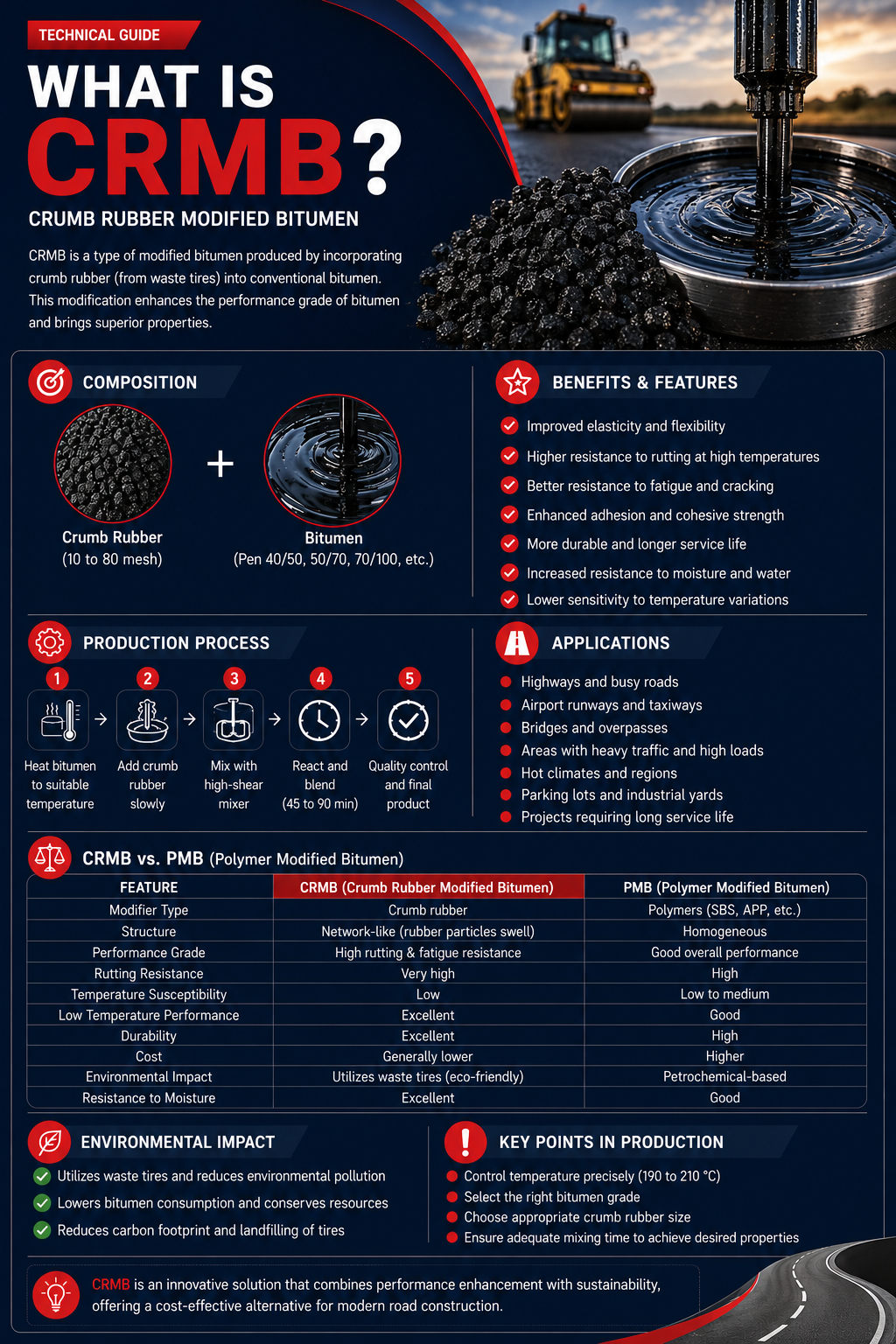 CRMB infographic covering the combination of base bitumen and recycled crumb rubber, the wet-process production sequence, key benefits and applications, quality factors and the main differences between CRMB and polymer modified bitumen. Click the image to view the full-size version.
How Is CRMB Produced?
The exact process depends on the technology and target specification. In the wet process, the general production sequence commonly includes the following steps:
- Select a base bitumen compatible with the required grade and performance.
- Check crumb-rubber gradation, cleanliness, moisture and consistency.
- Heat the base bitumen within the process range defined by the formulation.
- Add crumb rubber gradually while maintaining uniform agitation.
- Hold the blend for the defined reaction time and temperature.
- Check viscosity, uniformity and other required technical properties.
- Transfer the product for immediate use or to a tank with suitable circulation and temperature control.
Excessive temperature may accelerate oxidation and aging, while insufficient temperature may limit blending and interaction. Reaction time should be sufficient to achieve the target properties without exposing the product to unnecessary prolonged heating.
Factors Affecting CRMB Quality
Base bitumenGrade, composition and compatibility affect reaction and final performance.
Crumb-rubber propertiesTyre source, grinding route, particle size and cleanliness should be controlled.
Rubber dosageThe modifier content should match the product specification and mixture design.
Reaction temperatureAn unsuitable temperature may cause incomplete interaction or excessive aging.
Mixing time and intensityTime, agitation speed and mixer type affect uniformity and rubber swelling.
Post-production storageTemperature, circulation and holding time may change viscosity and uniformity.
Potential Benefits of CRMB
The benefits of CRMB depend on formulation, mixture design, production quality, construction and project conditions. They should not be applied universally to every product or project. A properly designed system may provide the following advantages:
- Higher viscosity and a thicker effective binder film in a suitable mixture.
- Improved resistance to rutting and permanent deformation under appropriate conditions.
- Improved elastic response and recovery in selected formulations.
- Potential improvement in resistance to selected cracking mechanisms when the mixture is properly designed.
- Reduced temperature sensitivity compared with some unmodified binders.
- A value-added use for part of the rubber recovered from end-of-life tyres.
- Possible use in dense-graded, gap-graded or open-graded mixtures, depending on the project design.
Higher viscosity is not always beneficial. Excessive viscosity may make pumping, mixing, laying and compaction more difficult and may require tighter control of production and construction temperatures.
Limitations and Construction Considerations
- The product may require dedicated blending, circulation and pumping equipment.
- High viscosity can affect production and compaction temperatures.
- Long holding periods may alter uniformity or allow partial settling.
- Direct substitution for PMB or conventional bitumen is not recommended without redesign and verification.
- Effective binder content and total binder content should be assessed in mixture design.
- Process fumes, odour and worker safety should be managed through proper ventilation and operating procedures.
- Low-temperature performance should be evaluated separately rather than assumed from high-temperature improvement.
Applications of CRMB
Highways and heavy-traffic roads
Projects where repeated loading and resistance to permanent deformation are important.
Overlays and pavement rehabilitation
Selected systems may be evaluated for performance overlays and control of some reflective cracking.
Gap-graded mixtures
Their aggregate structure may accommodate higher binder content and rubber particles in a designed system.
Open-graded mixtures
Used in selected projects for surface drainage, spray reduction and binder-drain-down control.
Surface treatments
Some asphalt-rubber systems are used in surface treatments or protective layers.
Special-performance projects
Use in airports, terminals or industrial routes should follow project-specific design and approval.
CRMB vs Conventional Bitumen
| Criterion | CRMB | Conventional bitumen |
|---|
| Composition | Base bitumen with crumb rubber and, where required, compatible additives | Unmodified refinery bitumen |
| Viscosity | Generally higher and formulation dependent | Depends on the base grade |
| Elastic response | May improve in a suitable formulation | Depends on the natural properties of the base binder |
| Storage and handling | Usually requires closer control of temperature, circulation and holding time | Generally simpler when managed according to grade guidance |
| Mixture design | Requires design matched to the modified binder | Designed according to the conventional grade and project method |
For information about one of the most widely used conventional paving grades, read What Is Bitumen 60/70?
CRMB vs Polymer Modified Bitumen
CRMB and polymer modified bitumen are both modified binders, but their modifiers and modification mechanisms are different. CRMB uses processed tyre rubber, while PMB is generally produced with selected elastomeric or plastomeric polymers.
| Criterion | CRMB | PMB |
|---|
| Main modifier | Processed crumb rubber from tyres | Selected polymer according to formulation |
| Product structure | May contain swollen rubber particles and an undissolved fraction | Polymer network or phase depending on polymer type and compatibility |
| Process control | Sensitive to particle size, reaction time, temperature and circulation | Sensitive to polymer type, shear conditions, compatibility and storage stability |
| Direct substitution | Not recommended without specification matching and mixture redesign |
For a detailed review of polymer modification, read What Is Polymer Modified Bitumen?
Can CRMB Have a PG Grade?
CRMB describes the type of modification, while PG is a performance-grading system. Therefore, a rubber-modified binder may receive a specific PG classification after the required testing. The presence of crumb rubber alone does not determine the final performance grade.
For an explanation of pavement-temperature grades and selection principles, read What Is PG Bitumen?
Important Tests for CRMB
The test programme should be defined by the product standard and project requirements. One or two conventional tests are not sufficient to confirm complete CRMB performance.
- Rotational viscosity or another viscosity method specified for the product.
- Penetration and softening point for general consistency assessment.
- Elastic recovery where required by the applicable specification.
- Storage-stability or separation evaluation.
- Flash point and thermal-safety requirements.
- Short-term and long-term aging tests.
- DSR, MSCR or other rheological tests where performance grading is used.
- Asphalt-mixture tests for rutting, cracking and moisture susceptibility.
For an overview of conventional binder tests, read What Are the Main Bitumen Quality Control Tests?
Storage and Transportation of CRMB
CRMB may be sensitive to long periods without circulation, temperature variation and separation. Tank design, agitation or circulation, holding time and product temperature should follow the producer’s guidance and project specification.
- Tanks and transfer lines should be clean, dry and free of incompatible residues.
- The product should not be held at an unnecessarily high temperature.
- Circulation or agitation should match the product’s stability requirements.
- Maximum holding time should be defined before loading or use.
- Viscosity and pumpability should be checked before unloading.
- Accidental mixing with another grade or product should be prevented.
For general storage and temperature-control guidance, read How Should Bitumen Be Stored and Transported?
Sampling CRMB
Because CRMB contains rubber particles and may change in uniformity during static storage, sampling requires careful control. The sample should represent the actual tank, tanker or production batch.
- Record the tank’s circulation or agitation condition before sampling.
- Document sampling location, time and product temperature.
- Use a clean, dry container suitable for the product temperature.
- Link the sample to the batch, tank or loading documents.
- Avoid laboratory preparation that causes additional separation or aging.
- Keep a sealed retained sample where required for dispute resolution.
For more information, read How Is Bitumen Sampled?
How Should a CRMB Certificate of Analysis Be Reviewed?
The Certificate of Analysis should be linked to a specific sample, production batch or shipment. Reviewing only the numerical results is not enough; the test method, acceptance limits, units, test date and sample identification should also be checked.
Because CRMB specifications can vary between projects and standards, the COA should be compared with the technical requirements of the actual order rather than with a generic table or another product’s analysis.
Read How to Read a Bitumen Certificate of Analysis for a practical document-review process.
Factors Affecting CRMB Price
CRMB pricing depends on more than the price of base bitumen. Raw materials, processing equipment, energy, production control, testing and delivery requirements all contribute to the final quotation.
Base bitumenGrade, quality and market price affect the final cost.
Crumb-rubber specificationGradation, cleanliness, processing and dosage influence production cost.
FormulationAdditional components and performance requirements may change the cost.
Testing and inspectionRheological testing, mixture testing and independent inspection can affect the quotation.
Order volumeVolume, production planning and delivery schedule are commercially important.
Transport and deliveryHeated transport, distance, destination and transfer time should be considered.
For a broader review of market and commercial pricing factors, read the Iran Bitumen Price Guide.
Information Required When Ordering CRMB
A request that only says “rubberized bitumen” is not sufficient for preparing a technical and commercial proposal. The following information should be included wherever possible:
| Required information | Description |
|---|
| Standard or technical specification | Test limits, production route and exact product definition |
| Base bitumen | Required base grade, where specified by the project |
| Rubber requirements | Dosage, gradation or other crumb-rubber requirements |
| Final application | Mixture type, pavement layer, surface treatment or another application |
| Order quantity | Required volume in metric tons and delivery programme |
| Destination and delivery method | Delivery location, transport distance, tanker type and unloading facilities |
| Documents and inspection | COA, TDS, laboratory report, inspection certificate or pre-shipment sample |
Important Points Before Purchase
- Extract the exact CRMB definition from the project specification.
- Confirm whether the wet or dry process is required.
- Check the base-bitumen grade and crumb-rubber requirements.
- Do not rely only on penetration and softening point.
- Review viscosity, stability and performance tests required by the project.
- Define storage-time limits and delivery temperature before shipment.
- Confirm compatibility with the asphalt plant, pumps, lines and tanker.
- Use retained samples or independent inspection for sensitive projects.
Conclusion
CRMB is a modified binder produced with processed crumb rubber. In the wet process, the rubber is blended and reacted with base bitumen before the asphalt mixture is produced. The system may improve viscosity, elastic response and resistance to selected pavement distresses, but the result depends on formulation, mixture design, process control and construction quality.
CRMB is not the same as PMB and is also different from a rubberized asphalt mixture produced through the dry process. Each system should be evaluated according to its own specification, production route and testing requirements.
Before purchase, the base bitumen, crumb-rubber properties, production process, viscosity limits, performance tests, storage conditions, order quantity and delivery method should be defined. A general product name alone is not enough to confirm shipment quality.
Request CRMB Specifications and Price
To request a technical review or quotation for CRMB, provide the project specification, intended application, order volume, destination, delivery conditions and required laboratory documents. Final product specifications and supply conditions should be confirmed after technical evaluation.
Contact Dejpa and Submit Your Request
Frequently Asked Questions
What is CRMB?
CRMB is a modified bitumen produced by combining base bitumen with processed crumb rubber, generally obtained from end-of-life tyres.
What is the difference between the wet and dry processes?
In the wet process, crumb rubber is blended and reacted with bitumen before asphalt production. In the dry process, rubber is introduced as a component of the asphalt mixture.
Is CRMB the same as PMB?
No. CRMB uses processed tyre rubber, while PMB is produced with selected polymers. Their structures, production controls and performance characteristics can differ.
Does CRMB always perform better?
No. Better performance depends on raw materials, formulation, mixture design, production control, construction quality and project conditions.
Can CRMB have a PG grade?
Yes. CRMB describes the modification type, while PG is a grading system. A rubber-modified binder may receive a PG classification after the required testing.
What is the most important CRMB test?
No single test is sufficient for every project. Viscosity, stability, elastic recovery, aging, rheology and mixture-performance tests should be selected according to the project specification.
What information is required for a quotation?
The request should include the standard, technical specification, application, quantity, destination, delivery conditions, tests and required documents.
Related Articles