Bitumen Grade Selection Guide for Asphalt Projects
Bitumen Grades Selection Guide: How to Choose the Right Grade for Your Project
Selecting the right bitumen grade is one of the key factors affecting the long-term performance of asphalt pavements. Different grades such as 40/60, 60/70, and 80/100 have different hardness, penetration values, and temperature behavior, and the appropriate choice depends on climate conditions, traffic loading, pavement structure, and project specifications.
This guide explains common bitumen grades, key selection factors, when to consider Polymer Modified Bitumen (PMB) or Performance Grade (PG) binders, and important purchasing considerations for contractors, engineers, and industrial buyers.
Quick Answer
The best bitumen grade depends on the specific requirements of the project. Harder grades such as 30/45 and 40/60 are generally considered for applications requiring higher resistance to permanent deformation, while grades such as 60/70 and 80/100 are widely used in general asphalt paving projects. The final selection should consider climate, traffic loading, pavement design, and applicable specifications.
What Is Bitumen Grade?
Bitumen grade is a classification system used to define the physical and performance characteristics of bitumen. One of the most common systems is penetration grading, which measures the depth a standard needle penetrates a bitumen sample under controlled conditions, usually at 25°C.
In penetration grading, a lower number generally indicates a harder binder. For example, 40/60 bitumen is harder than 60/70 bitumen, while 80/100 is softer. However, a harder grade is not always the best choice, because asphalt performance requires a balance between rutting resistance, flexibility, and cracking resistance.
Comparison of Common Bitumen Grades
| Bitumen Grade |
Penetration Range |
Relative Hardness |
Typical Applications |
| 30/45 |
30–45 dmm |
Harder |
Heavy traffic roads and warmer climates requiring higher stiffness |
| 40/60 |
40–60 dmm |
Medium-hard |
Heavy-duty pavements and applications requiring higher stiffness |
| 60/70 |
60–70 dmm |
Medium |
One of the most widely used grades for asphalt pavement construction |
| 80/100 |
80–100 dmm |
Softer |
Applications requiring greater flexibility |
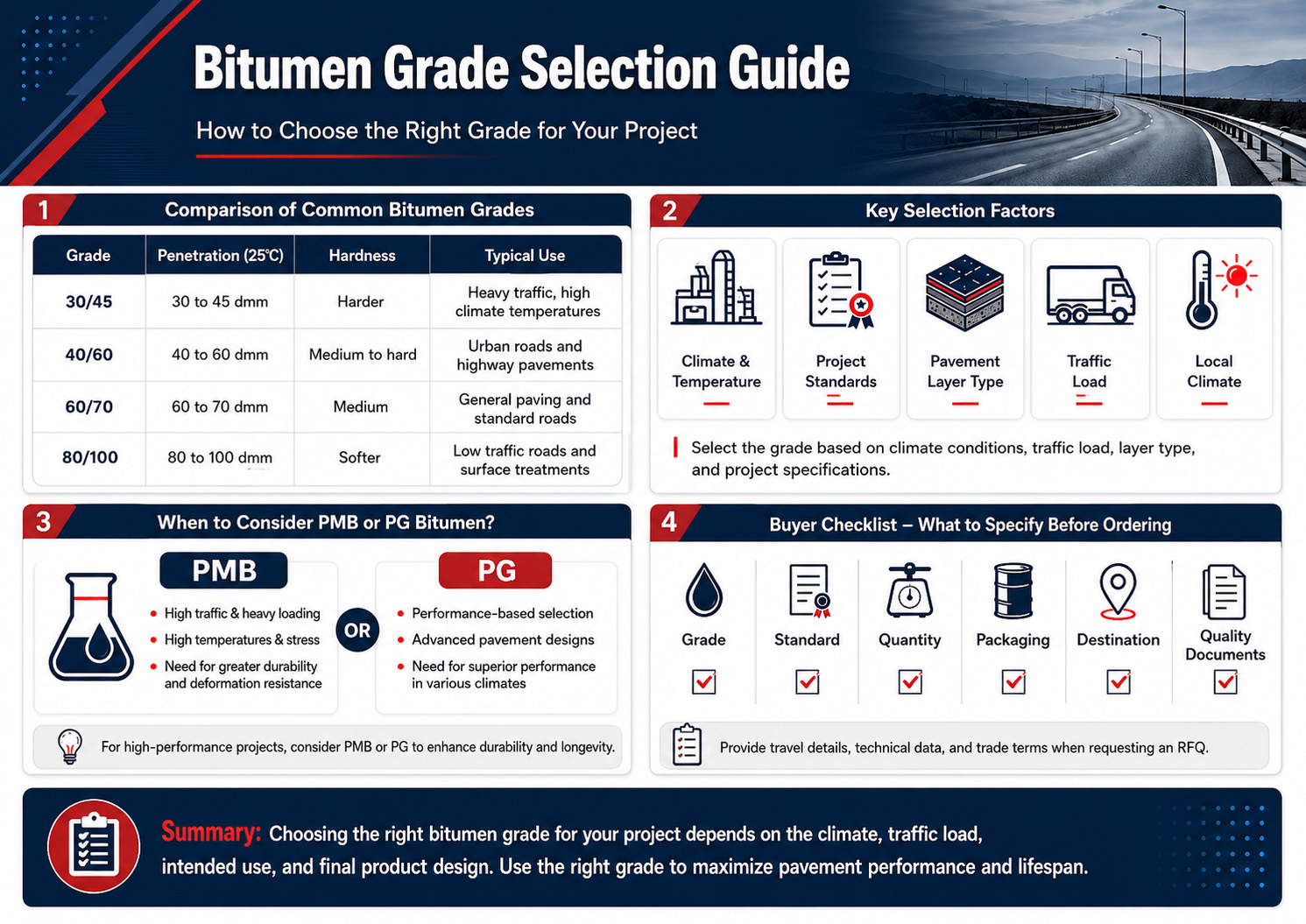
Bitumen Grade Selection Guide: Comparison of common bitumen grades and selection factors
Main Factors for Selecting Bitumen Grade
- Climate Conditions: High temperatures increase the risk of rutting, while low temperatures require better flexibility and cracking resistance.
- Traffic Loading: Heavy axle loads, slow-moving vehicles, and long-term loading conditions require higher performance binders.
- Asphalt Layer Type: Different pavement layers such as surface course and binder course may require different binder characteristics.
- Project Standards: The selected grade should comply with client requirements and applicable national or international standards.
- Production and Construction Conditions: Mixing temperature, compaction process, and asphalt plant conditions should also be considered.
Difference Between 40/60, 60/70 and 80/100 Bitumen
The main difference between 40/60, 60/70, and 80/100 bitumen grades is their penetration value and hardness level. These differences influence pavement behavior, durability, and resistance to environmental conditions.
For detailed information about each grade, you can read the following technical articles:
When Should PMB or PG Bitumen Be Used?
In many projects, selecting a conventional penetration grade such as 60/70 or 40/60 may not provide the required performance. For pavements exposed to heavy traffic, wide temperature variations, slow-moving loads, or demanding operating conditions, modified binders such as Polymer Modified Bitumen (PMB) or performance-based systems such as Performance Grade (PG) can be considered.
Polymer Modified Bitumen improves certain properties of conventional bitumen by adding polymer modifiers, enhancing characteristics such as elasticity, rutting resistance, and durability. In comparison, the PG system classifies bitumen based on its expected performance within specific temperature ranges and its rheological behavior.
When Is PMB a Suitable Choice?
- Heavy traffic pavements or roads exposed to high axle loads
- Airports, ports, terminals, and areas with slow-moving or static loading conditions
- Projects requiring improved resistance against rutting and cracking
- Applications where conventional bitumen does not meet performance requirements
For more information about modified binders and their applications, read:
What Is Polymer Modified Bitumen? Applications, Advantages and Differences from Conventional Bitumen
When Is PG Bitumen More Appropriate?
The Performance Grade (PG) system evaluates bitumen based on its expected behavior under specific temperature conditions rather than only penetration values. This approach allows engineers to select binders according to climate, traffic conditions, and pavement performance requirements.
- High-volume highways requiring performance-based specifications
- Projects exposed to wide temperature variations
- Pavements requiring detailed analysis of binder behavior
- Projects designed according to performance-based standards
What Is PG Bitumen? Performance Grades, Applications and Selection Method
Buyer Checklist Before Ordering Bitumen
Before purchasing bitumen, defining technical and commercial requirements helps reduce quality disputes and improves transparency throughout the supply process. A professional Request for Quotation (RFQ) should include product specifications, delivery requirements, and quality documentation requirements.
| Item |
Required Information |
| Grade |
Required grade such as 40/60, 60/70, 80/100, PMB or PG |
| Standard |
Required standards such as EN, ASTM, AASHTO or project specifications |
| Quantity |
Required quantity and delivery schedule |
| Packaging |
Bulk, drums, jumbo bags or other approved packaging methods |
| Destination |
Country, port, city, or project location |
| Quality Documents |
COA, TDS, SDS and required laboratory reports |
The Importance of COA in Bitumen Selection and Purchasing
A Certificate of Analysis (COA) is one of the most important quality documents in bitumen purchasing. This document confirms whether the supplied product complies with the agreed technical specifications and quality requirements.
For more information about reviewing a bitumen COA, read:
How to Read a Bitumen COA: A Guide to Specifications, Standards and Quality Verification
Important COA Parameters
- Penetration Value
- Softening Point
- Flash Point
- Aging test results
- Testing methods and applicable standards
- Batch number and production date