Technical Guide to Penetration Grade Bitumen
What Is Bitumen 30/45? Technical Specifications, Applications, Difference from 40/60 and 60/70, and Buyer’s Guide
Bitumen 30/45 is a hard penetration-grade paving bitumen with a penetration range of 30 to 45 tenths of a millimetre under the specified test conditions. Its relatively low penetration and comparatively high softening point make it suitable for selected asphalt mixtures exposed to high pavement temperatures, heavy traffic, slow-moving loads, or demanding structural conditions. This guide explains its grading principle, typical EN 12591 requirements, applications, differences from 40/60 and 60/70, quality-control tests, COA review, storage, packaging, and purchasing considerations.
Quick Answer
Bitumen 30/45 is a relatively hard paving binder identified by a penetration value between 30 and 45 dmm at 25°C. Compared with 40/60 and 60/70, it is generally harder, less penetrable, and more resistant to deformation at high service temperatures, but it can also be less flexible at low temperatures. It is commonly considered for hot-mix asphalt in heavily loaded roads, industrial pavements, airport works, base and binder courses, and selected wearing courses where the approved mix design confirms adequate rutting resistance, fatigue performance, adhesion, and low-temperature behaviour.
| Topic | Summary |
|---|
| Binder type | Hard penetration-grade paving bitumen |
| Grade designation | Penetration between 30 and 45 dmm at 25°C under the specified method |
| Typical standard | EN 12591 or the exact project specification stated in the contract |
| Typical use tendency | Hot-mix asphalt for demanding traffic and high-temperature conditions, subject to mix-design approval |
| Main procurement point | Confirm the standard, test methods, acceptance limits, batch COA, packaging, destination, and delivery conditions |
Key Takeaways
- 30/45 is harder than 40/60 and 60/70 because its penetration range is lower.
- A harder binder may improve resistance to permanent deformation, but binder selection cannot replace asphalt mix design and performance verification.
- Typical EN 12591 characteristics include penetration, softening point, flash point, solubility, and resistance to hardening.
- 30/45 should not automatically be selected only because the climate is hot; traffic speed, axle loading, pavement layer, aggregate structure, and low-temperature risk also matter.
- The shipment must be approved against the specified standard and the COA for the actual batch—not against a generic product description.
What Is Bitumen 30/45?
Bitumen 30/45 is a petroleum-derived paving binder classified through the penetration grading system. In the penetration test, a standard needle is allowed to penetrate a prepared bitumen sample under controlled load, time, and temperature. The result is reported in tenths of a millimetre, commonly written as dmm. A result within 30–45 dmm places the material within the 30/45 grade when the other requirements of the applicable specification are also satisfied.
The two numbers do not represent a mixing ratio, asphalt content, viscosity grade, or operating temperature. They define the permitted penetration interval. Because a lower penetration value generally indicates a harder binder, 30/45 is normally harder than 40/60 and 60/70.
Like other conventional paving bitumens, 30/45 is thermoplastic: it becomes softer when heated and harder when cooled. Its final suitability therefore depends not only on the grade name but also on climate, pavement temperature, loading rate, traffic volume, aggregate skeleton, asphalt layer, production temperatures, ageing, and project-specific performance requirements.
Technical note: A harder penetration grade may reduce binder-related rutting susceptibility, but excessive stiffness can increase the risk of thermal cracking, fatigue distress, or poor constructability. The approved asphalt mixture—not the binder grade alone—must meet the project’s performance criteria.
How Bitumen 30/45 Is Produced
Penetration-grade bitumen is commonly produced from the heavy residue remaining after atmospheric and vacuum distillation of suitable crude oil. Refinery process control is used to obtain the required consistency and durability characteristics. Depending on the crude source and refinery configuration, production may involve direct vacuum residue, controlled blending of compatible streams, or other approved refining operations.
The finished product should be homogeneous, free from water and visible contamination, and capable of meeting all specified requirements for the declared grade. The production route itself does not replace batch testing: conformity must be verified through the required laboratory tests and documented in the certificate of analysis.
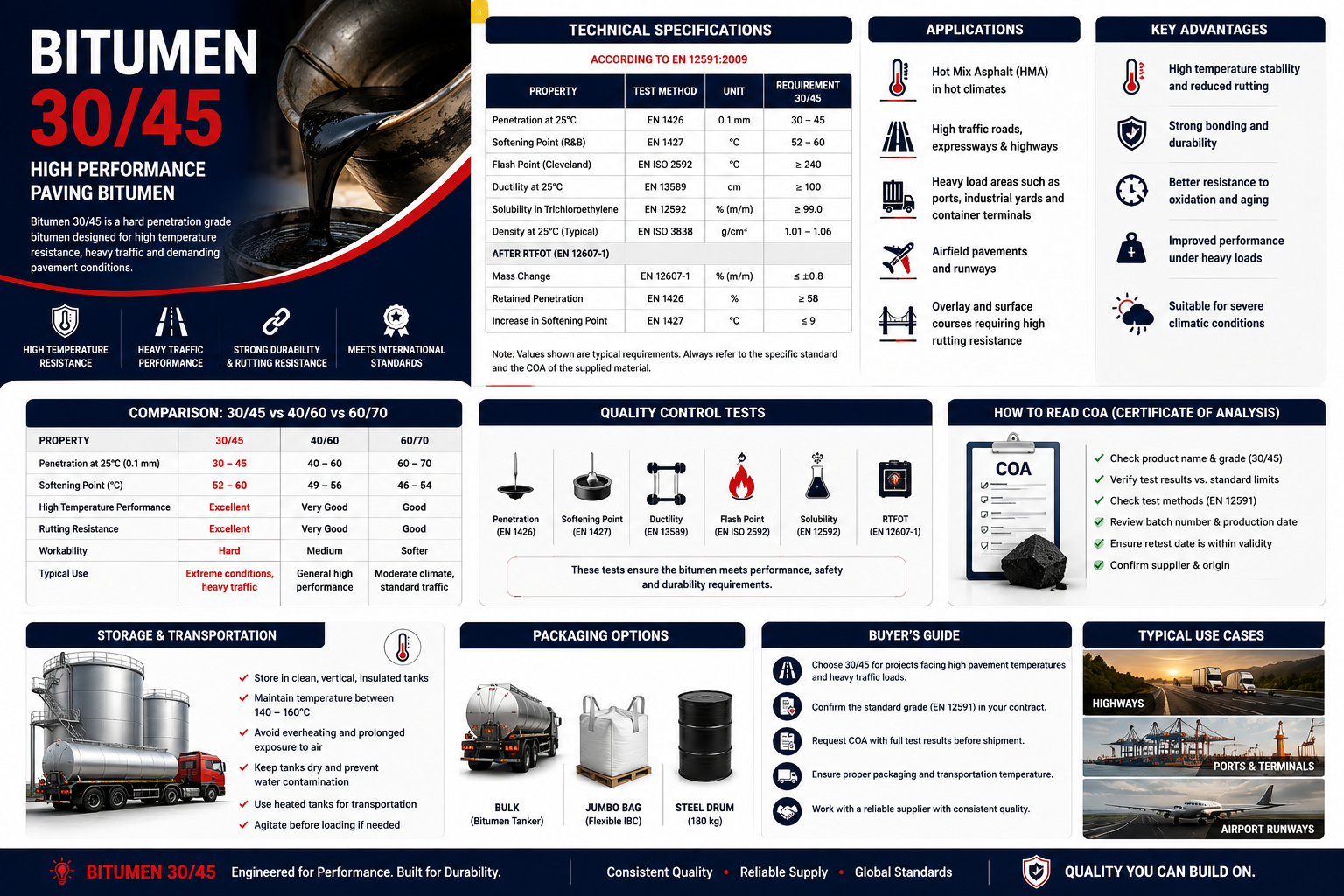 Visual guide to Bitumen 30/45, including typical technical characteristics, applications, comparison with 40/60 and 60/70, quality-control tests, storage and purchasing considerations. Click the image to view it at full size.
Typical Technical Specifications of Bitumen 30/45
The table below presents commonly referenced requirements for 30/45 paving-grade bitumen under EN 12591. Exact contractual limits may vary by standard edition, national annex, purchaser specification, refinery product declaration, or project requirement. The contract specification always takes precedence.
| Property | Typical requirement | Common test method | Why it matters |
|---|
| Penetration at 25°C | 30–45 dmm | EN 1426 | Defines the consistency grade |
| Softening point, Ring & Ball | Typically 52–60°C | EN 1427 | Indicates high-temperature consistency |
| Flash point | Typically 240°C minimum | EN ISO 2592 or specified method | Supports handling and heating safety assessment |
| Solubility | Typically 99.0% minimum | EN 12592 | Indicates bituminous purity and limited insoluble matter |
| Change in mass after RTFOT | Typically 0.5% maximum | EN 12607-1 | Evaluates volatility and short-term ageing |
| Retained penetration after RTFOT | Typically 53% minimum | EN 1426 after EN 12607-1 | Shows how much consistency remains after short-term ageing |
| Increase in softening point after RTFOT | Typically 8°C maximum | EN 1427 after EN 12607-1 | Limits excessive hardening during production simulation |
| Optional viscosity or penetration index | As required by the applicable specification | Specified EN method | Provides additional information on temperature susceptibility and handling |
Buyer note: Do not combine limits from different standards into one unofficial specification. EN 12591, ASTM D946, AASHTO requirements, national standards, and project-specific specifications may use different grade designations, properties, test methods, or acceptance criteria.
What Does the 30/45 Grade Mean?
The grade name is based on the needle penetration range measured at 25°C using the specified load and test duration. A value of 30 dmm equals 3.0 mm of needle penetration, while 45 dmm equals 4.5 mm. Lower penetration indicates greater resistance to the needle under the test conditions and therefore a harder binder.
Penetration is a consistency test, not a complete performance model. Two binders can fall within the same penetration range while differing in crude source, rheology, ageing behaviour, temperature susceptibility, wax content, adhesion, or performance after modification. For high-risk projects, additional rheological or performance testing may be required.
Applications of Bitumen 30/45
Bitumen 30/45 is mainly considered where a relatively stiff conventional binder is required. Its use must remain consistent with the approved pavement design, asphalt mixture design, local standards, and climatic conditions.
- Hot-mix asphalt for heavily trafficked highways and arterial roads.
- Base and binder courses requiring high stiffness and resistance to permanent deformation.
- Selected wearing courses when the mixture passes rutting, fatigue, moisture, and cracking requirements.
- Airport pavements and runways, subject to aviation authority specifications and performance verification.
- Industrial yards, ports, logistics areas, bus lanes, intersections, and slow-moving heavy-load zones.
- Asphalt mixtures used in hot climates or at locations with high pavement service temperatures.
- Selected asphalt products or industrial applications where a hard penetration-grade binder is specified.
Use in Hot Climates
High pavement temperatures reduce binder stiffness and can contribute to permanent deformation. A harder grade such as 30/45 may provide greater high-temperature consistency than softer penetration grades. However, climate alone is not sufficient for selection. The pavement temperature range, loading duration, mixture air voids, aggregate interlock, binder content, compaction, ageing, and low-temperature conditions must also be assessed.
Use under Heavy and Slow-Moving Traffic
Heavy axle loads and slow-moving or stationary traffic increase the time during which the asphalt layer is stressed. This can increase rutting risk, especially at intersections, climbing lanes, ports, terminals, bus stops, and industrial areas. A stiffer binder can be beneficial, but stone skeleton, aggregate quality, gradation, volumetrics, and compaction usually have an equally important or greater effect on rutting performance.
Advantages of Bitumen 30/45
- Higher stiffness than common softer penetration grades.
- Potentially improved resistance to binder-related permanent deformation at high service temperatures.
- Suitability for selected heavily loaded asphalt layers.
- Compatibility with conventional hot-mix asphalt production when properly heated and handled.
- Availability under established penetration-grade specifications such as EN 12591.
- Clear batch acceptance through familiar laboratory tests including penetration, softening point, flash point, and ageing resistance.
Limitations and Engineering Risks
- Lower flexibility than softer penetration grades, particularly at low pavement temperatures.
- Potentially higher mixing, pumping, and compaction temperatures depending on measured viscosity and plant conditions.
- Greater sensitivity to overheating or prolonged storage because additional ageing can make a hard binder excessively stiff.
- Not automatically suitable for every wearing course, cold climate, thin overlay, or fatigue-sensitive pavement.
- Cannot compensate for weak aggregate structure, incorrect gradation, poor compaction, excessive air voids, or inadequate drainage.
- May require a polymer-modified or performance-graded binder when traffic and climate demands exceed the capability of conventional 30/45.
Bitumen 30/45 vs 40/60 vs 60/70
The primary difference is consistency. A lower penetration range generally means a harder binder. Therefore, 30/45 is harder than 40/60, and both are harder than 60/70. The table presents a practical comparison; exact properties must be checked on the applicable specification and batch COA.
| Comparison point | Bitumen 30/45 | Bitumen 40/60 | Bitumen 60/70 |
|---|
| Penetration range | 30–45 dmm | 40–60 dmm | 60–70 dmm |
| Relative hardness | Highest of the three | Intermediate | Lowest of the three |
| Typical high-temperature tendency | Greater stiffness | Moderate-to-high stiffness | Lower stiffness |
| Low-temperature flexibility tendency | Lower | Intermediate | Higher |
| Common selection tendency | Hot climate, heavy or slow traffic, high-stress layers | Warm climate and demanding general paving | General paving in moderate-to-warm conditions |
| Main caution | Cracking, fatigue and constructability if too stiff | Balance between deformation and flexibility | Rutting risk in severe high-temperature or slow-load conditions |
30/45 vs 40/60
The penetration ranges overlap between 40 and 45 dmm, but the grades are not identical. A compliant 30/45 product can be harder overall and generally has a higher softening-point requirement under common specifications. When a project specifies 40/60, supplying 30/45 without approval may change mixing behaviour, compaction, fatigue response, low-temperature performance, and the designed binder-aggregate balance.
30/45 vs 60/70
The difference is more pronounced. 60/70 is softer and more penetrable, while 30/45 provides greater consistency at elevated temperatures. Replacing 60/70 with 30/45 may improve high-temperature stiffness but can also raise production temperatures and reduce flexibility. Any substitution should be supported by an approved mix redesign and performance testing.
For additional comparison, read What Is Bitumen 40/60? and What Is Bitumen 60/70?. Confirm the final URLs in DNN before publication if your existing slugs differ.
Quality-Control Tests for Bitumen 30/45
Quality approval should be based on the complete project specification. The following tests are commonly used for 30/45 paving bitumen.
Penetration
Confirms that the binder’s consistency falls within the declared 30–45 dmm range.
Softening Point
Evaluates the temperature at which the binder reaches a specified softened condition.
Flash Point
Provides an important safety indicator for heating, storage and handling.
Solubility
Indicates the proportion of bituminous material soluble in the specified solvent.
RTFOT
Simulates short-term ageing during asphalt production and placement.
Viscosity or PI
May be required to assess handling, flow and temperature susceptibility.
Learn more in What Are Bitumen Quality-Control Tests?. Confirm the final published URL before inserting it into DNN.
How to Read a Bitumen 30/45 COA
A certificate of analysis should identify the actual shipment or batch and show the applicable specification, test methods, units, limits and measured results. A generic technical data sheet is useful for product description but does not replace the batch COA.
| COA item | What to verify |
|---|
| Product name | It should clearly state paving-grade bitumen 30/45 and not another grade. |
| Batch identification | Batch, tank, production date or loading reference should match the shipment documents. |
| Standard and edition | The declared standard must match the purchase contract and approved specification. |
| Test methods | Each property should use the required method; similar property names do not guarantee equivalent methods. |
| Units and limits | Check dmm, °C, %, Pa·s or mm²/s carefully and compare each result with the correct limit. |
| Ageing results | Confirm mass change, retained penetration and softening-point increase where required. |
| Authorization | Review laboratory identity, issue date, approval signature or authorized electronic validation. |
For a detailed review process, see How to Read a Bitumen Certificate of Analysis. Confirm the final URL before publication.
Sampling and Independent Inspection
A test result is meaningful only when the sample represents the actual material. Sampling should follow the agreed method and identify the batch, tank, truck, vessel compartment, drum lot or loading period. Sample containers must be clean, dry, heat-resistant where required, closable, and correctly labelled.
- Define the sampling point and timing before loading begins.
- Use representative composite or spot samples as required by the inspection plan.
- Prepare sealed retention samples for the supplier, buyer and independent inspector when necessary.
- Record batch, seal number, date, location and sampler identity.
- Avoid contamination from previous products, water, fuel, oil, dust or unsuitable containers.
Read How Should Bitumen Be Sampled? for further guidance. Confirm the live URL before publication.
Storage and Handling
Because 30/45 is relatively hard, it normally requires controlled heating for pumping and transfer. The exact temperature range must be established from the supplier’s technical guidance, measured viscosity, equipment design, storage duration, tank circulation, and site safety procedures.
- Use clean, dry, insulated tanks and lines designed for hot bitumen.
- Prevent contamination with water, fuel oil, cutback, emulsion, polymer-modified bitumen or another penetration grade.
- Avoid unnecessary overheating and long residence times at elevated temperature.
- Use temperature monitoring, calibrated instruments and controlled heating systems.
- Maintain adequate tank level above heating elements in accordance with equipment procedures.
- Apply safe venting, confined-space, burn-prevention and loading procedures.
- Maintain batch and tank traceability throughout storage and delivery.
Safety warning: Water contacting hot bitumen can expand rapidly and cause violent foaming or ejection. Site-specific risk assessment, trained personnel, suitable PPE, safe loading procedures and the supplier’s SDS are essential.
For broader guidance, read Bitumen Storage and Transportation Guide. Confirm the final DNN URL before publication.
Packaging and Delivery Options
The appropriate delivery format depends on quantity, destination, unloading facilities, local regulations, freight economics and the buyer’s heating capability.
| Delivery format | Advantages | Main checks |
|---|
| Bulk tanker | Efficient for large domestic or regional deliveries | Tank cleanliness, insulation, temperature, seals and unloading capability |
| Bulk vessel or tank container | Suitable for large export volumes and organized terminals | Heating, compartment history, sampling, quantity measurement and port facilities |
| Steel drums | Flexible handling where bulk infrastructure is unavailable | Net weight, drum thickness, closure, palletization, weather protection and melting procedure |
| Approved bags or blocks | May simplify selected logistics chains | Packaging compatibility, climate exposure, storage, local approval and safe melting system |
How to Choose Between 30/45, 40/60 and 60/70
- Start with the project specification. Do not select by climate or price alone.
- Identify the pavement layer. Base, binder and wearing courses can have different performance needs.
- Assess temperature conditions. Consider both maximum pavement temperature and minimum service temperature.
- Review traffic loading. Include axle load, traffic volume, tyre pressure, speed, standing loads and channelization.
- Verify the asphalt mixture. Conduct volumetric, rutting, moisture, fatigue and cracking tests as required.
- Check plant capability. Confirm storage, pumping, mixing and compaction temperatures.
- Review durability. Consider short-term ageing, long-term ageing and expected service life.
- Approve the actual batch. Review COA, representative samples and inspection documents.
Engineering decision: If conventional 30/45 does not provide the required balance between rutting resistance and cracking resistance, the correct solution may be a performance-graded or polymer-modified binder rather than simply selecting an even harder penetration grade.
Buyer’s Guide: Information Required for a Quotation
| Required information | Details to provide |
|---|
| Product | Paving-grade bitumen 30/45 |
| Standard | EN 12591 edition, national standard or complete project specification |
| Quantity | Total metric tonnes, shipment size and delivery schedule |
| Packaging | Bulk, drums, approved bags or another accepted format |
| Destination | Country, port, border, city, plant or project site |
| Delivery term | Required Incoterm or domestic delivery condition and named place |
| Quality documents | COA, TDS, SDS, certificate of origin, inspection report and other required documents |
| Inspection | Independent inspector, sampling plan, laboratory and acceptance procedure |
| Application | Asphalt layer, climate, traffic and any special project requirement |
Factors Affecting Bitumen 30/45 Price
- Crude oil, refinery feedstock and regional bitumen market conditions.
- Product specification, testing and batch acceptance requirements.
- Order volume, shipment schedule and loading availability.
- Bulk, drum or alternative packaging costs.
- Inland transport, port charges, ocean freight and destination infrastructure.
- Inspection, laboratory, documentation and certification requirements.
- Currency, payment terms, delivery term and commercial risk allocation.
- Seasonal demand from road construction and infrastructure projects.
A useful quotation must define the product and logistics basis. A price without grade, standard, quantity, packaging, destination and delivery term cannot be compared reliably.
Common Procurement Mistakes
- Ordering “30/45” without stating the governing standard and edition.
- Assuming every supplier’s typical data sheet is identical to the project specification.
- Comparing prices based on gross drum weight instead of verified net bitumen weight.
- Accepting a generic COA that is not linked to the actual shipment.
- Changing from 40/60 or 60/70 to 30/45 without asphalt mix redesign.
- Ignoring the buyer’s unloading, heating and storage capabilities.
- Failing to define inspection, sampling, retention samples and dispute procedures.
- Using a hard binder as the only response to rutting without reviewing aggregate structure and compaction.
Conclusion
Bitumen 30/45 is a hard penetration-grade paving binder with a penetration range of 30–45 dmm. Compared with 40/60 and 60/70, it generally offers greater high-temperature stiffness and may support rutting resistance in demanding asphalt applications. The trade-off is reduced flexibility and potentially more demanding production and compaction conditions.
The grade should be selected through the pavement specification and approved asphalt mix design—not solely from climate, traffic or the grade name. Buyers should define the applicable standard, test methods, quantity, packaging, destination, delivery term, inspection plan and documentation requirements, then verify the actual batch through a representative sample and COA.
Request Technical Information or a Quotation for Bitumen 30/45
Send the required standard, quantity, packaging, destination, delivery term, application and documentation requirements. Technical and commercial availability can then be reviewed against the requested specification.
Contact Dejpa
Frequently Asked Questions
What is Bitumen 30/45?
It is a hard penetration-grade paving bitumen with a penetration value between 30 and 45 dmm under the specified test conditions.
Is Bitumen 30/45 harder than 60/70?
Yes. Its lower penetration range means it is generally harder and less penetrable than 60/70.
What is the difference between 30/45 and 40/60?
30/45 is generally harder and has a lower penetration range. Although the ranges overlap from 40 to 45 dmm, the grades have different specification limits and should not be substituted without approval.
Is 30/45 suitable for hot climates?
It can be suitable for selected hot-climate applications because of its higher stiffness, but the final decision must consider the full pavement temperature range, traffic and asphalt mix performance.
Can Bitumen 30/45 be used for airport runways?
It may be used where the aviation authority and project specification permit it and the asphalt mixture meets the required rutting, fatigue, fuel-resistance and durability criteria.
What is the typical softening point of 30/45?
A commonly referenced EN 12591 range is 52–60°C, but the applicable contract specification and batch COA must be checked.
What tests are required for Bitumen 30/45?
Common tests include penetration, softening point, flash point, solubility and resistance to short-term hardening. Additional viscosity or temperature-susceptibility requirements may apply.
Can 30/45 replace 60/70 directly?
No. The change can affect production temperature, compaction, rutting, fatigue and cracking. It requires technical approval and normally a revised mix design.
Which packaging is available for Bitumen 30/45?
Depending on supplier capability and destination, it may be delivered in bulk tankers, vessels or tank containers, steel drums, or approved bag and block systems.
What information is needed for a quotation?
Provide the standard, quantity, packaging, destination, delivery term, shipment schedule, application, inspection plan and required documents.
Related Articles
References
- EN 12591 — Bitumen and bituminous binders: specifications for paving-grade bitumens.
- EN 1426 — Determination of needle penetration.
- EN 1427 — Determination of softening point: Ring and Ball method.
- EN 12592 — Determination of solubility.
- EN 12607-1 — Determination of resistance to hardening under the influence of heat and air: RTFOT method.
- EN ISO 2592 — Determination of flash and fire points by Cleveland open cup method.
- Applicable national standards, project specifications, approved asphalt mix design, supplier TDS, batch COA and SDS.