BITUMEN MARKET & PROCUREMENT GUIDE
What Determines Bitumen Prices? Key Factors Affecting Bitumen Price per Ton
Bitumen does not have one universal price. A quotation can vary according to feedstock economics, crude and fuel oil markets, regional supply and demand, exchange rates, product grade, packaging, freight, shipment size, delivery basis and destination.
For buyers, this means that two offers showing different prices per metric ton may not actually be comparable unless the product specification, packing, quantity, loading point, Incoterm and delivery conditions are aligned.
Quick Answer: What Determines the Price of Bitumen?
Bitumen price per ton is determined by a combination of upstream, market and logistics factors rather than one fixed formula. Important drivers can include the cost and availability of refinery feedstock, movements in crude oil and fuel oil markets, local supply and demand, exchange rates, bitumen grade, packaging, freight, destination, order size and the agreed delivery term.
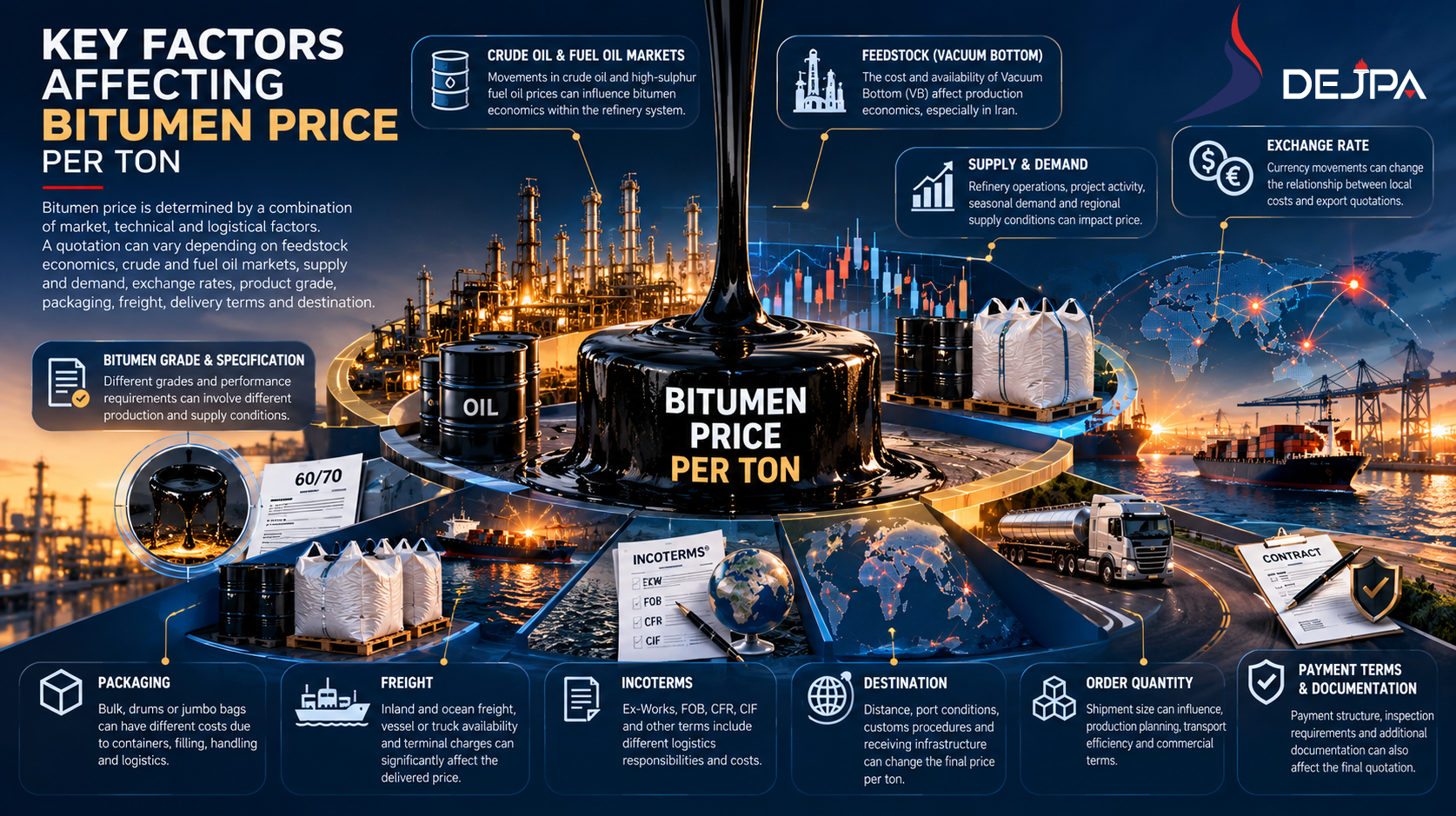
A bitumen quotation should always be evaluated together with the product specification, delivery basis, packaging, quantity and destination.
Why Does Bitumen Price Change?
Bitumen is produced within the petroleum refining system, and its commercial value is connected to refinery economics as well as conditions in the bitumen market itself. As a result, price movements can reflect changes in upstream petroleum markets, refinery availability, competing product values, local demand and logistics.
Professional bitumen price assessments therefore do not rely on one variable alone. Market reporting methodologies may consider actual trades and bids together with freight, nearby market values, high-sulphur fuel oil, crude oil movements and the consensus of active market participants.
There Is No Single Global Bitumen Price
Bitumen markets are regional. A price quoted for one loading point or destination cannot automatically be applied to another market because supply conditions, transport costs, local demand and commercial terms may be different.
What Does “Bitumen Price per Ton” Actually Mean?
A price per metric ton is meaningful only when the commercial basis of the quotation is clear. Buyers should check whether the quoted price is ex-works, FOB, CFR, CIF or another agreed delivery term.
The same physical product can have a different quoted price depending on how much of the logistics chain is included in the seller’s obligation. For example, a delivered price normally includes more transport-related cost than a refinery or loading-point price.
| Price Basis |
What Buyers Should Understand |
| Ex-Works |
Price is quoted at the seller’s facility; downstream transport and related costs are generally outside the product price unless otherwise agreed. |
| FOB |
The quotation is based on delivery on board at the named port of shipment under the agreed Incoterm. |
| CFR |
The seller contracts and pays for freight to the named port of destination, while risk transfer follows the applicable Incoterms rule. |
| CIF |
The seller arranges freight and the required cargo insurance to the named port of destination under the applicable Incoterms rule. |
A Lower Price Is Not Always a Cheaper Offer
An FOB quotation should not be compared directly with a CFR or CIF quotation without separating freight, insurance and other applicable costs. The commercial basis must be normalized before two offers can be compared correctly.
How Do Crude Oil and Fuel Oil Markets Affect Bitumen Prices?
Crude oil and fuel oil markets can influence bitumen economics because bitumen is part of the refinery product system and can compete economically with other heavy refinery streams and uses.
In international bitumen markets, some price assessments and commercial discussions are expressed relative to high-sulphur fuel oil or crude oil benchmarks. Changes in these upstream markets can therefore influence bitumen values, although the relationship is not necessarily immediate or one-to-one.
Bitumen Does Not Simply Follow Crude Oil Dollar for Dollar
A change in crude oil prices does not automatically produce the same percentage change in bitumen. Regional supply, refinery operations, fuel oil values, seasonal demand and freight can strengthen, weaken or delay the effect.
Why Is Vacuum Bottom Important in the Iranian Bitumen Market?
In Iran, Vacuum Bottom or VB is an important refinery feedstock used by bitumen producers. Changes in its availability and listed or traded value can therefore affect production economics and the commercial price of finished bitumen.
Market reports on Iranian bitumen regularly track Vacuum Bottom prices and supply conditions alongside finished bitumen transactions. This is why changes in feedstock cost can become an important factor when Iranian producers revise export or domestic offers.
Feedstock Cost Is Important, but It Is Not the Final Price
The finished bitumen quotation can still be affected by conversion and operating costs, product specification, packaging, supply-demand conditions, foreign exchange, freight and the commercial terms of the transaction.
How Do Supply and Demand Affect Bitumen Prices?
Like other commodity markets, bitumen prices respond to changes in available supply and buying demand. Refinery maintenance, feedstock availability, production changes or logistical disruption can reduce available supply, while strong road construction activity can increase demand.
The effect can also be regional. A tight market in one location may support prices there even while another region experiences weaker demand and lower offers.
This regional behavior is one reason buyers should be cautious about using a single online number as the “world bitumen price.”
Does the Bitumen Grade Affect the Price?
It can. A quotation must correspond to the exact product specification requested by the buyer. Different grades, performance requirements or modified binders can involve different production, testing, handling or supply conditions.
However, buyers should not assume that one grade is always more expensive than another in every market. The actual price difference depends on current production economics, availability, demand and the specification being supplied.
Compare Like with Like
Before comparing prices, confirm that both quotations refer to the same grade, standard, test requirements, packaging, quantity and delivery basis.
How Do Exchange Rates Affect Bitumen Prices?
Exchange rates can significantly affect bitumen quotations, especially in markets where feedstock, export transactions, packaging materials, freight or other commercial costs are linked directly or indirectly to foreign currencies.
In export markets, a producer may incur part of its costs locally while the sale itself is quoted in US dollars or another international currency. Currency movements can therefore change the relationship between local production costs and the final export offer.
Exchange Rate Effects Are Market-Specific
The impact of currency movements depends on the cost structure of the producer, the quotation currency, the timing of payment and the commercial terms of the transaction. There is no universal exchange-rate multiplier that can be applied to every bitumen offer.
How Does Packaging Affect Bitumen Price per Ton?
Packaging can materially affect the final price per ton because packaged bitumen requires containers, filling operations, handling, storage and additional logistics that are different from bulk supply.
The total cost depends on the required packaging format, packaging specification, unit weight, loading method, container utilization, handling requirements and destination logistics.
| Supply Format |
Main Cost Considerations |
Buyer Should Check |
| Bulk Bitumen |
Heated storage, tank transport, vessel or tanker availability, loading and unloading infrastructure |
Minimum shipment size, receiving facilities, heating capability and destination logistics |
| Steel Drums |
Drum cost, filling, handling, container loading and packaging weight |
Drum specification, net weight, container loading pattern and destination handling |
| Jumbo Bags |
Bag specification, filling system, handling method, container utilization and unloading requirements |
Bag type, unit weight, climate suitability, handling equipment and project acceptance |
Packaging Price Is Only Part of the Difference
A packaged product can also change freight efficiency, loading capacity, handling time and destination costs. For this reason, the lowest ex-works product price may not always produce the lowest delivered cost.
Bulk vs Drum vs Jumbo Bag: Which Is Cheaper?
There is no universal answer. Bulk supply often avoids the direct cost of drums or bags, but it requires suitable heated transport, storage and discharge infrastructure. Packaged products introduce packaging and handling costs but may be more practical for destinations without bulk receiving facilities.
The economically best option should therefore be evaluated on a delivered-cost basis, not only by comparing the refinery price per ton.
Compare Total Landed Cost
A useful comparison includes product price, packaging, inland transport, terminal or port costs, ocean freight where applicable, insurance, unloading and destination handling.
How Does Freight Affect Bitumen Price?
Freight can be one of the most important differences between a loading-point price and a delivered bitumen price. The effect depends on distance, transport mode, vessel or truck availability, fuel costs, route conditions, terminal charges and shipment size.
For seaborne trade, freight markets can change independently from the bitumen product price. A stable FOB value can therefore result in a higher CFR or CIF quotation if ocean freight increases.
The same principle applies to inland transportation. A project located far from a refinery, storage terminal or port may have a significantly different delivered cost from a buyer purchasing the same grade closer to the supply point.
Why Does Destination Matter?
Destination affects more than distance. Different markets can have different port conditions, vessel restrictions, customs procedures, inland transport requirements, unloading infrastructure and packaging preferences.
For this reason, suppliers normally need a clearly defined destination before they can calculate a meaningful delivered quotation.
| Destination Factor |
Possible Effect on Quotation |
| Distance from Loading Point |
Changes inland or ocean freight cost |
| Port / Terminal Conditions |
Can affect vessel choice, handling, storage and terminal charges |
| Receiving Infrastructure |
May determine whether bulk or packaged supply is practical |
| Local Handling Requirements |
Can increase unloading, storage or inland delivery costs |
Does Order Quantity Affect the Bitumen Price?
Order quantity can affect pricing because shipment size influences production planning, packaging requirements, transport efficiency, vessel or truck utilization and commercial terms.
A larger order does not automatically guarantee a lower price per ton. The result depends on available supply, shipment structure, loading capacity, payment terms and the supplier’s operational conditions at the time of quotation.
Quantity and Shipment Size Are Not Always the Same
A contract for a large total volume may still be delivered in several smaller shipments. Buyers should therefore specify both total quantity and expected shipment schedule when requesting a quotation.
Are Bitumen Prices Seasonal?
Bitumen demand can show seasonal patterns because road construction and maintenance activity is affected by weather, project schedules and government or infrastructure spending cycles.
However, seasonality is not identical in every region. Construction seasons, climate, refinery maintenance and local supply conditions differ from one market to another.
A buyer should therefore avoid assuming that prices will always rise or fall during a particular month without considering the specific regional market.
How Do Incoterms Change the Quoted Bitumen Price?
Incoterms define important responsibilities between buyer and seller, including where delivery occurs, how certain transport obligations are allocated and when risk transfers. Because different terms allocate different logistics responsibilities, the quoted price can change substantially.
For example, a seller quoting FOB is not providing the same commercial package as a seller quoting CFR or CIF to the destination port. The difference in headline price may therefore reflect freight and insurance responsibilities rather than a difference in the underlying bitumen value.
Always Name the Place with the Incoterm
A commercial request should state the Incoterm together with the named place or port, for example FOB named port or CFR named destination port. Without that information, a price comparison may be incomplete.
How Do Payment Terms Affect a Bitumen Quotation?
Payment terms can influence commercial pricing because different arrangements can involve different financing, timing and transaction risks for the seller and buyer.
For this reason, two otherwise similar quotations may not be fully comparable if one is based on advance payment and another uses a different agreed payment structure.
Payment terms should therefore be reviewed together with product price, delivery basis and shipment conditions rather than treated as a separate detail.
Does Quality Documentation Add to the Cost?
Standard product quality control is part of normal bitumen supply, but individual projects may require additional documentation, independent inspection, specific laboratory testing, retained samples or third-party certification.
Where these additional services are required, they can create extra commercial or logistical costs depending on the contract and inspection scope.
Buyers should therefore communicate all required inspection and documentation conditions before requesting a final quotation.
For guidance on verifying technical results, see Dejpa’s guide to reading a Bitumen Certificate of Analysis .
How Should Buyers Compare Two Bitumen Quotations?
The safest approach is to normalize the commercial and technical conditions before deciding which offer is cheaper.
- Confirm that the bitumen grade and technical standard are identical
- Compare the same net quantity and shipment size
- Check the packaging format and packaging specification
- Confirm whether the offer is Ex-Works, FOB, CFR, CIF or another term
- Use the same named loading point or destination when comparing logistics
- Separate product value from freight and insurance where necessary
- Compare payment terms and quotation validity
- Check inspection, testing and documentation requirements
The Right Comparison Is “Same Product, Same Basis”
A USD-per-ton figure alone is not enough. A meaningful comparison requires the same grade, specification, packaging, quantity, Incoterm, destination, payment conditions and quality requirements.
What Does “Bitumen Price Today” Really Mean?
When buyers search for “bitumen price today,” they are usually looking for a current market indication. However, a meaningful daily price still needs a commercial basis.
A current quotation should identify the product grade, packaging, quantity, loading point or destination, Incoterm, payment terms and quotation validity. Without these details, a published number may provide only a rough market indication rather than a directly comparable purchase price.
A “Today’s Price” Without a Basis Can Be Misleading
The same day can produce different valid quotations for the same grade if packaging, shipment size, destination, freight or Incoterm are different.
Why Can Online Bitumen Prices Be Misleading?
Online price lists can be useful as market references, but they should not automatically be treated as firm commercial offers. Some prices may be indicative, delayed, based on another market, or published without enough information about grade, packaging, freight and delivery terms.
In addition, commodity markets can move quickly. A figure published earlier may no longer reflect the seller’s current feedstock cost, freight, exchange rate or available supply.
Use Online Prices as Context, Not as the Final Purchase Basis
For procurement, buyers should request a dated quotation with a defined validity period and complete technical and commercial terms.
What Information Is Needed to Get an Accurate Bitumen Quote?
The more complete the request, the more accurately a supplier can calculate the quotation. A short message such as “Please send your best bitumen price” usually does not contain enough information for a reliable commercial offer.
| Information Required |
Example |
| Bitumen Grade |
60/70, 40/50, VG30, PG grade or another specified product |
| Technical Standard |
Applicable project or product specification |
| Quantity |
Total tonnage and expected shipment size |
| Packaging / Supply Mode |
Bulk, steel drums, jumbo bags or another required format |
| Delivery Term |
Ex-Works, FOB, CFR, CIF or another agreed Incoterm |
| Named Place / Port |
Loading port, destination port or project delivery point |
| Payment Terms |
Required commercial payment structure |
| Quality / Inspection Requirements |
TDS, COA, third-party inspection or specific laboratory requirements |
The More Complete the RFQ, the More Meaningful the Price
A supplier cannot calculate a precise delivered price without knowing where the product is going, how it will be supplied and what technical and commercial conditions apply.
What Are Common Mistakes When Comparing Bitumen Prices?
- Comparing different bitumen grades as if they were the same product
- Comparing bulk prices with drum or jumbo bag prices without adding packaging and logistics
- Comparing FOB with CFR or CIF without separating freight and insurance
- Ignoring quotation validity and using an outdated price
- Comparing prices from different loading points or destinations
- Ignoring payment terms
- Ignoring technical standards, test limits and inspection requirements
- Assuming the lowest headline price gives the lowest total landed cost
- Using an online indicative number as if it were a firm supplier quotation
Frequently Asked Questions About Bitumen Prices
What is the price of bitumen per ton?
There is no single universal price per ton. The current quotation depends on grade, market conditions, packaging, quantity, loading point, destination, freight, delivery term and payment conditions.
Why does the price of bitumen change?
Bitumen prices can change because of feedstock economics, crude and fuel oil markets, supply and demand, exchange rates, refinery conditions, freight and regional market developments.
Does crude oil price determine bitumen price?
Crude oil can influence bitumen economics, but bitumen does not necessarily move one-for-one with crude. Fuel oil values, refinery operations, regional supply and demand and logistics can change the relationship.
Why is Vacuum Bottom important for Iranian bitumen pricing?
Vacuum Bottom is an important refinery feedstock for Iranian bitumen production. Changes in its value and availability can influence production economics and, together with other factors, affect finished bitumen offers.
Is bulk bitumen cheaper than drum bitumen?
Bulk bitumen avoids the direct cost of drums, but the final economic result depends on heated transport, storage, shipment size and receiving infrastructure. The correct comparison is total delivered or landed cost.
Why is drum bitumen more expensive per ton?
Drummed supply includes the cost of steel drums, filling, handling and container logistics. The exact difference depends on drum specification, net weight, loading efficiency and destination.
Does jumbo bag packaging affect bitumen price?
Yes. Jumbo bag supply can involve bag material, filling, handling, container utilization and destination unloading requirements, all of which can affect the final cost.
What is the difference between FOB and CFR bitumen price?
An FOB quotation is based on delivery on board at the named port of shipment, while a CFR quotation includes the seller’s contracted freight to the named destination port. The risk-transfer rules should still be interpreted according to the applicable Incoterm.
Why can two suppliers quote different prices for 60/70 bitumen?
Different suppliers can have different feedstock economics, inventories, packaging costs, logistics, loading points, payment terms and commercial conditions. Buyers should first confirm that the offers are technically and commercially comparable.
How often does bitumen price change?
There is no fixed universal frequency. Prices may change when feedstock, currency, freight, supply-demand conditions or other market variables move. This is why commercial quotations normally have a defined validity period.
How can I get an accurate bitumen price today?
Provide the supplier with the exact grade and standard, quantity, packaging, destination, required Incoterm, shipment schedule, payment terms and quality or inspection requirements. A dated quotation can then be prepared on the appropriate commercial basis.
Final Considerations
Bitumen price per ton is the result of several connected variables rather than one universal benchmark. Feedstock economics, petroleum markets, supply and demand, exchange rates, product specification, packaging, logistics and commercial terms can all influence the final quotation.
For Iranian bitumen, Vacuum Bottom economics and currency conditions can be important, but they still form only part of the final commercial picture. Freight, packing, destination, quantity and delivery basis can materially change the price presented to the buyer.
The most reliable way to compare offers is therefore to compare the same grade and specification on the same commercial basis and calculate the total cost relevant to the buyer’s actual destination.
In One Sentence
The real bitumen price is not just a USD-per-ton number—it is the price of a defined grade, specification, quantity and packaging delivered under clearly defined commercial terms.
Need a Current Bitumen Quotation?
Send Dejpa your required bitumen grade, specification, quantity, packaging or supply mode, destination, Incoterm and documentation requirements for a commercial supply review.
Request a Bitumen Quote
sales@dejpa.com