ASPHALT PERFORMANCE & BITUMEN QUALITY GUIDE
Bitumen–Aggregate Adhesion: Causes of Stripping, Moisture Damage and Prevention Methods
The durability of asphalt pavement depends not only on the quality of bitumen and aggregates individually but also on how these materials interact within the asphalt mixture. An effective bond between bitumen and aggregate surfaces contributes to the integrity of the pavement and its ability to withstand traffic loading and environmental exposure.
When moisture enters an asphalt mixture, it may weaken the bond between the binder and aggregate or contribute to other forms of moisture-induced deterioration. This can lead to stripping, loss of mixture strength and premature pavement distress. Understanding the mechanisms of bitumen–aggregate adhesion is therefore important for binder selection, aggregate evaluation, asphalt mixture design and construction quality control.
Quick Answer: What Is Bitumen–Aggregate Adhesion?
Bitumen–aggregate adhesion is the bonding interaction that helps bitumen remain attached to the surface of aggregate particles in an asphalt mixture. The effectiveness and durability of this bond depend on binder chemistry, aggregate mineralogy, surface characteristics, moisture conditions and mixture preparation.
When water weakens or displaces the binder at the aggregate interface, stripping can occur. Moisture may also reduce cohesion within the asphalt mixture. Resistance to these effects should be evaluated using appropriate material and mixture tests, such as AASHTO T283, alongside project-specific performance requirements.
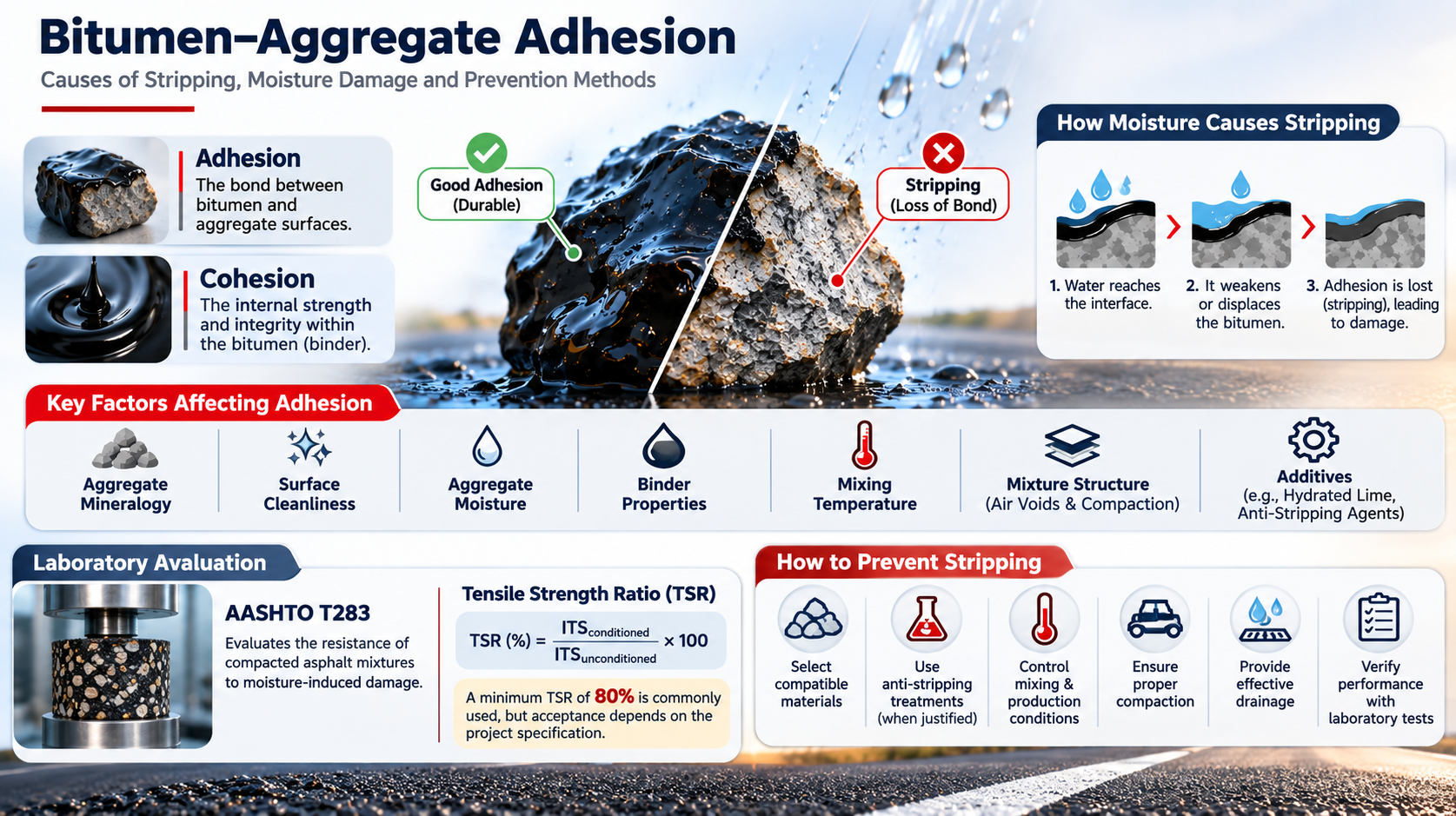
Bitumen–aggregate bonding, moisture damage mechanisms, laboratory evaluation and approaches to reducing asphalt stripping.
Why Is Bitumen–Aggregate Adhesion Important in Asphalt Pavements?
An asphalt mixture is composed of aggregates, bituminous binder and air voids, with other materials or additives included where required by the mix design. The binder coats aggregate particles and contributes to binding the aggregate structure together.
The interaction between bitumen and aggregate is important because asphalt pavement is repeatedly exposed to traffic loads, temperature changes and environmental conditions. Moisture can enter the pavement through interconnected air voids, cracks, surface defects or other pathways.
If the binder–aggregate bond is vulnerable to moisture, the mixture may lose strength or stiffness as damage develops. This can contribute to stripping, raveling, cracking and other forms of pavement deterioration, depending on the mixture and service conditions.
Does Strong Adhesion Guarantee Durable Asphalt?
No. Adhesion is an important contributor to asphalt performance, but pavement durability also depends on aggregate structure, binder properties, mixture design, air voids, drainage, construction quality, traffic loading and environmental conditions. Strong bonding alone cannot compensate for all other deficiencies.
What Is the Difference Between Adhesion and Cohesion in Asphalt?
Adhesion and cohesion describe different aspects of bonding and material integrity. Although these terms are sometimes used together, they should not be treated as interchangeable.
Adhesion refers to the interaction between different materials, such as the bond at the interface between bitumen and aggregate.
Cohesion refers to the internal integrity and resistance to separation within a material or material phase, such as the bituminous binder or mastic.
Moisture-induced damage can involve loss of adhesion at the binder–aggregate interface, loss of cohesion within the binder or mastic, or a combination of mechanisms. Understanding the distinction is important when selecting laboratory investigations and interpreting pavement distress.
| Characteristic |
Adhesion |
Cohesion |
| Meaning |
Bonding between different materials |
Internal bonding and integrity within a material |
| Relevant Location |
Bitumen–aggregate interface |
Within the binder or bituminous mastic |
| Potential Failure |
Binder separates from aggregate surface |
Internal separation or deterioration of the binder or mastic |
| Moisture-Related Concern |
Water may weaken or displace the interfacial bond |
Moisture may contribute to the loss of internal mixture integrity |
What Is Asphalt Stripping?
Asphalt stripping is the loss of adhesion between bitumen and aggregate surfaces, commonly associated with the presence of moisture. Water can interfere with the binder–aggregate interface and contribute to the separation of the binder film from the aggregate.
Stripping may develop progressively as the pavement experiences water exposure, traffic loading and repeated environmental cycles. The extent of damage depends on the specific combination of binder, aggregates, mixture structure and exposure conditions.
In practice, moisture-related deterioration may involve several mechanisms rather than a single process. Consequently, identifying exposed aggregate surfaces can be useful evidence, but a complete diagnosis should also consider the possibility of cohesive damage and other pavement defects.
Stripping Is Not the Same as Bitumen Contamination
Stripping generally concerns the loss of bonding between the binder and aggregate within an asphalt mixture, often caused or accelerated by moisture. Bitumen contamination refers to unintended foreign materials entering the binder. Both can affect pavement quality, but they involve different mechanisms and require different investigations.
How Does Moisture Cause Bitumen to Separate From Aggregates?
Moisture damage may develop when water reaches the aggregate–binder interface and competes with the binder for interaction with the aggregate surface.
Depending on aggregate mineralogy, binder chemistry and environmental conditions, water may reduce the stability of the interfacial bond and promote binder displacement.
Traffic loading and repeated wetting may further contribute to damage propagation. Moisture can also affect the internal response of the asphalt mixture, meaning not all moisture-related strength loss results exclusively from visible stripping.
Why Is Water Particularly Important?
Water can interact strongly with certain mineral surfaces and interfere with the adhesion of bitumen. The susceptibility of a particular mixture depends on the actual binder–aggregate combination, the access of water to the interface and the surrounding mechanical and environmental conditions.
What Factors Affect Bitumen–Aggregate Adhesion?
Bitumen–aggregate adhesion is influenced by a combination of chemical, physical and operational factors. A material that performs well with one aggregate source may not provide the same moisture resistance when combined with a different aggregate.
| Factor |
Potential Influence on Adhesion |
Technical Consideration |
| Aggregate Mineralogy |
Affects surface chemistry and binder–aggregate interaction |
Evaluate the actual aggregate source and binder combination |
| Aggregate Surface Cleanliness |
Dust, clay or other surface contaminants may interfere with effective coating and bonding |
Control aggregate cleanliness and unwanted fine materials |
| Aggregate Moisture |
Residual moisture may interfere with coating under unsuitable production conditions |
Maintain appropriate drying and production controls for the selected technology |
| Binder Characteristics |
Binder composition and rheology influence wetting, coating and interfacial behavior |
Use product-specific data and mixture testing |
| Mixing Conditions |
Influence binder distribution and aggregate coating |
Follow appropriate temperature, mixing and production procedures |
| Mixture Air Voids and Drainage |
Influence moisture access and the likelihood of moisture-related deterioration |
Control mix design, compaction and water management |
| Additives and Treatments |
May improve moisture resistance for suitable material combinations |
Verify effectiveness through appropriate laboratory evaluation |
Does Aggregate Mineralogy Affect Bitumen Adhesion?
Yes. Aggregate mineralogy affects the chemical nature of the surface and its interaction with bituminous binders and water.
Different mineral surfaces can exhibit different affinities for water and bitumen. For this reason, the same binder may produce different adhesion and moisture-susceptibility results when used with aggregates from different sources.
Although broad distinctions are sometimes made between siliceous and carbonate aggregates, mineral classification alone is not a reliable substitute for laboratory evaluation. Surface condition, mineral composition, binder chemistry and mixture design all influence the final response.
Is Limestone Always Better Than Granite for Adhesion?
Not necessarily. Some carbonate aggregates may exhibit favorable bonding behavior with certain binders, while some siliceous aggregates may be more moisture-sensitive. However, these are not universal rankings. The actual material combination must be evaluated under the relevant test conditions.
How Do Aggregate Cleanliness and Surface Texture Affect Bonding?
The condition of the aggregate surface influences how effectively bitumen can coat and interact with it.
Dust, clay coatings and unwanted surface materials may reduce direct contact between the binder and the underlying aggregate. This can interfere with effective coating or create a weaker interfacial zone.
Surface texture also influences mechanical interaction and the distribution of binder over the aggregate. However, roughness alone does not guarantee moisture-resistant adhesion. Chemical compatibility, cleanliness and mixture design remain important.
Aggregate preparation and quality control should therefore address not only gradation and mechanical properties but also surface cleanliness and suitability for the intended asphalt mixture.
Does Bitumen Grade Affect Adhesion to Aggregates?
Binder grade can influence asphalt mixture behavior, but it does not independently determine the adhesion or moisture resistance of a particular binder–aggregate combination.
Penetration grades such as 60/70 and 80/100 describe specified consistency characteristics under standard testing conditions. They do not directly establish the bond strength between a binder and every possible aggregate type.
Similarly, viscosity and performance grading systems provide important information about binder characteristics, but moisture resistance should still be evaluated using the materials and mixture design intended for the project.
For more information about the properties of a commonly used paving grade, read Dejpa's guide to 60/70 bitumen .
Can a Higher-Performance Binder Eliminate Stripping?
No binder grade or modification should be assumed to eliminate stripping in every asphalt mixture. Even when a binder provides favorable performance characteristics, moisture susceptibility depends on the combination of binder, aggregate, mix design, water exposure and construction conditions.
Key Technical Principle
Bitumen–aggregate adhesion should be evaluated as a material interaction, not as a property determined by binder grade alone. The most reliable assessment considers the actual binder, aggregate source, mixture design and moisture exposure conditions together.
How Does Mixing Temperature Affect Bitumen–Aggregate Adhesion?
Mixing temperature influences the viscosity of bitumen and its ability to flow around and coat aggregate particles during asphalt production. When the temperature is unsuitable for the binder and production technology, effective coating and uniform binder distribution may become more difficult.
At an excessively low mixing temperature for a conventional hot-mix process, the binder may be too viscous to achieve satisfactory distribution within the available mixing time. Inadequate coating can leave portions of aggregate surfaces insufficiently covered and may affect mixture consistency and performance.
Excessive heating introduces different problems. Prolonged exposure to unnecessarily high temperatures can accelerate binder aging and alter its properties. Consequently, increasing mixing temperature without technical justification is not a reliable method of improving adhesion.
The appropriate production temperature depends on binder characteristics, aggregate conditions, mixture design, plant equipment and the selected technology. Warm-mix asphalt systems, for example, may achieve adequate coating at lower temperatures through suitable processes or additives.
Does Higher Mixing Temperature Always Improve Adhesion?
No. Temperature must be sufficient for the intended coating process, but excessive heating does not guarantee stronger bitumen–aggregate bonding. The suitable temperature range should be established using binder-specific information, mixture requirements and approved production procedures.
For a more detailed discussion of temperature management, see Dejpa's technical guide to bitumen storage and handling.
Why Is Complete Aggregate Coating Important in Asphalt Production?
Aggregate coating refers to the distribution of bituminous binder over the surface of aggregate particles during mixture preparation. Adequate coating is important for forming a consistent asphalt mixture and establishing contact between the binder and aggregate surfaces.
Insufficient coating may result from inappropriate mixing conditions, unsuitable aggregate moisture, inadequate mixing time, binder distribution problems or other production-related factors. Such deficiencies can interfere with the intended performance of the mixture.
However, complete visible coating immediately after mixing does not prove that the binder–aggregate bond will remain resistant to water during pavement service. A mixture may initially appear well coated but still demonstrate moisture susceptibility under laboratory conditioning or field exposure.
Aggregate Coating and Moisture Resistance Are Not Identical
Coating quality describes how effectively the binder covers aggregate surfaces during mixture preparation. Moisture resistance describes the ability of the mixture to retain acceptable integrity and performance after water exposure. Both must be considered in quality control.
How Do Air Voids, Compaction and Drainage Influence Moisture Damage?
Moisture susceptibility is not determined solely by the chemical bond between bitumen and aggregates. The internal structure of an asphalt mixture affects how easily water enters, moves through and remains within the pavement.
Air void content, void connectivity, construction compaction and drainage conditions influence the exposure of binder–aggregate interfaces to moisture. A highly permeable or poorly compacted mixture may permit increased water infiltration, creating conditions that contribute to moisture-related deterioration.
Conversely, minimizing air voids without regard to the approved mix design is not an appropriate solution. Asphalt mixtures require a suitable volumetric structure for their intended loading, durability and deformation resistance.
Effective moisture management therefore involves appropriate mixture design, controlled compaction, pavement drainage and construction quality, rather than reliance on binder selection alone.
How Is Moisture Susceptibility Evaluated in Asphalt Mixtures?
Moisture susceptibility testing is used to assess how asphalt mixtures respond to water exposure under defined laboratory conditions. These tests help identify material combinations that may be vulnerable to moisture-induced strength loss or other forms of deterioration.
Laboratory evaluations may examine retained tensile strength, changes in mixture behavior, visible binder separation or other performance indicators. The appropriate test depends on project specifications, the type of asphalt mixture and the question being investigated.
A widely used method is AASHTO T283, which evaluates the resistance of compacted asphalt mixtures to moisture-induced damage by comparing the indirect tensile strength of conditioned and unconditioned specimens.
It is important to distinguish a mixture-level moisture susceptibility test from a direct measurement of adhesion between two individual materials. The result of AASHTO T283 reflects the combined response of the binder, aggregates, mixture structure and applied conditioning procedure.
What Is the AASHTO T283 Test?
AASHTO T283, titled Resistance of Compacted Asphalt Mixtures to Moisture-Induced Damage, is a standardized laboratory method for evaluating the potential moisture sensitivity of asphalt mixtures.
In simplified terms, comparable compacted asphalt specimens are divided into conditioned and unconditioned groups. The conditioned specimens undergo moisture exposure according to the applicable test procedure, while the comparison group is prepared and tested under its prescribed reference conditions.
The indirect tensile strengths of the two groups are measured and used to calculate a tensile strength ratio. The full procedure involves specified requirements for specimen preparation, conditioning, testing and reporting, which must be followed from the applicable standard edition.
What Does AASHTO T283 Actually Measure?
AASHTO T283 evaluates the relative tensile strength retained by a compacted asphalt mixture after specified moisture conditioning. It does not directly measure the chemical adhesion energy of bitumen to an aggregate surface, and it does not identify a single damage mechanism in isolation.
What Is Tensile Strength Ratio (TSR) in Asphalt Testing?
The Tensile Strength Ratio, commonly abbreviated as TSR, expresses the average indirect tensile strength of moisture-conditioned asphalt specimens relative to that of the unconditioned reference specimens.
Tensile Strength Ratio (TSR)
TSR (%) = (Average Conditioned ITS / Average Unconditioned ITS) × 100
ITS = Indirect Tensile Strength. The specimens, conditioning and test conditions must follow the applicable method.
For example, if the average indirect tensile strength of the conditioned specimens is 720 kPa and that of the unconditioned specimens is 900 kPa, the calculated TSR is 80%.
A higher retained-strength ratio generally indicates less relative strength loss under the specified conditioning procedure. However, the ratio should not be interpreted without considering the actual strength values, test validity and other mixture performance requirements.
| Measurement |
Example Result |
Interpretation |
| Average Unconditioned ITS |
900 kPa |
Reference tensile strength |
| Average Conditioned ITS |
720 kPa |
Tensile strength after prescribed conditioning |
| Calculated TSR |
80% |
80% of the reference strength is retained |
Is a TSR of 80% Always Acceptable?
No. A minimum TSR of 80% is frequently encountered in asphalt specifications, but it is not a universal acceptance requirement for every project, mixture or jurisdiction. Compliance must be assessed against the actual governing specification. A passing TSR also does not guarantee that a pavement will never experience stripping or other moisture-related damage.
What Are the Limitations of TSR and Moisture Susceptibility Testing?
Although AASHTO T283 and TSR are valuable tools, laboratory results should not be treated as complete predictions of long-term pavement behavior.
Field performance depends on variables that may not be fully represented by one laboratory conditioning procedure, including repeated traffic loading, drainage, construction variability, environmental exposure and long-term aging.
Furthermore, a ratio can be misleading if the underlying tensile strengths are unusually low. Two mixtures may have similar TSR values while differing substantially in absolute strength and other performance characteristics.
Important Limitations to Consider
- TSR represents strength retention under the specified laboratory conditioning procedure.
- The result does not isolate adhesion loss from all other possible damage mechanisms.
- Conditioning details and specimen preparation can affect test outcomes.
- Absolute tensile strengths should be reviewed alongside the calculated ratio.
- Passing the test does not guarantee satisfactory field performance under every exposure condition.
- The applicable specification determines the acceptance criteria and any additional required evaluations.
What Other Tests Can Help Investigate Asphalt Stripping?
Depending on the objective, additional laboratory methods may be used alongside mixture-level moisture susceptibility testing. These may involve observations of binder coating, conditioned mechanical performance or more specialized evaluation of binder–aggregate interaction.
| Evaluation Approach |
What It Can Indicate |
Main Limitation |
| AASHTO T283 / TSR |
Relative strength retention following moisture conditioning |
Does not directly isolate interfacial adhesion |
| Qualitative Coating or Stripping Observations |
Visible binder coverage or removal under specified conditions |
Visual ratings may be subjective and may not predict field performance |
| Moisture-Conditioned Mechanical Tests |
Changes in selected mixture properties following conditioning |
Interpretation depends on the method and its validation |
| Surface Energy or Interfacial Tests |
Selected aspects of binder–aggregate interaction and moisture affinity |
May require specialized equipment and do not replace mixture performance evaluation |
The selected method should answer a clearly defined technical question. Screening aggregate coating, evaluating moisture-conditioned mixture strength and investigating interfacial bonding are related but distinct objectives.
How Can Asphalt Stripping and Moisture Damage Be Reduced?
Reducing stripping risk generally requires attention to both the materials selected for the mixture and the conditions under which the pavement is produced and placed.
An effective approach begins with evaluating the actual binder–aggregate combination. Aggregate cleanliness, suitable binder characteristics, mixture volumetrics, appropriate mixing procedures and drainage controls all contribute to moisture-related performance.
When a mixture demonstrates inadequate moisture resistance, suitable treatments or additives may be considered. Their effectiveness must be verified through appropriate testing rather than assumed from the additive name or a supplier's general recommendation.
Practical Moisture Damage Prevention Measures
- Evaluate the moisture susceptibility of the actual binder–aggregate combination.
- Control aggregate cleanliness and undesirable surface materials.
- Maintain suitable aggregate preparation and drying for the selected process.
- Use appropriate binder handling, mixing and coating procedures.
- Meet the approved mixture volumetric and compaction requirements.
- Address surface drainage and moisture infiltration in pavement design and construction.
- Assess anti-stripping treatments when justified by testing.
- Verify the treated mixture against the applicable project specifications.
What Are Anti-Stripping Additives in Asphalt?
Anti-stripping additives are materials used to improve the resistance of suitable asphalt mixtures to moisture-induced damage. Depending on their chemistry and application method, they may influence binder–aggregate interaction or the moisture-related response of the mixture.
Commonly investigated approaches include liquid anti-stripping additives and hydrated lime treatments. These materials are not interchangeable, and neither should be assumed to produce the best result for every binder, aggregate or mixture.
The appropriate additive type, dosage, introduction method and quality-control requirements should be determined through suitable technical evaluation and testing of the intended asphalt mixture.
How Do Liquid Anti-Stripping Additives Work?
Some liquid anti-stripping additives contain surface-active chemical components designed to influence interactions between the binder, aggregate and water.
Depending on their formulation and the materials used, these additives may help promote binder adhesion or reduce the tendency of water to displace the binder at the aggregate surface.
However, additive effectiveness can vary significantly with aggregate mineralogy, binder composition, dosage, storage conditions and production procedures. Performance should be verified using the intended mixture rather than relying solely on generalized product claims.
How Does Hydrated Lime Improve Moisture Resistance?
Hydrated lime is a mineral treatment used in certain asphalt mixtures to improve resistance to moisture-related deterioration.
It can modify interactions among the aggregate surface, binder and moisture. Depending on the mixture and the method of application, hydrated lime may improve bonding-related behavior and contribute to improved moisture resistance.
Its effectiveness depends on the aggregate source, binder characteristics, application procedure, dosage and mixture design. The correct treatment procedure and quantity should follow the governing specification and validated mixture design.
Which Is Better: Hydrated Lime or a Liquid Anti-Stripping Additive?
Neither option is universally superior. Their relative effectiveness depends on the actual binder–aggregate combination, method of application and performance requirements. Comparative testing is the appropriate basis for selecting a treatment.
Can Polymer-Modified Bitumen Prevent Asphalt Stripping?
Polymer-modified bitumen can provide advantages for selected performance requirements, including changes in rheological behavior and resistance to certain pavement distresses.
However, polymer modification alone does not guarantee moisture-resistant adhesion with every aggregate source. The response depends on polymer type, binder formulation, aggregate characteristics and the overall mixture design.
A polymer-modified binder should therefore be evaluated for moisture susceptibility under the same project-specific principles applied to conventional paving binders.
How Should an Anti-Stripping Treatment Be Selected?
Selecting an anti-stripping treatment is a technical decision that should account for the materials, production process, required performance and relevant specifications.
| Selection Stage |
Recommended Evaluation |
Purpose |
| 1. Establish Baseline |
Test the untreated binder–aggregate mixture |
Determine whether moisture susceptibility requires intervention |
| 2. Review Material Compatibility |
Consider binder, aggregate mineralogy and treatment characteristics |
Identify technically appropriate candidate treatments |
| 3. Evaluate Treatments |
Prepare and test mixtures with appropriate candidate formulations |
Compare actual moisture-related performance |
| 4. Check Other Properties |
Review relevant volumetric and mechanical performance requirements |
Avoid solving one problem while introducing another |
| 5. Validate Production |
Confirm dosage, introduction method and operational controls |
Support consistent implementation at production scale |
Key Technical Principle
Moisture-resistant asphalt is achieved through the combined performance of binder, aggregate, mixture design and construction practices. Anti-stripping additives can be useful, but they should be selected through testing and must not be used as a substitute for proper material selection, drainage, coating and compaction.
How Can Bitumen–Aggregate Adhesion Be Improved in Asphalt Projects?
Improving bitumen–aggregate adhesion requires more than selecting a particular binder grade or adding an anti-stripping agent. Effective moisture resistance depends on the compatibility of the binder and aggregate, the quality of mixture preparation, appropriate laboratory verification and proper construction practices.
The first step is to evaluate the actual materials intended for the project. Aggregate mineralogy, surface cleanliness, binder properties and moisture-related performance should be considered together rather than independently.
Once a suitable combination has been selected, consistent plant operations, appropriate aggregate preparation, correct binder handling and construction quality control help maintain the performance established during the mix design process.
Where testing identifies inadequate moisture resistance, engineers may investigate alternative aggregates, binder formulations, mixture adjustments or validated anti-stripping treatments. Any modification should be assessed for its effects on the mixture's other required performance characteristics.
What Should Asphalt Producers Check to Reduce Stripping Risk?
Asphalt producers can reduce the likelihood of moisture-related problems by maintaining consistent material identification, aggregate preparation and production controls.
A production checklist should support, rather than replace, the approved job mix formula, applicable specifications and the plant's operating procedures.
Asphalt Plant Quality-Control Checklist
- Verify the identity and consistency of the approved bitumen grade and aggregate sources.
- Check aggregate cleanliness and control undesirable dust, clay coatings and foreign materials.
- Maintain suitable aggregate moisture and drying conditions for the production technology.
- Follow approved binder and aggregate temperature requirements.
- Monitor binder distribution, mixing conditions and aggregate coating.
- Maintain the approved aggregate gradation, binder content and mixture volumetric properties.
- Verify any anti-stripping treatment's identity, dosage and application method.
- Perform required moisture susceptibility and mixture quality-control tests.
- Record relevant changes in material sources, production settings and test results.
- Investigate unexplained differences before approving affected material for use.
What Should Contractors Check During Asphalt Placement and Compaction?
Even when a mixture demonstrates acceptable moisture resistance in the laboratory, poor construction practices can increase its vulnerability to water exposure.
Inadequate compaction, segregation, poorly constructed joints and ineffective drainage may create pathways for moisture infiltration or contribute to premature pavement deterioration.
Construction quality control should therefore address both the properties of the delivered asphalt mixture and the condition of the finished pavement.
Construction-Stage Moisture Protection Checklist
- Confirm that the delivered mixture matches the approved mix design.
- Follow the specified placement and compaction temperature requirements.
- Achieve the required in-place density and compaction quality.
- Identify and address excessive mixture segregation.
- Construct joints and pavement interfaces according to approved requirements.
- Protect the pavement structure from avoidable moisture infiltration.
- Maintain appropriate surface and subsurface drainage where required by the design.
- Document construction conditions and investigate relevant quality deviations.
How Can Stripping Be Identified in an Existing Asphalt Pavement?
Identifying stripping in an existing pavement requires careful investigation because several forms of pavement distress can produce similar surface symptoms.
Possible indicators of moisture-related deterioration include loss of aggregate particles, progressive raveling, localized weakening, cracking or deformation associated with a loss of mixture integrity.
However, these observations do not independently establish stripping as the cause. Similar distress may result from inadequate compaction, unsuitable mixture design, excessive loading, construction deficiencies or other deterioration mechanisms.
A more reliable investigation may involve pavement condition assessment, review of design and construction records, suitable core sampling, laboratory examination and evaluation of drainage and moisture exposure.
Does Raveling Always Mean Asphalt Stripping?
No. Raveling is the progressive loss of aggregate particles from an asphalt surface. Stripping may contribute to raveling, but raveling can also develop for other reasons. The underlying cause should be established through an appropriate pavement investigation rather than surface appearance alone.
How Should Engineers Investigate Suspected Moisture Damage?
When moisture-induced deterioration is suspected, the investigation should consider the pavement's construction history, material characteristics, environmental exposure and observed distress patterns.
The objective is not simply to confirm the presence of water, but to determine whether moisture contributed to a loss of adhesion, cohesion or other aspects of mixture performance.
| Investigation Stage |
Recommended Review |
Technical Objective |
| Pavement Condition |
Distress type, location, extent and progression |
Identify patterns that warrant further investigation |
| Material Records |
Binder grade, aggregate source, mix design and additives |
Establish the original material combination |
| Construction Records |
Production conditions, compaction, density and quality-control results |
Identify possible construction-related contributors |
| Water Exposure |
Drainage, moisture pathways and environmental conditions |
Evaluate the potential contribution of moisture |
| Material Examination |
Representative pavement samples and suitable laboratory evaluation |
Investigate mixture condition and possible failure mechanisms |
| Engineering Assessment |
Combined interpretation of field evidence and test results |
Support a defensible diagnosis and corrective strategy |
Why Is the Original Mix Design Important?
The original mix design provides information about the intended binder–aggregate combination, volumetric properties and quality requirements. Comparing this information with actual production and field conditions can help engineers distinguish material compatibility concerns from construction or service-related factors.
What Are the Most Common Mistakes in Managing Asphalt Moisture Damage?
Some moisture-related problems arise from assumptions about binder selection, aggregate behavior or the significance of laboratory results.
Avoiding these assumptions is important because an unsuitable corrective measure may increase cost without addressing the underlying cause of deterioration.
- Assuming that a particular penetration grade automatically provides superior aggregate adhesion.
- Selecting aggregates solely by broad rock classification without evaluating the actual material combination.
- Treating complete initial aggregate coating as proof of long-term moisture resistance.
- Increasing mixing temperature unnecessarily to compensate for inadequate coating or material preparation.
- Ignoring aggregate cleanliness, surface moisture or inconsistent production conditions.
- Assuming that a passing TSR result guarantees satisfactory field performance.
- Using anti-stripping additives without validating their effectiveness in the intended mixture.
- Assuming that polymer modification automatically eliminates moisture susceptibility.
- Neglecting compaction, pavement drainage or other construction-related sources of moisture exposure.
- Diagnosing stripping solely from visible surface raveling or cracking.
Frequently Asked Questions About Bitumen–Aggregate Adhesion
What is bitumen–aggregate adhesion?
Bitumen–aggregate adhesion refers to the bonding interaction between bituminous binder and aggregate surfaces within an asphalt mixture. Its effectiveness depends on binder chemistry, aggregate characteristics, moisture exposure and mixture preparation.
What is the difference between adhesion and cohesion in asphalt?
Adhesion describes bonding between different materials, such as bitumen and aggregate. Cohesion describes internal bonding and integrity within a material, such as the bituminous binder or mastic. Moisture damage may involve deterioration of either mechanism or both.
What causes asphalt stripping?
Asphalt stripping commonly occurs when moisture weakens or displaces bitumen from aggregate surfaces. The process is influenced by aggregate mineralogy, binder chemistry, mixture properties, water exposure and traffic-related stresses.
Does water always cause stripping in asphalt?
No. The presence of water does not automatically mean stripping will occur. Moisture damage depends on the susceptibility of the binder–aggregate combination, the mixture's structure, exposure conditions and its ability to withstand environmental and mechanical stresses.
Which aggregates provide the best adhesion with bitumen?
No single aggregate type is universally best. Mineralogy, surface chemistry, cleanliness and texture influence bonding, but the performance of the actual binder–aggregate combination must be verified through suitable evaluation.
Does 60/70 bitumen provide better adhesion than 80/100 bitumen?
Not necessarily. Penetration grades such as 60/70 and 80/100 describe binder consistency under specified test conditions. They do not independently determine adhesion or moisture resistance with a particular aggregate. Comparative mixture testing is required.
What is the AASHTO T283 test used for?
AASHTO T283 evaluates the resistance of compacted asphalt mixtures to moisture-induced damage by comparing the indirect tensile strengths of conditioned and unconditioned specimens prepared according to the applicable procedure.
What does TSR mean in asphalt testing?
TSR stands for Tensile Strength Ratio. It is the average indirect tensile strength of conditioned asphalt specimens divided by the average strength of unconditioned specimens, expressed as a percentage.
Is a TSR value of 80% acceptable?
An 80% TSR threshold is used in many asphalt specifications, but it is not a universal acceptance criterion. The required value depends on the governing specification, mixture type and project requirements. Passing the test does not eliminate every risk of field moisture damage.
Do anti-stripping additives improve asphalt durability?
Appropriate anti-stripping additives can improve moisture resistance in suitable asphalt mixtures. Their effectiveness depends on the binder, aggregate, dosage, application method and mixture design. Laboratory verification is needed before selecting a treatment.
Is hydrated lime better than liquid anti-stripping additives?
Neither is universally superior. Hydrated lime and liquid anti-stripping additives act through different mechanisms and may produce different results with different materials. The preferred option should be determined by comparative testing and project requirements.
Can polymer-modified bitumen prevent stripping?
Polymer modification can improve selected binder properties, but it does not guarantee resistance to stripping in every asphalt mixture. The actual binder–aggregate combination should still be evaluated for moisture susceptibility.
Can poor compaction increase moisture damage?
Yes. Inadequate compaction can contribute to interconnected air voids and increased water infiltration, potentially making the pavement more vulnerable to moisture-related deterioration. Compaction should meet the approved mixture and construction requirements.
How can engineers prevent stripping in asphalt pavements?
Engineers can reduce stripping risks by evaluating binder–aggregate compatibility, selecting suitable materials, controlling mixture preparation, verifying moisture susceptibility, managing compaction and drainage, and using validated anti-stripping treatments where necessary.
Final Considerations: Building Moisture-Resistant Asphalt Pavements
Bitumen–aggregate adhesion is an important component of asphalt pavement performance because the binder must maintain an effective interaction with aggregate surfaces throughout production, construction and service.
When moisture weakens the binder–aggregate interface, stripping may develop. Moisture may also contribute to cohesive deterioration and other forms of mixture damage, making it essential to distinguish among different failure mechanisms.
The resistance of an asphalt mixture to moisture damage depends on several interacting factors, including aggregate mineralogy, binder chemistry, surface cleanliness, production conditions, mixture volumetrics, compaction and drainage.
Laboratory methods such as AASHTO T283 and the resulting TSR can provide useful information about moisture susceptibility, but their results should be interpreted within the applicable specification and alongside other relevant performance requirements.
Where additional treatment is necessary, liquid anti-stripping additives, hydrated lime or alternative material combinations may be considered. Their suitability should be established through technically appropriate evaluation and testing of the intended mixture.
Ultimately, improving asphalt durability requires coordinated control of material selection, mixture design, production quality, construction practices and pavement drainage rather than reliance on any single binder characteristic or additive.
In One Sentence
Effective bitumen–aggregate adhesion and moisture-resistant asphalt performance depend on a compatible binder–aggregate combination, appropriate mixture design, validated testing and controlled construction conditions.
Technical References and Further Reading
The technical principles discussed in this article are consistent with established asphalt materials engineering concepts and commonly used moisture susceptibility evaluation methods. The following resources provide additional information for laboratory and pavement engineering applications.
- AASHTO T283: Resistance of Compacted Asphalt Mixtures to Moisture-Induced Damage. Refer to the applicable edition for the full test procedure and reporting requirements.
- Federal Highway Administration (FHWA): Research and technical guidance addressing asphalt mixture moisture susceptibility, stripping and pavement performance.
- Asphalt Institute: Asphalt materials, mixture design and construction guidance relevant to aggregate coating, compaction and moisture-related performance.
- Project Specifications: The governing road authority or project specification should determine the required laboratory methods, moisture susceptibility limits and acceptance procedures.
Looking for Bitumen for Your Asphalt Project?
Contact Dejpa with your required bitumen grade, technical specification, quantity, packaging preference and intended application. Our team can review product availability and relevant technical documentation to support your procurement inquiry. The suitability of a binder–aggregate combination for moisture resistance should be verified through appropriate project-specific mixture testing.
Standard commercial supply terms are EXW factory gate. Export customs declaration and international transportation are not arranged by Dejpa.
Request Bitumen Information & Quotation
sales@dejpa.com