Bitumen Storage & Quality Guide
Bitumen Packaging and Shelf Life: How Storage Conditions Affect Product Quality
Bitumen quality is influenced not only by its original grade and production specifications, but also by the way the material is packaged, stored and handled before use. Temperature control, exposure to air, contamination, packaging integrity and storage duration can all affect the condition of the binder during the supply chain.
For buyers, contractors and distributors, understanding these factors is particularly important when bitumen is transported over long distances or stored before application. Proper storage does not change the specified grade of the product, but it can help preserve the characteristics that were verified at the time of production and shipment.
Quick Answer
Bitumen does not have one universal shelf-life period that applies to every grade, packaging method or storage condition. Its condition during storage depends on factors such as temperature, exposure to oxygen, contamination, repeated heating, packaging integrity and whether the binder is conventional or modified. Good storage practice therefore focuses on maintaining appropriate handling conditions and minimizing unnecessary thermal and environmental exposure.
Does Bitumen Have a Fixed Shelf Life?
Unlike many packaged consumer products, paving-grade bitumen is not normally managed according to a single universal expiration date. The practical storage life of a shipment depends on the type of bitumen and the conditions under which it is maintained.
For example, bitumen stored in a properly managed heated tank is exposed to a different set of conditions than bitumen supplied in sealed drums or jumbo bags. Modified binders may also have specific storage and circulation requirements that differ from conventional penetration-grade bitumen.
Buyer takeaway: Instead of asking only “How many months can bitumen be stored?”, buyers should also ask how the material will be packaged, what temperature it will experience, whether it will be reheated, and how contamination or moisture will be prevented.
What Factors Affect Bitumen Quality During Storage?
Several variables can influence the condition of bitumen between production and final application. These factors become increasingly important when storage periods are long or when the product passes through several transport and handling stages.
| Factor |
Why It Matters |
Buyer Consideration |
| Storage Temperature |
Excessive or prolonged heating may accelerate changes in binder properties. |
Use the lowest practical temperature required for safe handling and pumping. |
| Exposure to Air |
Oxidative aging can gradually increase binder stiffness. |
Avoid unnecessary exposure and maintain appropriate storage conditions. |
| Contamination |
Water, fuels, oils or residues from other products may affect product consistency or usability. |
Use clean tanks, lines, containers and handling equipment. |
| Packaging Integrity |
Damaged drums or bags can increase the risk of contamination, leakage or handling problems. |
Inspect packaging before storage and before use. |
| Repeated Heating |
Repeated or unnecessary thermal cycles can increase thermal exposure. |
Plan inventory and heating cycles carefully. |
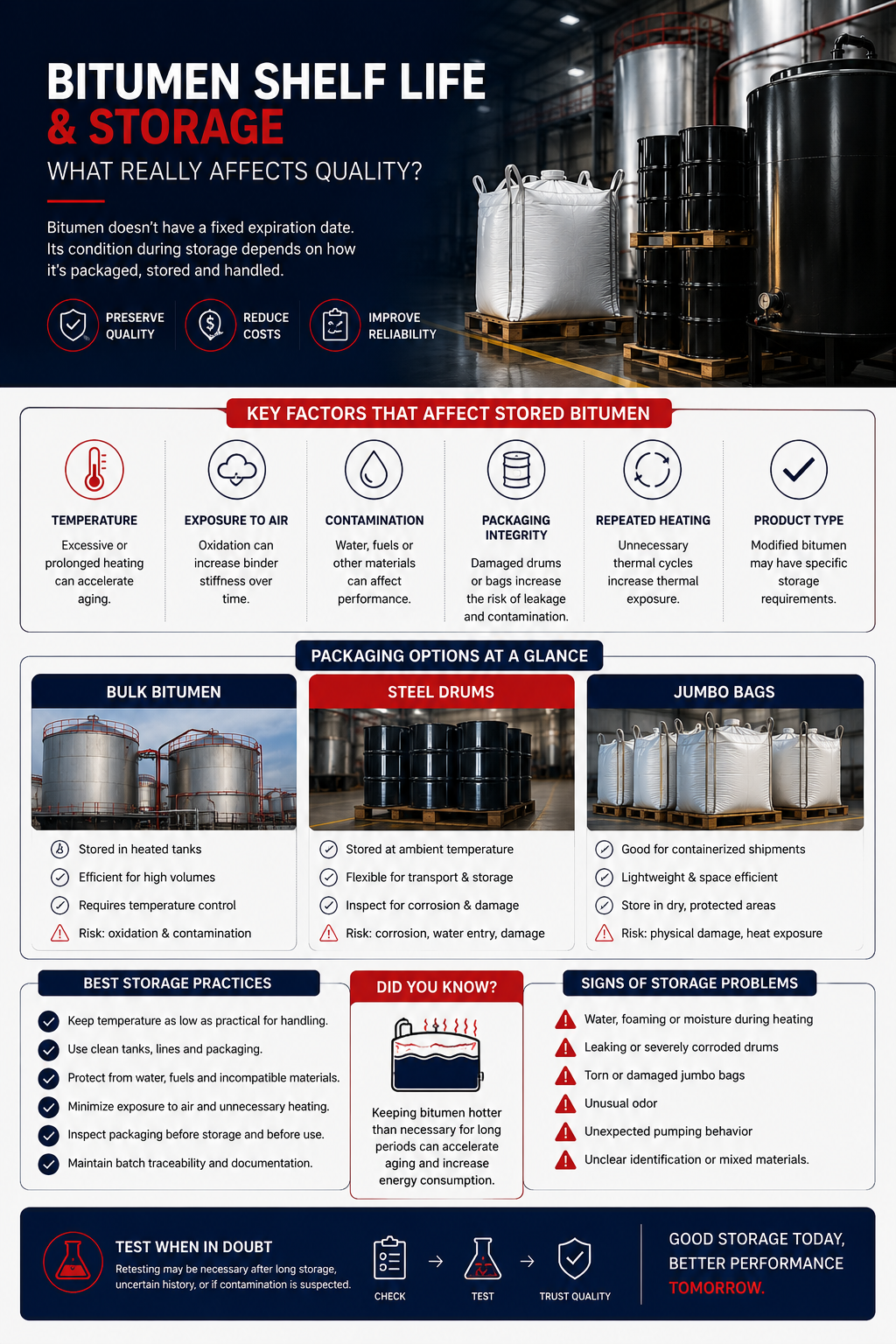
Bitumen shelf life and storage guide: key quality factors, packaging options and recommended storage practices.
How Does Temperature Affect Stored Bitumen?
Temperature is one of the most important variables in bulk bitumen storage. Bitumen must be sufficiently fluid for pumping and transfer, but keeping it hotter than necessary for extended periods can increase energy consumption and expose the binder to additional thermal aging.
Industry guidance generally recommends maintaining storage temperatures only as high as required to achieve the viscosity needed for storage, handling and pumping rather than using one fixed temperature for every product. The appropriate temperature therefore depends on the specific grade and its viscosity characteristics.
Why overheating should be avoided
- It can increase unnecessary thermal exposure of the binder.
- It may accelerate oxidative aging during extended storage.
- It increases energy consumption.
- It may increase operational and safety risks in heated storage systems.
For a broader discussion of tank temperature, contamination prevention and transport conditions, see:
Bitumen Storage and Transportation Guide
How Does Oxidation Affect Bitumen During Storage?
Oxidation is one of the mechanisms associated with bitumen aging. As a binder oxidizes, its rheological behavior can change and it may become stiffer. The rate and significance of this process depend on temperature, exposure conditions, binder chemistry and storage duration.
This does not mean that every stored shipment will experience significant deterioration. In large storage tanks, for example, the exposed surface area relative to the total volume can be limited. However, unnecessary prolonged heating should still be avoided and storage conditions should be controlled.
Key principle
The objective of storage management is not simply to keep bitumen hot. It is to keep the material in a condition suitable for safe transfer and use while minimizing unnecessary thermal exposure, oxidation and contamination.
How Does Packaging Affect Bitumen Shelf Life?
Packaging does not create a fixed shelf life for bitumen, but it can strongly influence how well the material is protected during transportation and storage. The main differences between bulk storage, drums and jumbo bags relate to temperature exposure, contact with air, risk of contamination, handling conditions and the ability to keep the packaging intact until use.
For buyers, the most important question is not simply which packaging method can store bitumen for the longest period. The better question is which method best matches the expected storage duration, destination infrastructure, shipment size and handling conditions.
| Packaging Method |
Main Storage Condition |
Main Quality Risk |
Best Suited For |
| Bulk Bitumen |
Heated storage tanks |
Excessive heat, oxidation and contamination |
High-volume and continuous supply |
| Steel Drums |
Ambient storage in protected areas |
Drum corrosion, damage, water entry or contamination |
Flexible export and distributed storage |
| Jumbo Bags |
Dry, protected and controlled storage |
Packaging damage, heat exposure or poor stacking |
Containerized and medium-volume shipments |
Bulk Bitumen Storage and Quality Preservation
Bulk bitumen is generally stored in insulated heated tanks because the material must remain sufficiently fluid for pumping and transfer. This method is efficient for large-volume supply chains, but it also requires the most active control of storage conditions.
The main objective is to maintain the binder at a practical handling temperature without exposing it to unnecessarily high temperatures for extended periods. Tank cleanliness, heating-system performance, temperature measurement and control of cross-contamination are therefore important parts of bulk storage management.
Bulk storage checklist
- Confirm that tanks and transfer lines are clean and compatible with the product.
- Avoid heating above the temperature required for pumping and handling.
- Monitor temperature at appropriate locations inside the storage system.
- Minimize unnecessary long-term hot storage where possible.
- Prevent contamination with water, fuels, solvents or other bitumen grades.
- Review product-specific storage guidance for modified binders.
How Should Bitumen Drums Be Stored?
Steel drums allow bitumen to be stored without maintaining the product continuously at elevated temperature. This can reduce thermal exposure during the storage period, but the condition of the drum becomes an important part of quality protection.
Drums should be stored in a stable area and protected from conditions that may cause severe corrosion, deformation or damage. Buyers should also inspect drums before reheating or opening, especially after long-distance transportation or extended storage.
Important checks for drum storage
- Keep drums on a stable, clean and well-drained surface.
- Inspect for corrosion, punctures, leakage or deformation.
- Protect drums from unnecessary water exposure where practical.
- Maintain traceability of grade, batch and shipment identification.
- Use appropriate procedures when reheating or removing bitumen from drums.
How Should Jumbo Bag Bitumen Be Stored?
Jumbo bags provide a lighter packaging alternative for certain export supply chains and can be particularly useful for containerized transport. However, their storage performance depends heavily on the integrity of the bag system and the conditions of the warehouse or storage area.
Because flexible packaging can be more sensitive to physical damage than steel drums, stacking, handling equipment and exposure to heat or sharp objects should be carefully controlled.
Jumbo bag storage checklist
- Store bags in a dry and protected area.
- Avoid contact with sharp surfaces or equipment that may puncture the packaging.
- Follow appropriate stacking limits and handling procedures.
- Protect the packaging from unnecessary heat exposure.
- Inspect outer and inner packaging before use.
Which Packaging Method Is Better for Long-Term Storage?
There is no single packaging method that is automatically best for every long-term storage situation. The decision depends on the product, expected storage period, climate, available infrastructure and how the material will eventually be heated and used.
In general:
- Bulk storage is efficient for high-volume operations where tanks, heating and turnover are well managed.
- Drums can be practical when material needs to remain packaged during transport or storage and continuous heating is not desirable.
- Jumbo bags can support containerized supply chains when storage and handling conditions are suitable for flexible packaging.
For a detailed comparison of these export formats, see:
Bitumen Export Packaging Guide: Bulk, Drums and Jumbo Bags
How Can Contamination Affect Stored Bitumen?
Contamination can create significant quality and operational problems even when the original bitumen met the required specification. Possible contaminants include water, fuel, lighter petroleum products, residues from previous tank contents and foreign material introduced during transfer.
The impact of contamination depends on its type and quantity. In some cases, contamination may alter viscosity, create foaming during heating, affect adhesion performance or make the product unsuitable for its intended application.
How buyers can reduce contamination risk
- Verify tank and line cleanliness before transfer.
- Keep packaging sealed until the material is required.
- Maintain clear grade and batch identification.
- Avoid using equipment that has contained incompatible materials unless properly cleaned.
- Investigate unusual appearance, odor, foaming or handling behavior before use.
Should Stored Bitumen Be Retested Before Use?
Retesting may be appropriate when bitumen has been stored for an extended period, when storage conditions are uncertain, when packaging has been damaged, or when there is reason to suspect contamination or significant thermal exposure.
The exact testing program should depend on the applicable specification and project requirements. For penetration-grade bitumen, buyers may review properties such as penetration, softening point, viscosity and other required specification parameters.
A representative sample is essential. A laboratory result can only meaningfully describe the stored product when the sample itself properly represents the material being evaluated.
How Is Bitumen Sampled? A Guide to Representative Sampling
Main Bitumen Quality Control Tests
Can a COA Confirm the Current Condition of Stored Bitumen?
A Certificate of Analysis (COA) confirms the tested properties of a specific batch at the time the sample was analyzed. It is an important quality document, but it does not automatically confirm that the material remains unchanged after extended storage, repeated heating, damaged packaging or possible contamination.
For this reason, buyers should consider both the original COA and the actual storage history of the product. When storage conditions are uncertain or the material has been held for an extended period, additional inspection or retesting may be appropriate before use.
Important distinction: A COA describes tested product properties at a specific point in time. Storage condition, packaging integrity and handling history help determine whether additional verification is needed later.
How to Read a Bitumen Certificate of Analysis (COA)
What Signs May Indicate a Storage or Handling Problem?
Not every visible change means that bitumen is out of specification, but certain observations should trigger further inspection before the material is used. Buyers and operators should pay particular attention to unusual changes that are inconsistent with the expected condition of the product.
- Unexpected water, foaming or moisture during reheating
- Damaged, leaking or severely corroded drums
- Torn or compromised jumbo bag packaging
- Unusual odor suggesting possible contamination
- Unexpected pumping or handling behavior
- Loss of clear batch or grade identification
- Evidence that different materials may have been mixed
When these conditions are observed, the appropriate response is not to assume that the product has failed. The material should instead be investigated through document review, representative sampling and appropriate laboratory testing where necessary.
Bitumen Storage Inspection Checklist for Buyers
Before accepting, storing or using a shipment, procurement teams can reduce risk by reviewing a small number of practical points. This is especially useful for imported material that may have passed through several transportation and storage stages.
| Check |
What to Verify |
Why It Matters |
| Product Identification |
Grade, batch, supplier and shipment reference |
Maintains traceability and prevents product mix-up |
| Packaging Condition |
Drums, bags, seals and visible damage |
Helps identify contamination or leakage risk |
| Storage History |
Duration, temperature and handling conditions |
Supports decisions on inspection or retesting |
| Quality Documents |
COA, TDS, SDS and applicable specification |
Confirms product identity and original tested properties |
| Sampling Need |
Whether current-condition testing is required |
Reduces uncertainty before application |
Frequently Asked Questions About Bitumen Shelf Life and Storage
How long can bitumen be stored?
There is no single storage period that applies to every bitumen product. Practical storage life depends on the grade, packaging method, temperature history, exposure to air, contamination risk and product-specific requirements.
Does bitumen expire?
Conventional bitumen is not normally treated as a product with one universal expiration date. However, its properties and usability can be affected by poor storage, excessive heating, oxidation or contamination.
Is bitumen in drums better for long-term storage?
Drums can be practical for storage because the material does not need to remain continuously heated. However, the drums must remain intact and protected from corrosion, water entry, physical damage and contamination.
Can bulk bitumen be stored for long periods?
Bulk bitumen can be stored successfully when tank temperature, cleanliness, heating and inventory turnover are properly managed. Unnecessary prolonged hot storage should be avoided because additional thermal exposure can contribute to aging and increase energy consumption.
Should bitumen be tested after long storage?
Retesting may be advisable when the storage period is extended, storage history is uncertain, packaging has been damaged, contamination is suspected or project specifications require confirmation before use.
Which documents should buyers request before storage or use?
Depending on the product and project, buyers commonly review the Certificate of Analysis (COA), Technical Data Sheet (TDS), Safety Data Sheet (SDS), applicable specification and shipment or batch identification.
Final Considerations for Bitumen Buyers
Bitumen shelf life should not be evaluated as a fixed number of months without considering the conditions in which the material is stored. Packaging type, temperature, exposure to air, contamination risk, repeated heating and product formulation can all influence the condition of the binder before application.
For procurement teams, the most reliable approach is to combine appropriate packaging with controlled storage, clear batch traceability, quality documentation and inspection before use. When storage history is uncertain, representative sampling and laboratory verification can provide additional confidence that the material remains suitable for the intended application.
Before placing an RFQ, confirm:
- Required bitumen grade and applicable specification
- Preferred packaging: bulk, drums or jumbo bags
- Expected shipment and storage duration
- Destination storage and unloading facilities
- Required COA, TDS, SDS or other technical documents
- Any project-specific testing or inspection requirements
Need Bitumen Supply or Technical Information?
For product specifications, packaging options, quality documentation and export supply inquiries, contact the Dejpa sales team with your required grade, quantity, destination and preferred delivery format.
Contact Dejpa Sales
sales@dejpa.com